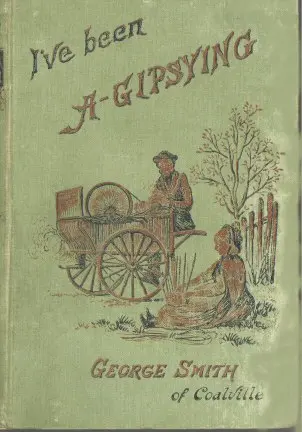
I’ve been a Gipsying or, Rambles among our Gipsies and their children in their tents and vans
George Smith

THE CLASSIC COLLECTION · 1880
"Gipsy Life" by George Smith is an account written in the late 19th century that examines the lives, origins, and social conditions of the Gipsy population in England. The book delves into the challenges faced by Gipsies, particularly women and children, highlighting themes of neglect and societal misunderstanding. The opening reveals the author's dedication to raising awareness about the plight of Gipsies and the need for educational intervention in their lives. Smith outlines the historical treatment of Gipsies across Europe, touching on their origins and the stigma associated with their lifestyle. He paints a vivid picture of the struggles they have endured, from persecution in various countries to their current state in England, emphasizing the importance of understanding their story to foster compassion and potential improvement in their circumstances.
Introduction adapted from the source catalogue; source summaries may be automatically generated.
Free to read · English · 108,927 words · No account needed
MAKE TIME FOR A GOOD BOOK
On by default. Untick to stop anonymous reading totals. Each page counts after 10 seconds in view. How this works.
Anonymous counting is on unless you have switched it off.
One writer observes:--"Commend me to Gipsy life and hard living. Robust exercise, out-door life, and pleasant companions are sure to beget good dispositions both of body and mind, and would create a stomach under the very ribs of death capable of digesting a bar of pig-iron." Their habits of uncleanliness are most disgusting. Occasionally you will meet with clean people, and children with clean, red, chubby faces; but in nine cases out of ten they are of parents who have had a different bringing up than squatting about in the mud and filth. One woman I know at Notting Hill, and who was born in an Oxfordshire village, is at the present time surrounded with filth of the most sickening kind, which she cannot help, and to her credit manages to keep her children tolerably clean and nice for a woman of her position. There is another at Garrett Lane, Wandsworth; another at Sheepcot Lane, Battersea; two at Upton Park; one at Cherry Island; two at Hackney Wick, and several others in various parts on the outskirts of London. At Hackney Wick I saw twenty tents and vans, connected with which there were forty men and women and about seventy children of all ages, entirely devoid of all sanitary arrangements. A gentleman who was building some property in the neighbourhood told me that he had seen grown-up youths and big girls running about entirely nude in the morning, and squatting about the ground and leaving their filth behind them more like animals than human beings endowed with souls and reason. When I was there it was with some difficulty I could put my foot in a clean place. The same kind of thing occurs in a more or less degree wherever Gipsies are located, and, sad to relate, house-dwelling Gipsies are very little better in this respect. Grellmann, speaking of the German and Hungarian Gipsies many years ago, says:--"We may easily account for the colour of their skin. The Laplanders, Samoyeds, as well as the Siberians, have bronze, yellow-coloured skins, in consequence of living from their childhood in smoke and dirt, as the Gipsies do. These would long ago have got rid of their swarthy complexions if they had discontinued this Gipsy manner of living. Observe only a Gipsy from his birth till he comes to man's estate, and one must be convinced that their colour is not so much owing to their descent as to the nastiness of their bodies. In summer the child is exposed to the scorching sun, in winter it is shut up in a smoky hut. Some mothers smear their children over with black ointment, and leave them to fry in the sun or near the fire. They seldom trouble themselves about washing or other modes of cleaning themselves. Experience also shows us that it is more their manner of life than descent which has propagated this black colour of the Gipsies from generation to generation." I am told, and I verily believe it, that many of the children are not washed for years together. I have seen over and over again dirt peeling off the poor children's bodies and faces like a skin, and leaving a kind of white patch behind it, presenting a kind of a piebald spectacle. Some of the children never take their clothes off till they drop off in shreds. Many of the Gipsies, both old and young, have only one suit of clothes. English delicacy of feeling and sentiment for female virtue must stand abashed with horror at this kind of civilisation in the nineteenth century of Christian England. I have seen washing done on the Sunday afternoon among them, and while the clothes have been drying on the line the women and children have been roasting themselves before the fires in nearly a nude state. A Sunday or two ago a poor Gipsy woman was washing her only smoky-looking blanket late in the afternoon, and upon which she would have to lay that night. It was a cold, wintry, drizzling afternoon, and how it was to get dry was a puzzle to me. A Gipsy woman, named Hearn, said to me a few days ago, in answer to some conversation relating to their dirty habits; "The reason for the Gipsies not washing themselves oftener was on account of their catching cold after each time they washed." She "only washed herself once in a fortnight, and she was almost sure to catch cold after it." In some things the real old Gipsies are very particular, i.e., they will on no account take their food out of cups, saucers, or basins, that have been washed in the same pansions in which their linen has been washed; so sensitive are they on this point that if they found out that by an accident this custom had been transgressed they would immediately break the vessel to pieces. This is a custom picked up by the Gipsies among the Jews in their wandering from India through the Holy Land. Another practice they adopt in common with the Jews is, swearing or taking oaths over their dead relations. The customs, practices, and words picked up by them during their wanderings have added to their mystification. While they will respect certain delicacy observed among the Jews, they will eat pork, the most detestable of all food in the eyes of the Israelites, and will even pay a greater price for it than for beef or mutton. An Englishwoman, who had married a Gipsy named Smith, told me very recently, in presence of her mother-in-law and another woman, that she had seen her husband eat a small plate of cooked snails as a dainty. While the daughter-in-law was telling me this, the old Gipsy mother-in-law, with one foot in the grave, not far from Mary's Place, near the Potteries, Notting Hill, was trying to make me believe what a choice dish there was in store for me if I would allow her to cook me a hedgehog. She said I should "find it nicer than the finest rabbit or pheasant I had ever tasted." The fine, old, Gipsy woman, as regards her appearance, although suffering from congestion of lungs and inflammation, and expecting every moment to be her last, would joke and make fun as if nothing was the matter with her. When I questioned her upon the sin of lying, she said, "If the dear Lord spares me, I shall tell lies again. I could not get on without it; how could I? I could not sell my things without lies." She was rather severe, and this was a pleasing feature in the old woman's character, upon a Gipsy who was pretending to "'ligious," and yet living upon the money gained by his wife in telling fortunes. She said, "If I must be ''ligious,' I would be ''ligious.' You might," said the old woman, "as well eat the devil as suck his broth. Ah! I hate the fellow." After asking her, and getting her interpretation of "God bless you" in Romany, which is Mi-Doovel-Parik-tooti--and she was the only Gipsy round London who could put the words in Romany--and some other conversation accompanied with "coppers and baccy," &c., and to which she replied, "Amen!" with as much earnestness as if she was the greatest saint outside heaven, we parted.
Your reading position is saved on this browser. Take it to another device with a library code. Reading pages adapt to text, rather than matching a printed edition.
George Smith
George Smith
BEHIND THE BOOK
This eBook is for the use of anyone anywhere in the United States and most other parts of the world at no cost and with almost no restrictions whatsoever. You may copy it, give it away or re-use it under the terms of the Project Gutenberg License included with this eBook or online at www.gutenberg.org. If you are not located in the United States, you will have to check the laws of the country where you are located before using this eBook. Read the source licence.
The original source file, including credits and licence, is retained by this library. Request an original-format copy at no charge. Please include the book title and Project Gutenberg identifier #28548.
KEEP YOUR CURIOSITY GOING
Cécile Tormay

Moritz Busch
John L. Ransom
Frances Wright
Cécile Tormay

Mabel Potter Daggett