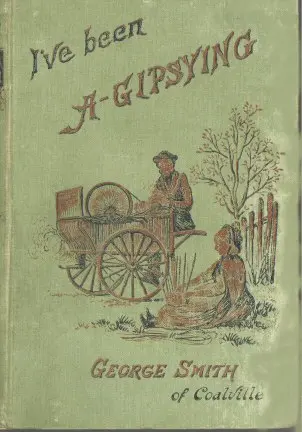
I’ve been a Gipsying or, Rambles among our Gipsies and their children in their tents and vans
George Smith

THE CLASSIC COLLECTION · 1880
"Gipsy Life" by George Smith is an account written in the late 19th century that examines the lives, origins, and social conditions of the Gipsy population in England. The book delves into the challenges faced by Gipsies, particularly women and children, highlighting themes of neglect and societal misunderstanding. The opening reveals the author's dedication to raising awareness about the plight of Gipsies and the need for educational intervention in their lives. Smith outlines the historical treatment of Gipsies across Europe, touching on their origins and the stigma associated with their lifestyle. He paints a vivid picture of the struggles they have endured, from persecution in various countries to their current state in England, emphasizing the importance of understanding their story to foster compassion and potential improvement in their circumstances.
Introduction adapted from the source catalogue; source summaries may be automatically generated.
Free to read · English · 108,927 words · No account needed
MAKE TIME FOR A GOOD BOOK
On by default. Untick to stop anonymous reading totals. Each page counts after 10 seconds in view. How this works.
Anonymous counting is on unless you have switched it off.
The following is a specimen of house-dwelling Gipsies in the Midlands I have visited. In the room downstairs there were a broken-down old squab, two rickety old chairs, and a three-legged table that had to be propped against the wall, and a rusty old poker, with a smoking fire-place. The Gipsy father was a strong man, not over fond of work; he had been in prison once; the mother, a strong Gipsy woman of the old type, marked with small-pox, and plenty of tongue--by the way, I may say I have not yet seen a dumb and deaf Gipsy. She turned up her dress sleeves and showed me how she had "made the blood run out of another Gipsy woman for hitting her child." As she came near to me exhibiting her fisticuffing powers, I might have been a little nervous years ago; but dealing with men and things in a rough kind of fashion for so many years has taken some amount of nervousness of this kind out of me.
It may be as well to remark here that the Gipsy women can do their share of fighting, and are as equally pleased to have a stand-up fight as the Gipsy men are. One of these Gipsy women lives with a man who is not a thorough Gipsy, who spends a deal of his time under lock and key on account of his poaching inclinations; and other members of this large family are on the same kind of sliding scale, and not one of whom can read or write.
It is not pleasant to say strong things about clergymen, for whom I have the highest respect; nevertheless, there are times when respect for Christ's church, duty to country, love for the children and anxiety for their eternal welfare, compels you to step out of the beaten rut to expose, though with pain, wrong-doing. In a day and Sunday school-yard connected with the Church of England, not one hundred miles from London, there are to be seen--and I am informed by them, except during the hop-picking season, that it is their camping-ground, and has been for years--one van, in which there are man, wife, young woman, and a daughter of about fourteen years of age; the young woman and daughter sleep in a kind of box under the man and his wife. In another part of the yard is a Gipsy tent, where God's broad earth answers the purpose of a table, and a "batten of straw" serves as a bed. There is a woman, two daughters, one of whom is of marriageable age and the other far in her teens, and a youth I should think about sixteen years of age. I should judge that the mother and her two daughters sleep on one bed at one end of the tent and the youth at the other; there is no partition between them, and only about seven feet of space between each bed of litter. In another tent there is man, wife, and one child. When I was there, on the Sunday afternoon, they were expecting the Gipsy "to come home to his tent drunk and wake the baby." In another tent there was a Gipsy with his lawful wife and three children. One of the Gipsy women in the yard frequently came home drunk, and I have seen her smoking with a black pipe in her mouth three parts tipsy. Now, I ask my countrymen if this is the way to either improve the habits and morals of the Gipsies themselves, or to set a good example to day and Sunday scholars. Drunkenness is one of the evil associations of Gipsy life. Brandy and "fourpenny," or "hell fire," as it is sometimes called, are their chief drinks. A Gipsy of the name of Lee boasted to me only a day or two since that he had been drunk every night for more than a fortnight, his language being, "Oh! it is delightful to get drunk, tumble into a row, and smash their peepers. What care we for the bobbies." They seldom if ever use tumblers. A large jug is filled with this stuff, in colour and thickness almost like treacle and water, leaving a kind of salty taste behind it as it passes out of sight; but, I am sorry to say, not out of the body, mind, or brain, leaving a trail upon which is written--more! more! more! Under its influence they either turn saints or demons as will best serve their purpose. The more drink some of the Gipsy women get the more the red coloured piety is observable in their faces, and when I have been talking to them, or otherwise, they have said, "Amen," "Bless the Lord," "Oh, it is nice to be 'ligious and Christany," as they have closed round me; and with the same breath they have begun to talk of murder, bloodshed, and revenge, and to say, "How nice it is to get a living by telling lies." Half an ounce of tobacco and a few gentle words have a most wonderful effect upon their spirits and nerves under such circumstances. I have frequently seen drunken Gipsy women in the streets of London. Early this year I met one of my old Gipsy women friends in Garrett Lane, Wandsworth, with evidently more than she could carry, and a weakness was observable in her knees; and when she saw me she was not so far gone as not to know who I was. She tried to make a curtsy, and in doing so very nearly lost her balance, and it took her some ten yards to recover her perpendicular. With a little struggling, stuttering, and stumbling, she got right, and pursued her way to the tent.
Your reading position is saved on this browser. Take it to another device with a library code. Reading pages adapt to text, rather than matching a printed edition.
George Smith
George Smith
BEHIND THE BOOK
This eBook is for the use of anyone anywhere in the United States and most other parts of the world at no cost and with almost no restrictions whatsoever. You may copy it, give it away or re-use it under the terms of the Project Gutenberg License included with this eBook or online at www.gutenberg.org. If you are not located in the United States, you will have to check the laws of the country where you are located before using this eBook. Read the source licence.
The original source file, including credits and licence, is retained by this library. Request an original-format copy at no charge. Please include the book title and Project Gutenberg identifier #28548.
KEEP YOUR CURIOSITY GOING
Cécile Tormay

Moritz Busch
John L. Ransom
Frances Wright
Cécile Tormay

Mabel Potter Daggett