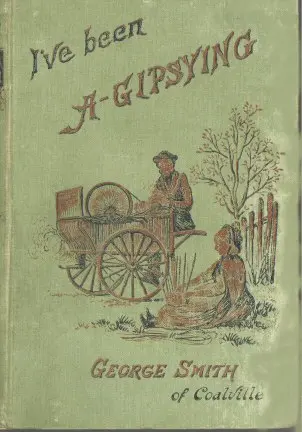
I’ve been a Gipsying or, Rambles among our Gipsies and their children in their tents and vans
George Smith

THE CLASSIC COLLECTION · 1880
"Gipsy Life" by George Smith is an account written in the late 19th century that examines the lives, origins, and social conditions of the Gipsy population in England. The book delves into the challenges faced by Gipsies, particularly women and children, highlighting themes of neglect and societal misunderstanding. The opening reveals the author's dedication to raising awareness about the plight of Gipsies and the need for educational intervention in their lives. Smith outlines the historical treatment of Gipsies across Europe, touching on their origins and the stigma associated with their lifestyle. He paints a vivid picture of the struggles they have endured, from persecution in various countries to their current state in England, emphasizing the importance of understanding their story to foster compassion and potential improvement in their circumstances.
Introduction adapted from the source catalogue; source summaries may be automatically generated.
Free to read · English · 108,927 words · No account needed
MAKE TIME FOR A GOOD BOOK
On by default. Untick to stop anonymous reading totals. Each page counts after 10 seconds in view. How this works.
Anonymous counting is on unless you have switched it off.
Towards the end of the year 1417, in the Hanseatic towns on the Baltic coast and at the mouth of the Elbe, there appeared before the gates of Luneburg, and later on at Hamburg, Lubeck, Wirmar, Rostock, and Stralsuna, a herd of swarthy and strange specimens of humanity, uncouth in form, hideous in complexion, and their whole exterior shadowed forth the lowest depths of poverty and degradation. A cloak made of the fragments of oriental finery was generally used to disguise the filth and tattered garments of their slight remaining apparel. The women and young children travelled in rude carts drawn by asses or mules; the men trudged alongside, casting fierce and suspicious glances on those they met, thief-like, from underneath their low, projecting foreheads and eyebrows; the elder children, unkempt and half-clad, swarmed in every direction, calling with shrill cries and monkey-like faces and grimaces to the passers-by to their feats of jugglery, craft, and deception. Forsaking the Baltic provinces the dusky band then sought a more friendly refuge in central Germany--and it was quite time they had begun to make a move, for their deeds of darkness had oozed out, and a number of them paid the penalty upon the gallows, and the rest scampered off to Meissen, Leipsic, and Herse. At these places they were not long in letting the inhabitants know, by their depredations, witchcraft, devilry, and other abominations, the class of people they had in their midst, and the result was their speedy banishment from Germany; and in 1418, after wandering about for a few months only, they turned their steps towards Switzerland, reaching Zurich on August 1st, and encamped during six days before the town, exciting much sympathy by their pious tale and sorrowful appearance. In Switzerland the inhabitants were more gullible, and the soft parts of their nature were easily getatable, and the consequence was the Gipsies made a good thing of it for the space of four years. Soon after leaving Zurich, according to Dr. Mikliosch, the wanderers divided their forces. One detachment crossed the Botzberg and created quite a panic amongst the peaceable inhabitants of Sisteron, who, fearing and imagining all sorts of evils from these satanic-looking people, fed them with a hundred loaves, and induced them, for the good of their health, to make themselves miserably less. We next hear of them in Italy, in 1422. After leaving Asiatic Turkey, and in their wanderings through Russia and Germany, the Asiatic, sanctimonious, religious halo, borrowed from their idolatrous form and notions of the worship of God in the East, had suffered much from exposure to the civilising and Christianising influences of the West; and the result was their leaders decided to make a pilgrimage to Rome to regain, under the cloak of religion, some of the self-imagined lost prestige; and in this they were, at any rate, for a time, successful. On the 11th day of July, 1422, a leader of the Gipsies, named Duke Andrew, arrived at Bologna, with men, women and children, fully one hundred persons, carrying with them, as they alleged, a decree signed by the King of Hungary, permitting them, owing to their return to the Christian faith--stating at the same time that 4,000 had been re-baptised--to rob without penalty or hindrance wherever they travelled during seven years. Here these long-faced, pious hypocrites were in clover, as a reward for their professed re-embracing Christianity. After the expiration of this term they told the open-mouthed inhabitants, as a kind of sweetener, that they were to present themselves to the Pope, and then return to India--aye, with the spoils of their lying campaign, gained by robbing and plundering all they came in contact with. The result of their deceitful, lying expedition to Rome was all they could wish, and they received a fresh passport from . the Pope, asking for alms from his faithful flock on behalf of these wretches, who have been figuring before western nations of the world--sometimes as kings, counts, martyrs, prophets, witches, thieves, liars, and murderers; sometimes laying their misfortunes at the door of the King of Egypt, the Sultan of Turkey, religious persecution in India, the King of Hungary, and a thousand other Gorgios since them. Sometimes they would appear as renegade Christians, converted heathens, Roman Catholics, in fact, they have been everything to everybody; and, so long as the "grist was coming to the mill," it did not matter how or by whom it came.
Your reading position is saved on this browser. Take it to another device with a library code. Reading pages adapt to text, rather than matching a printed edition.
George Smith
George Smith
BEHIND THE BOOK
This eBook is for the use of anyone anywhere in the United States and most other parts of the world at no cost and with almost no restrictions whatsoever. You may copy it, give it away or re-use it under the terms of the Project Gutenberg License included with this eBook or online at www.gutenberg.org. If you are not located in the United States, you will have to check the laws of the country where you are located before using this eBook. Read the source licence.
The original source file, including credits and licence, is retained by this library. Request an original-format copy at no charge. Please include the book title and Project Gutenberg identifier #28548.
KEEP YOUR CURIOSITY GOING
Cécile Tormay

Moritz Busch
John L. Ransom
Frances Wright
Cécile Tormay

Mabel Potter Daggett