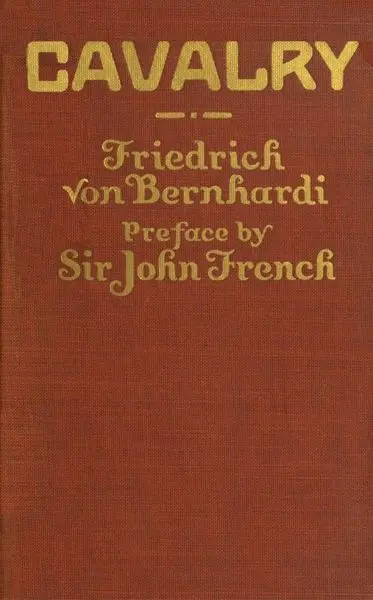
Cavalry A Popular Edition of “Cavalry in War and Peace”
Friedrich von Bernhardi
THE CLASSIC COLLECTION · 1912
"Germany and the Next War" by Friedrich von Bernhardi is a military and political treatise written in the early 20th century. The work elaborates on the rationale and necessity of war as a means for national self-assertion and the pursuit of power, asserting that for Germany, conflict is not merely an option but a duty in the face of external threats and internal weaknesses. The opening of the book sets a tone of urgency, reflecting on the public sentiment in Germany during the summer of 1911, amidst a perceived threat to national honor and political stability, particularly concerning the Morocco crisis. Von Bernhardi aims to clarify the national objectives, difficulties, and sacrifices required for Germany to secure its future. He emphasizes the need for a candid discussion of the rights and responsibilities of nations concerning war, framing it not only as an inevitability but also a moral obligation. Through this lens, he seeks to galvanize a nationalistic fervor, arguing that war is essential for maintaining and enhancing a nation's strength and cultural vitality.
Introduction adapted from the source catalogue; source summaries may be automatically generated.
Free to read · English · 98,480 words · No account needed
MAKE TIME FOR A GOOD BOOK
On by default. Untick to stop anonymous reading totals. Each page counts after 10 seconds in view. How this works.
Anonymous counting is on unless you have switched it off.
On a war footing the field army will be 100,000 strong, comprising 74,000 infantry, 7,250 cavalry, 10,000 field artillery, 1,900 engineers and transport service, and is formed into 4 army divisions and 2 cavalry divisions. The latter are each 20 squadrons and 2 batteries strong; each of the army divisions consists nominally of 17 battalions infantry, 1 squadron, 12 batteries, and 1 section engineers. In addition there is a garrison army of 80,000, which can be strengthened by the garde civique, Antwerp forms the chief military base, and may be regarded as a very strong fortress. Besides this, on the line of the Maas, there are the fortified towns of Liege, Huy, and Namur. There are no coast fortifications.
Denmark, as commanding the approaches to the Baltic, is of great military importance to us. Copenhagen, the capital, is a strong fortress. The Army, on the other hand, is not an important factor of strength, as the training of the units is limited to a few months. This State maintains on a peace footing some 10,000 infantry, 800 cavalry, 2,300 artillery, and 1,100 special arms, a total of 14,200 men; but the strength varies between 7,500 and 26.000. In war-time an army of 62,000 men and 10,000 reserves can be put into the field, composed numerically of 58,000 infantry, 3,000 cavalry, 9,000 artillery, and 2,000 special arms.
Sweden can command eight classes of the First Ban, which comprises units from twenty-one to twenty-eight years of age, and is 200,000 strong, as well as four classes of the Second Ban, with a strength of 90,000, which is made up of units from twenty-eight to thirty-two years of age. There are also available 30,000 trained volunteers, students and ex-students from twenty-one to thirty-two years of age.
The eight classes of the Landsturm are 165,000 men strong. It can, accordingly, be roughly calculated what field army can be raised in case of war. The entire First Ban certainly comes under this head.
In Greece, which does not signify much for a European war, but might in combination with the small Balkan States prove very troublesome to Turkey, and is therefore important for us, an active army of 146,000 men can be put into the field; there are besides this 83,000 men in the Landwehr and 63,000 men in the Landsturm.
Spain has a peace army of 116,232 men, of whom 34,000 are permanently stationed in Africa. In war she can raise 327,000 men (140,000 active army, 154,000 garrison troops, 33,000 gendarmerie). The mobilization is so badly organized that at the end of a month 70,000 to 80,000 men could at most be put into the field.
Your reading position is saved on this browser. Take it to another device with a library code. Reading pages adapt to text, rather than matching a printed edition.
Friedrich von Bernhardi
BEHIND THE BOOK
This eBook is for the use of anyone anywhere in the United States and most other parts of the world at no cost and with almost no restrictions whatsoever. You may copy it, give it away or re-use it under the terms of the Project Gutenberg License included with this eBook or online at www.gutenberg.org. If you are not located in the United States, you will have to check the laws of the country where you are located before using this eBook. Read the source licence.
The original source file, including credits and licence, is retained by this library. Request an original-format copy at no charge. Please include the book title and Project Gutenberg identifier #11352.
KEEP YOUR CURIOSITY GOING
Cécile Tormay

Moritz Busch
John L. Ransom
Frances Wright
Cécile Tormay

Mabel Potter Daggett