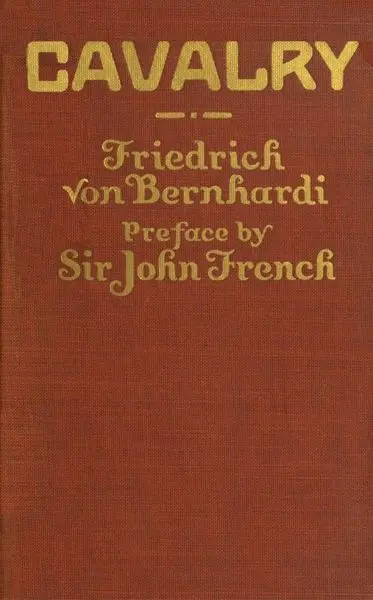
Cavalry A Popular Edition of “Cavalry in War and Peace”
Friedrich von Bernhardi
THE CLASSIC COLLECTION · 1912
"Germany and the Next War" by Friedrich von Bernhardi is a military and political treatise written in the early 20th century. The work elaborates on the rationale and necessity of war as a means for national self-assertion and the pursuit of power, asserting that for Germany, conflict is not merely an option but a duty in the face of external threats and internal weaknesses. The opening of the book sets a tone of urgency, reflecting on the public sentiment in Germany during the summer of 1911, amidst a perceived threat to national honor and political stability, particularly concerning the Morocco crisis. Von Bernhardi aims to clarify the national objectives, difficulties, and sacrifices required for Germany to secure its future. He emphasizes the need for a candid discussion of the rights and responsibilities of nations concerning war, framing it not only as an inevitability but also a moral obligation. Through this lens, he seeks to galvanize a nationalistic fervor, arguing that war is essential for maintaining and enhancing a nation's strength and cultural vitality.
Introduction adapted from the source catalogue; source summaries may be automatically generated.
Free to read · English · 98,480 words · No account needed
MAKE TIME FOR A GOOD BOOK
On by default. Untick to stop anonymous reading totals. Each page counts after 10 seconds in view. How this works.
Anonymous counting is on unless you have switched it off.
For war a field army can be raised of some 6,000 officers and 274,000 men, with 550 cannons. Of these 215,000 men belong to the infantry, 7,000 to the cavalry, and 20,000 to the artillery. The cavalry is therefore weaker than on the peace footing, since, as it seems, a part of the Calarashi is not to be employed as cavalry. Inclusive of reserves and militia, the whole army will be 430,000 strong. There are 650,000 trained men available for service.
Although the Balkan States, from a military point of view, chiefly concern Austria, Turkey, and Russia, and only indirectly come into relations with Germany, yet the armies of the smaller Central European States may under some circumstances be of direct importance to us, if they are forced or induced to take part with us or against us in a European war.
Of our western neighbours, Switzerland and Holland come first under consideration, and then Belgium.
Switzerland can command, in case of war, a combined army of 263,000 men. The expeditionary force, which is of first importance for an offensive war, consists of 96,000 infantry and 5,500 cavalry, with 288 field guns and 48 field howitzers (the howitzer batteries are in formation), a total of 141,000 men.
The Landwehr consists of 50.000 infantry and 4,000 cavalry, with 36 12-centimetre cannons belonging to foot artillery. It has a total strength of 69,000 men. The Landsturm finally has a strength of 53,000 men.
The Dutch army has a peace establishment averaging 30,000 men, which varies much owing to the short period of service. There are generally available 13,000 infantry, 3,000 cavalry, 5,000 field artillery, 3,400 garrison artillery, and I,400 engineers, pontonniers, and transport troops. The field army in war is 80,000 strong, and is made up of 64,000 infantry, cyclist, and machine-gun sections, 2,600 cavalry, 4,400 artillery, and goo engineers. It is formed into 4 army divisions each of 15 battalions, 4 squadrons, 6 batteries, and 1 section engineers. There is, further, a garrison army of 80,000 men, which consists of 12 active and 48 Landwehr infantry battalions, 44 active and 44 Landwehr foot artillery companies, and 10 companies engineers and pontonniers, including Landwehr. The Dutch coast also is fortified. At Holder, Ymuiden, Hook of Holland, at Völkerack and Haringvliet there are various outworks, while the fortifications at Flushing are at present unimportant. Amsterdam is also a fortress with outlying fortifications in the new Dutch water-line (Fort Holland).
Holland is thus well adapted to cause serious difficulties to an English landing, if her coast batteries are armed with effective cannons. It would easily yield to a German invasion, if it sided against us.
Belgium in peace has 42,800 troops available, distributed as follows: 26,000 infantry, 5,400 cavalry, 4,650 field artillery, 3,400 garrison artillery, 1,550 engineers and transport service.
Your reading position is saved on this browser. Take it to another device with a library code. Reading pages adapt to text, rather than matching a printed edition.
Friedrich von Bernhardi
BEHIND THE BOOK
This eBook is for the use of anyone anywhere in the United States and most other parts of the world at no cost and with almost no restrictions whatsoever. You may copy it, give it away or re-use it under the terms of the Project Gutenberg License included with this eBook or online at www.gutenberg.org. If you are not located in the United States, you will have to check the laws of the country where you are located before using this eBook. Read the source licence.
The original source file, including credits and licence, is retained by this library. Request an original-format copy at no charge. Please include the book title and Project Gutenberg identifier #11352.
KEEP YOUR CURIOSITY GOING
Cécile Tormay

Moritz Busch
John L. Ransom
Frances Wright
Cécile Tormay

Mabel Potter Daggett