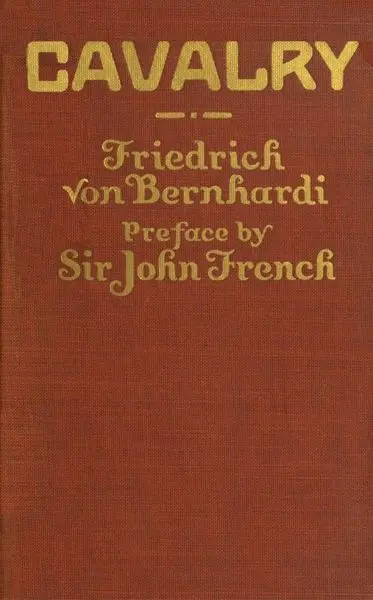
Cavalry A Popular Edition of “Cavalry in War and Peace”
Friedrich von Bernhardi
THE CLASSIC COLLECTION · 1912
"Germany and the Next War" by Friedrich von Bernhardi is a military and political treatise written in the early 20th century. The work elaborates on the rationale and necessity of war as a means for national self-assertion and the pursuit of power, asserting that for Germany, conflict is not merely an option but a duty in the face of external threats and internal weaknesses. The opening of the book sets a tone of urgency, reflecting on the public sentiment in Germany during the summer of 1911, amidst a perceived threat to national honor and political stability, particularly concerning the Morocco crisis. Von Bernhardi aims to clarify the national objectives, difficulties, and sacrifices required for Germany to secure its future. He emphasizes the need for a candid discussion of the rights and responsibilities of nations concerning war, framing it not only as an inevitability but also a moral obligation. Through this lens, he seeks to galvanize a nationalistic fervor, arguing that war is essential for maintaining and enhancing a nation's strength and cultural vitality.
Introduction adapted from the source catalogue; source summaries may be automatically generated.
Free to read · English · 98,480 words · No account needed
MAKE TIME FOR A GOOD BOOK
On by default. Untick to stop anonymous reading totals. Each page counts after 10 seconds in view. How this works.
Anonymous counting is on unless you have switched it off.
Infantry 133,000
Cavalry 26,000
Artillery 43,000
Pioneers 4,500
Special troops 7,500
Train formations 3,000
Mechanics 3,000
A total, that is, of 220,000 men.
2. The Redif (militia) cadres, composed of infantry, 25,000 men. Within this limit, according to the Redif law, men are enlisted in turns for short trainings.
3. Officers in the Nizam and Redif troops, military employés, officials, and others, more than 30,000.
The entire war strength of the Turkish army amounts to 700,000 men. We need only to take into consideration the troops from Europe, Anatolia, Armenia, and Syria. All these troops even are not available in a European theatre of war. On the other hand, the "Mustafiz" may be regarded as an "extraordinary reinforcement"; this is usually raised for local protection or the maintenance of quiet and order in the interior. To raise 30,000 or 40,000 men of this militia in Europe is the simplest process. From the high military qualities of the Turkish soldiers, the Turkish army must be regarded as a very important actor. Turkey thus is a very valuable ally to whichever party she joins.
The smaller Balkan States are also able to put considerable armies into
the field.
Montenegro can put 40,000 to 45,000 men into the field, with 104 cannons and 44 machine guns, besides 11 weak reserve battalions for frontier and home duties.
Servia is supposed to have an army 28,000 strong on a peace footing; this figure is seldom reached, and sinks in winter to 10,000 men. The war establishment consists of 250,000 men, comprising about 165,000 rifles, 5,500 sabres, 432 field and mountain guns (108 batteries of 4 guns); besides this there are 6 heavy batteries of 4 to 6 cannons and 228 machine guns available. Lastly come the reserve formations (third line), so that in all some 305,000 men can be raised, exclusive of the militia, an uncertain quantity.
The Bulgarian army has a peace establishment of 59,820 men. It is not known how they are distributed among the various branches of the service. On a war footing an army of 330,000 is raised, including infantry at a strength of 230,000 rifles, with 884 cannons, 232 machine guns, and 6,500 sabres. The entire army, inclusive of the reserves and national militia, which latter is only available for home service and comprises men from forty-one to forty-six years of age, is said to be 400,000 strong.
Rumania, which occupies a peculiar position politically, forms a power in herself. There is in Rumania, besides the troops who according to their time of service are permanently with the colours, a militia cavalry called "Calarashi" (intelligent young yeomen on good horses of their own), whose units serve intermittently for short periods.
In peace the army is composed of 5,000 officers and 90,000 men of the permanent establishment, and some 12,000 serving intermittently. The infantry numbers some 2,500 officers and 57,000 men, the permanent cavalry (Rosiori) some 8,000 men with 600 officers, and the artillery 14,000 men with 700 officers.
Your reading position is saved on this browser. Take it to another device with a library code. Reading pages adapt to text, rather than matching a printed edition.
Friedrich von Bernhardi
BEHIND THE BOOK
This eBook is for the use of anyone anywhere in the United States and most other parts of the world at no cost and with almost no restrictions whatsoever. You may copy it, give it away or re-use it under the terms of the Project Gutenberg License included with this eBook or online at www.gutenberg.org. If you are not located in the United States, you will have to check the laws of the country where you are located before using this eBook. Read the source licence.
The original source file, including credits and licence, is retained by this library. Request an original-format copy at no charge. Please include the book title and Project Gutenberg identifier #11352.
KEEP YOUR CURIOSITY GOING
Cécile Tormay

Moritz Busch
John L. Ransom
Frances Wright
Cécile Tormay

Mabel Potter Daggett