THE CLASSIC COLLECTION✦An outlaw’s diary: the CommuneCLASSIC FREE BOOKS
An outlaw’s diary: the Commune
Cécile Tormay
THE CLASSIC COLLECTION · 1913
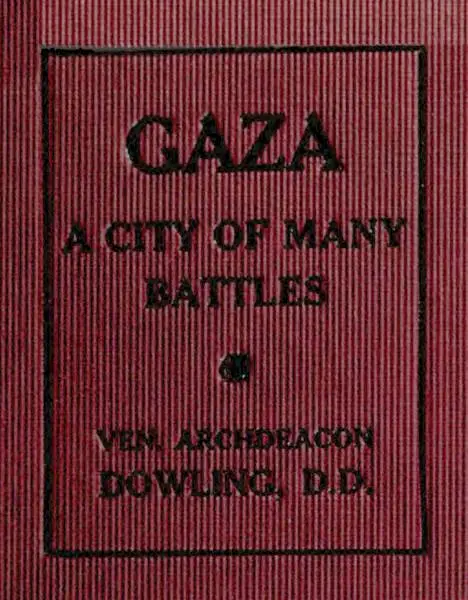
"Gaza: A City of Many Battles" by Theodore Edward Dowling is a historical account written in the early 20th century. The book explores the complex history of Gaza from its ancient origins to modern times, detailing its significance as a battleground through various historical periods, including biblical references and conflicts during the Crusades. The opening of the book sets the stage for its detailed examination of Gaza's historical significance, highlighting the author's recent visit to the city in 1912. Dowling recounts interactions with local scholars and clergy, gathering insights about the city's rich past and its religious importance. He references biblical events, notable figures such as Samson, and the area's strategic geographic position that made it a focal point for various civilizations, establishing a foundation for understanding the many battles and governance transitions that have shaped Gaza throughout history.
Introduction adapted from the source catalogue; source summaries may be automatically generated.
Free to read · English · 28,045 words · No account needed
MAKE TIME FOR A GOOD BOOK
On by default. Untick to stop anonymous reading totals. Each page counts after 10 seconds in view. How this works.
Anonymous counting is on unless you have switched it off.
In Greek, the goddess of love and beauty.
The worship of the Phœnician goddess Astarte, brought in by Phœnician traders in early days, helped to form the conception which the Greeks had of Aphrodite.
A Sanctuary of Aphrodite (Astarte) stood on the place where, according to Christian tradition, was the Sepulchre of CHRIST.
A chief worship of Ascalon was that of Ἀφροδίτη Οὐρανία, i.e. of Astarte, as Queen of Heaven. Herodotus mentions her as the deity of Ascalon.
This female deity is represented on coins of the Imperial epoch chiefly as the tutelary goddess of the City.
As goddess of the sea, and maritime traffic, especially of calm seas, and prosperous voyages, she was widely worshipped by sailors and fishermen as the goddess of calm.
Her influence was also felt in the gardens among the flowers in the spring-time. It was then that her principal festivals occurred.
A chief seat of her worship was Cyprus.
Additional information on this independent, unmarried goddess is to be found in Sayce's Patriarchal Palestine, pp. 218-21.
3. APOLLO (Greek Ἀπόλλων), son of Zeus and Leto, brother of Artemis, portrayed with flowing hair, as ever being young.
Apollo appears originally as a god of light. As the god of spiritual light, his festivals are all in spring and summer. He is one of the great gods of the Greeks, and next to Zeus the most widely worshipped.
Josephus speaks of a Temple of Apollo at Gaza, 96 B.C. (Antiq., xiii. 13, 3), at the time when the city fell into the hands of Alexander Jannæus. "The Senators, who were in all five hundred, fled to Apollo's Temple (for this attack happened to be made as they were sitting), whom Alexander slew."
The worship of Apollo is to be traced to Seleucid influence, for Apollo was the ancestral god of the Seleucids, and a great favourite with them.
3. PERSEPHONE (Latin Proserpina), daughter of Zeus and the earth-goddess Demeter, the goddess of the lower world.[56]
Her special name in Attic cult is CORÊ, lit. "the maiden."
Persephone is emblematic of vegetable life that comes and goes with the
changing seasons.
Her festivals were celebrated in spring, and after the harvest.
The pomegranate was Proserpine's symbol, and the pigeon and the cock
were sacred to her.
5. HECATE, a Greek moon-goddess, perhaps of non-Hellenic origin. Her appearance is frightful. She is generally represented as a daughter of Perses.
As a goddess of the lower world she was the patroness of all enchanters and enchantresses, who were her disciples and protegés.
Your reading position is saved on this browser. Take it to another device with a library code. Reading pages adapt to text, rather than matching a printed edition.
BEHIND THE BOOK
This eBook is for the use of anyone anywhere in the United States and most other parts of the world at no cost and with almost no restrictions whatsoever. You may copy it, give it away or re-use it under the terms of the Project Gutenberg License included with this eBook or online at www.gutenberg.org. If you are not located in the United States, you will have to check the laws of the country where you are located before using this eBook. Read the source licence.
The original source file, including credits and licence, is retained by this library. Request an original-format copy at no charge. Please include the book title and Project Gutenberg identifier #49256.
KEEP YOUR CURIOSITY GOING
Cécile Tormay

Moritz Busch
John L. Ransom
Frances Wright
Cécile Tormay

Mabel Potter Daggett