THE CLASSIC COLLECTION✦An outlaw’s diary: the CommuneCLASSIC FREE BOOKS
An outlaw’s diary: the Commune
Cécile Tormay
THE CLASSIC COLLECTION · 1913
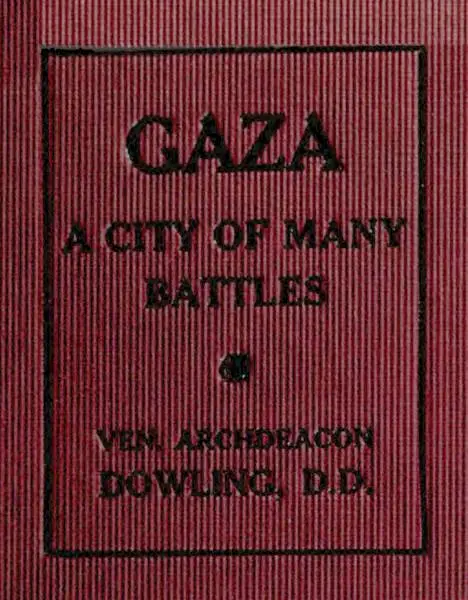
"Gaza: A City of Many Battles" by Theodore Edward Dowling is a historical account written in the early 20th century. The book explores the complex history of Gaza from its ancient origins to modern times, detailing its significance as a battleground through various historical periods, including biblical references and conflicts during the Crusades. The opening of the book sets the stage for its detailed examination of Gaza's historical significance, highlighting the author's recent visit to the city in 1912. Dowling recounts interactions with local scholars and clergy, gathering insights about the city's rich past and its religious importance. He references biblical events, notable figures such as Samson, and the area's strategic geographic position that made it a focal point for various civilizations, establishing a foundation for understanding the many battles and governance transitions that have shaped Gaza throughout history.
Introduction adapted from the source catalogue; source summaries may be automatically generated.
Free to read · English · 28,045 words · No account needed
MAKE TIME FOR A GOOD BOOK
On by default. Untick to stop anonymous reading totals. Each page counts after 10 seconds in view. How this works.
Anonymous counting is on unless you have switched it off.
SUMMARY OF CHIEF EVENTS RELATING TO GAZA[10] FROM 1503 B.C. to A.D. 1913
Section I (1503 B.C. to 30 B.C.)[11]
1503-1449 B.C.--Eighteenth Dynasty. In the twenty-second year of his reign, 1481 B.C. (according to Sayce), Thothmes III made his first determined attempt to subdue Canaan. Gaza was occupied with much difficulty. The fortress of the Prince of Gaza is mentioned in the great expedition of Thothmes III.
c. 1444 B.C.--Eighteenth Dynasty. Amen-hetep II, successor of Thothmes III, has hieroglyphic inscriptions in Gaza, which have been lately discovered. They show that a temple had been built by this Egyptian king to the goddess An Mut.
c. 1366 B.C.--Nineteenth Dynasty. Seti Mer-en Ptah I, the father of Rameses II, drove the Beduins before him from the frontiers of Egypt to those of Canaan, and established a line of fortresses and walls along "the way of the Philistines," which ran by the way of the shore to Gaza (Sayce).
1348-1281 B.C.--Nineteenth Dynasty. Rameses II, User-Maāt-Ra (the Great), continued to hold Gaza till at least 1292, or later.
c. 1225 B.C.--Twentieth Dynasty. Rameses III, Hik-An, captured Gaza, but it does not seem to have remained long in the possession of the Egyptians (Sayce).
734-732 B.C.--Tiglath-pileser III, the founder of the second Assyrian Empire, plundered Gaza, and made it subject to Assyria. It soon revolted against its new masters, relying, no doubt, upon help from Egypt, but in vain.
c. 720 B.C.--Hanno, King of Gaza, called to his aid So (Shabaka), King of Egypt (2 Kings xvii. 4), against the Assyrian general Sargon, and commenced that gigantic struggle between Asia and Egypt, of which Gaza was the centre. Sargon chastised the rebels. In 715 B.C. Rabshakeh (the title of the officer sent by Sennacherib) reproached Hezekiah: "Thou trustest upon the staff of this bruised reed, upon Egypt; whereupon if a man lean, it will go into his hand, and pierce it: So is Pharaoh King of Egypt unto all that trust on him" (2 Kings xviii. 21).
701 B.C.--Gaza remained subject to Sennacherib, the Assyrian king. Sennacherib died in 681 B.C. Tirhakah, the last king but one of the twenty-fifth (Ethiopian) dynasty, began to reign in 691 B.C. (2 Kings xix. 9).
674 B.C.--Esar-haddon, son of Sennacherib, one of the greatest Assyrian kings, retained Gaza (2 Kings xix. 37).
662 B.C.--One of Asshûr-bani-pal, King of Assyria's expeditions enveloped the east coast of the Mediterranean, including Gaza, which rendered him submission.
609 B.C.--Pharaoh Necho II took Gaza by force after the fall of the Empire of the Sargonides (Jeremiah xlvii. 1).
The Hellenistic population after this period became more numerous.
Your reading position is saved on this browser. Take it to another device with a library code. Reading pages adapt to text, rather than matching a printed edition.
BEHIND THE BOOK
This eBook is for the use of anyone anywhere in the United States and most other parts of the world at no cost and with almost no restrictions whatsoever. You may copy it, give it away or re-use it under the terms of the Project Gutenberg License included with this eBook or online at www.gutenberg.org. If you are not located in the United States, you will have to check the laws of the country where you are located before using this eBook. Read the source licence.
The original source file, including credits and licence, is retained by this library. Request an original-format copy at no charge. Please include the book title and Project Gutenberg identifier #49256.
KEEP YOUR CURIOSITY GOING
Cécile Tormay

Moritz Busch
John L. Ransom
Frances Wright
Cécile Tormay

Mabel Potter Daggett