THE CLASSIC COLLECTION✦Frank Merriwell’s dangerCLASSIC FREE BOOKS
Frank Merriwell’s danger
Burt L. Standish
THE CLASSIC COLLECTION · 1901
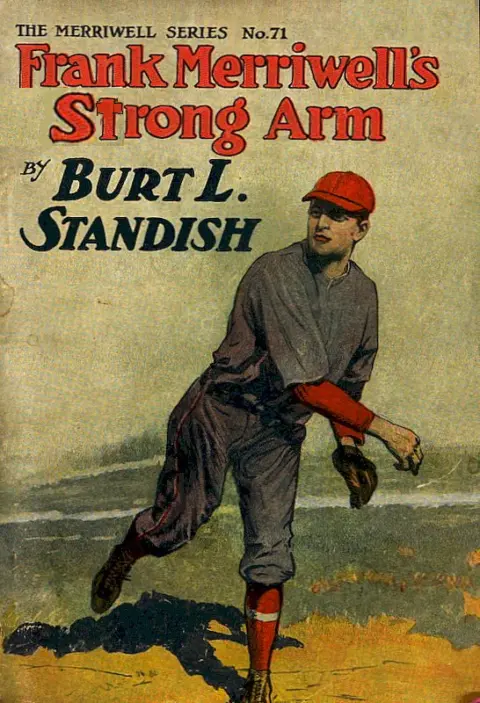
"Frank Merriwell's Strong Arm; Or, Saving an Enemy" by Burt L. Standish is a novel written in the early 20th century. This engaging story follows Frank Merriwell, a well-known athlete and moral paragon at Yale, as he navigates a series of challenges and confrontations, particularly with those envious of his success. The narrative explores themes of friendship, bravery, and integrity, showcasing Merriwell's character as he engages in sports and faces physical dangers. The beginning of the novel sets the stage for a lively spring day at Yale, where students, particularly seniors, are caught in a wave of youthful exuberance. We are introduced to Frank Merriwell and his peers spinning tops in a moment of nostalgia, reflecting on their impending transition to adulthood. Tension arises between Frank and the Chickering Set, a group that seeks to undermine him out of jealousy. The plot quickly escalates when a chaotic scene unfolds involving runaway horses, prompting Frank to heroically step in to save two women from imminent danger. This opening portion effectively captures not just the vibrant atmosphere of college life but also hints at the conflicts and rivalries that lay ahead in the story.
Introduction adapted from the source catalogue; source summaries may be automatically generated.
Free to read · English · 68,690 words · No account needed
MAKE TIME FOR A GOOD BOOK
On by default. Untick to stop anonymous reading totals. Each page counts after 10 seconds in view. How this works.
Anonymous counting is on unless you have switched it off.
“It’th a thame!” declared Lew Veazie, standing before Chickering’s fireplace, his feet as far apart as his short legs would comfortably permit, while he inhaled the smoke of a cigarette with the air of one long accustomed to the things.
“That’s so, chummie,” agreed Ollie Lord, regarding Lew with a look of admiration. “It’s a howling shame!”
“They say his mind is affected,” said Rupert, who had gently seated himself in a position that would bring the least possible strain on the knees of his handsomely creased trousers.
“Oh, no doubt of it!” nodded Julian Ives from the opposite side of the table, pressing a hand against his beautiful bang, as if he feared the air might disturb its symmetry, or it might fall off.
“It must have been an awful disappointment to him,” solemnly
croaked Tilton Hull.
“Poor fellow!” sighed Chickering. “The whole college is talking about it. He was a ‘Deke’ man, and yet he failed even to get into Wolf’s Head.”
“It’s perfectly dreadful, fellows!” said Ollie Lord.
“Thimply awful!” said Lew. “And evwybody knowth who ith to blame
faw it.”
“That’s so, chummie,” agreed Ollie.
“The man whose word is law at Yale brought it about, of course,” croaked Hull, like a parson droning a sermon with uplifted eyes.
“Let’s not be too harsh on any one,” put in Rupert hastily, with a warning gesture of his hand.
“Oh, come off!” exclaimed Ives. “The man had little feeling for poor Defarge, and, without doubt, it was his influence that kept Defarge down.”
Gene Skelding was sitting square in a chair, his hands clasped, his eyes roving from one speaker to another, a strange, grim expression on his face. Thus far he had taken little part in the conversation, but now he broke in.
“I think Defarge has only himself to blame,” he said.
“What?” exclaimed the others, staring at him in startled surprise.
“Let’s be honest with ourselves for once,” said Gene. “I was the one who found Defarge, hatless, coatless, his shirt torn open at the neck, wandering about in the old cemetery on the evening of tap day. I took him to his room and watched him all night long.”
“And you’ve told us how he raved about Merriwell’s dead eyes,” came
hoarsely from Hull.
“The fellow had been drinking dope of some sort,” asserted Gene.
“I’ve told you that.”
“Dwiven to dwink by the injuthice he had endured,” put in Lew, with an effort to be dramatic.
“Just so, chummie,” nodded Ollie.
Your reading position is saved on this browser. Take it to another device with a library code. Reading pages adapt to text, rather than matching a printed edition.
Burt L. Standish
Burt L. Standish

Burt L. Standish

Burt L. Standish
BEHIND THE BOOK
This eBook is for the use of anyone anywhere in the United States and most other parts of the world at no cost and with almost no restrictions whatsoever. You may copy it, give it away or re-use it under the terms of the Project Gutenberg License included with this eBook or online at www.gutenberg.org. If you are not located in the United States, you will have to check the laws of the country where you are located before using this eBook. Read the source licence.
The original source file, including credits and licence, is retained by this library. Request an original-format copy at no charge. Please include the book title and Project Gutenberg identifier #61558.
KEEP YOUR CURIOSITY GOING
Coulson Kernahan

Maurice Baring
Frances Wright
Cécile Tormay

Frederic Jesup Stimson

W. H. P. (William Henry Pope) Jarvis