THE CLASSIC COLLECTION✦Frank Merriwell’s dangerCLASSIC FREE BOOKS
Frank Merriwell’s danger
Burt L. Standish
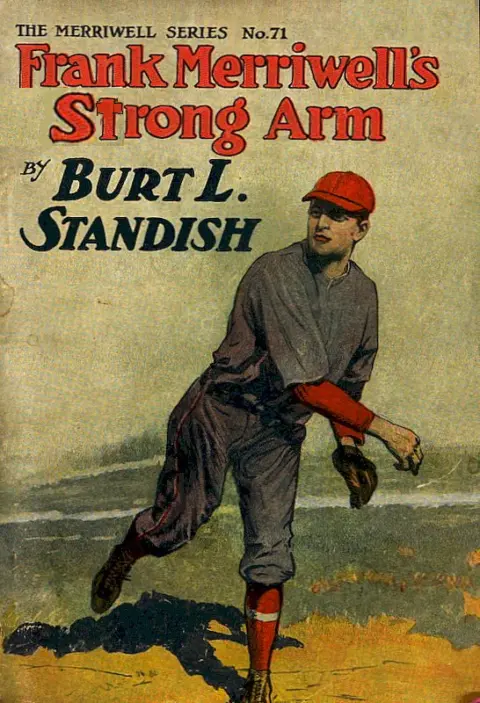
THE CLASSIC COLLECTION · 1901
"Frank Merriwell's Strong Arm; Or, Saving an Enemy" by Burt L. Standish is a novel written in the early 20th century. This engaging story follows Frank Merriwell, a well-known athlete and moral paragon at Yale, as he navigates a series of challenges and confrontations, particularly with those envious of his success. The narrative explores themes of friendship, bravery, and integrity, showcasing Merriwell's character as he engages in sports and faces physical dangers. The beginning of the novel sets the stage for a lively spring day at Yale, where students, particularly seniors, are caught in a wave of youthful exuberance. We are introduced to Frank Merriwell and his peers spinning tops in a moment of nostalgia, reflecting on their impending transition to adulthood. Tension arises between Frank and the Chickering Set, a group that seeks to undermine him out of jealousy. The plot quickly escalates when a chaotic scene unfolds involving runaway horses, prompting Frank to heroically step in to save two women from imminent danger. This opening portion effectively captures not just the vibrant atmosphere of college life but also hints at the conflicts and rivalries that lay ahead in the story.
Introduction adapted from the source catalogue; source summaries may be automatically generated.
Free to read · English · 68,690 words · No account needed
MAKE TIME FOR A GOOD BOOK
On by default. Untick to stop anonymous reading totals. Each page counts after 10 seconds in view. How this works.
Anonymous counting is on unless you have switched it off.
“Mason!” cried Merriwell, who was batting to the outfield.
Then he sent out a long, difficult fly, forcing Mason to run for it
as hard as he could.
Hock held it, though forced to take it on the dead run.
“Gamp!”
Merry gave Joe one very much like that driven out to Hock, and the New Hampshire youth made his long legs fly as he pranced over the ground. He gathered the fly in, whirled round, and sent it almost on a line to the plate. Gamp was a wonderful thrower, and he sometimes fancied showing off a little.
“Benson!”
Frank cracked out a liner to Lib Benson in right field. It was not straight at Benson, and he was compelled to jump to get in front of it; but he took it handsomely, giving Nash, Mullen, and Cowles a chance to applaud.
In the meantime, another man was batting all kinds of balls to the infield, keeping every one on the jump. Pretty soon Frank changed places with the other batter. He had given the outfielders the kind of work that he felt was best for them, and now he wished to see the infield practise.
Ready, covering second, was sent leaping after a ground-skimmer.
“First!” rang out Merry’s voice.
Jack picked it up, and, without straightening, still running, he
snapped it to Browning.
“Second!”
The command came from Merry while the ball was on its way to Bruce. Browning took it and threw, to second without a moment’s delay.
Morgan had leaped to cover the bag, but he was a trifle too slow, and he touched the ball with one hand only.
“Ginger up!” commanded Frank promptly. “You must cover that bag, Morgan, when Ready is after the ball like that.”
Dade started to shrug his shoulders, but changed his mind
instantly, smiled a bit sweetly, and called in a musical,
good-natured voice:
“All right, sir.”
And this was the same Dade Morgan who had once seemed to be Frank Merriwell’s bitter and unrelenting enemy. A great change had come over Dade since the death of Santenel. Released from the power of the hypnotist, Morgan was fast becoming quite a different fellow.
Next Frank drove a liner to Carson, who was on third, and the Westerner took it with out-thrust hand.
“First!”
Berlin lined it across the diamond in a very pretty manner.
“Home!”
Hodge was waiting, and the ball plunked into his mitt.
“Second!”
Bart’s throwing to second was a feature of any game. His short-arm throw was perfect, and he could line a ball down to the second bag without getting out of his tracks.
Your reading position is saved on this browser. Take it to another device with a library code. Reading pages adapt to text, rather than matching a printed edition.
Burt L. Standish
Burt L. Standish
Burt L. Standish
Burt L. Standish
BEHIND THE BOOK
This eBook is for the use of anyone anywhere in the United States and most other parts of the world at no cost and with almost no restrictions whatsoever. You may copy it, give it away or re-use it under the terms of the Project Gutenberg License included with this eBook or online at www.gutenberg.org. If you are not located in the United States, you will have to check the laws of the country where you are located before using this eBook. Read the source licence.
The original source file, including credits and licence, is retained by this library. Request an original-format copy at no charge. Please include the book title and Project Gutenberg identifier #61558.
KEEP YOUR CURIOSITY GOING
Coulson Kernahan

Maurice Baring
Frances Wright
Cécile Tormay

Frederic Jesup Stimson

W. H. P. (William Henry Pope) Jarvis