THE CLASSIC COLLECTION✦Frank Merriwell’s dangerCLASSIC FREE BOOKS
Frank Merriwell’s danger
Burt L. Standish
THE CLASSIC COLLECTION · 1901
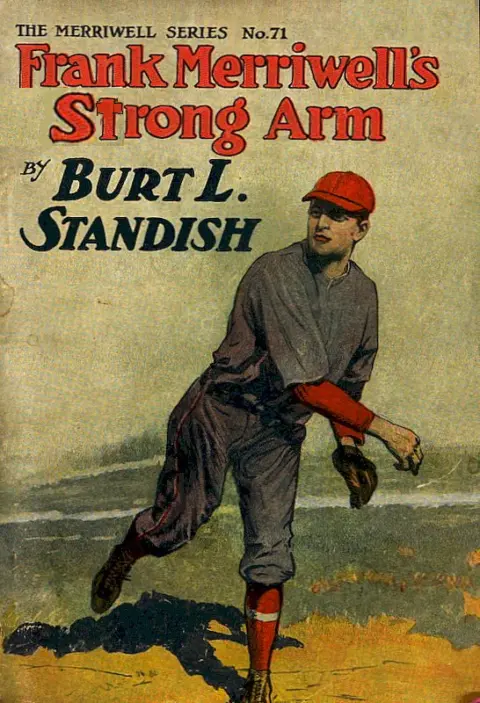
"Frank Merriwell's Strong Arm; Or, Saving an Enemy" by Burt L. Standish is a novel written in the early 20th century. This engaging story follows Frank Merriwell, a well-known athlete and moral paragon at Yale, as he navigates a series of challenges and confrontations, particularly with those envious of his success. The narrative explores themes of friendship, bravery, and integrity, showcasing Merriwell's character as he engages in sports and faces physical dangers. The beginning of the novel sets the stage for a lively spring day at Yale, where students, particularly seniors, are caught in a wave of youthful exuberance. We are introduced to Frank Merriwell and his peers spinning tops in a moment of nostalgia, reflecting on their impending transition to adulthood. Tension arises between Frank and the Chickering Set, a group that seeks to undermine him out of jealousy. The plot quickly escalates when a chaotic scene unfolds involving runaway horses, prompting Frank to heroically step in to save two women from imminent danger. This opening portion effectively captures not just the vibrant atmosphere of college life but also hints at the conflicts and rivalries that lay ahead in the story.
Introduction adapted from the source catalogue; source summaries may be automatically generated.
Free to read · English · 68,690 words · No account needed
MAKE TIME FOR A GOOD BOOK
On by default. Untick to stop anonymous reading totals. Each page counts after 10 seconds in view. How this works.
Anonymous counting is on unless you have switched it off.
Clackson picked out a bat and stepped up to the plate. Starbright
prepared to deliver the ball.
Clackson was regarded as Princeton’s safest single hitter. He could not drive out a long hit, but he could place his hits beautifully, having a way of driving the ball through any opening left in the infield.
Starbright had tried Clackson on all sorts of twists and benders, and he had found the fellow able to hit almost anything. It was a mystery to know just what sort of a ball to give the fellow.
Starbright tried him with an out curve, but Clackson calmly let it
pass.
“One ball,” was the decision.
Then Dick put one close to the fellow’s body, but the latter simply stepped back and let that pass.
“Two balls!”
The big Yale freshman followed with a sharp drop.
Clackson swung at it and missed.
“One strike.”
“Fooled him that time,” thought Dick exultantly.
Then he used a rise, but it was above the latter’s shoulders, and
Clackson did not offer.
“Three balls.”
“Bad hole!” thought Starbright. “But I can put ’em over if I want
to.”
He felt that his control was good, and so he followed with another
drop.
Whiz--went the bat, but the ball was not touched.
“Two strikes.”
“That’s better!” thought Dick, with relief. “He doesn’t seem able to connect with a drop to-day.”
Fancying Clackson would not be looking for another drop, Dick
ventured to give it to him.
The Princeton man had his teeth shut, and he hit the ball a nice easy little tap that dropped it just over the second-baseman’s head, but far enough back so Ready could not get it.
The Princeton crowd cheered. The first man up had obtained a hit, which was starting the game right.
Leverage followed Clackson. He grinned at Starbright in a most derisive manner as, with a flirt of his head, he tossed a waving mane of yellow hair out of his eyes.
Dick smiled back, but he remembered that Leverage was a “bad un,” for he had given Dick trouble in the last game, besides lifting the long fly out to Mason while Merriwell was pitching.
But Starbright fancied the batter would wait to give Clackson an opportunity to try to steal, and so, after letting the runner get a little start the big freshman whistled a ball straight over.
Starbright did this because he had absolute confidence in Hodge,
knowing Bart could put a ball down to second like a bullet from a
rifle.
But it did seem that Starbright had delayed too long, for Clackson was away toward second and running like a deer.
Your reading position is saved on this browser. Take it to another device with a library code. Reading pages adapt to text, rather than matching a printed edition.
Burt L. Standish
Burt L. Standish

Burt L. Standish

Burt L. Standish
BEHIND THE BOOK
This eBook is for the use of anyone anywhere in the United States and most other parts of the world at no cost and with almost no restrictions whatsoever. You may copy it, give it away or re-use it under the terms of the Project Gutenberg License included with this eBook or online at www.gutenberg.org. If you are not located in the United States, you will have to check the laws of the country where you are located before using this eBook. Read the source licence.
The original source file, including credits and licence, is retained by this library. Request an original-format copy at no charge. Please include the book title and Project Gutenberg identifier #61558.
KEEP YOUR CURIOSITY GOING
Coulson Kernahan

Maurice Baring
Frances Wright
Cécile Tormay

Frederic Jesup Stimson

W. H. P. (William Henry Pope) Jarvis