THE CLASSIC COLLECTION✦Frank Merriwell’s dangerCLASSIC FREE BOOKS
Frank Merriwell’s danger
Burt L. Standish
THE CLASSIC COLLECTION · 1901
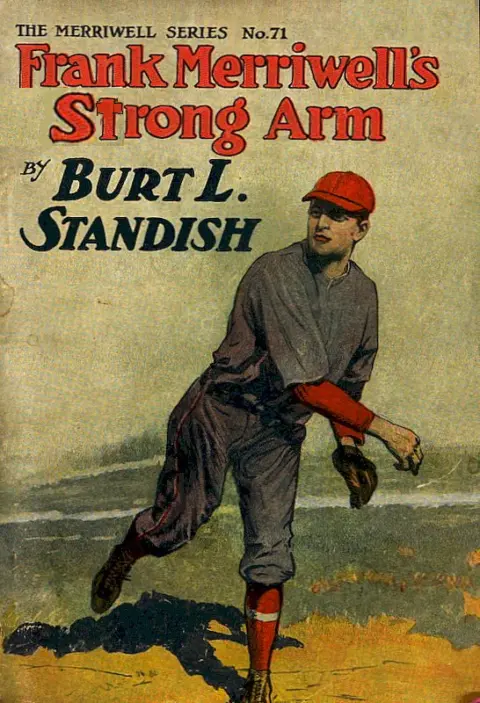
"Frank Merriwell's Strong Arm; Or, Saving an Enemy" by Burt L. Standish is a novel written in the early 20th century. This engaging story follows Frank Merriwell, a well-known athlete and moral paragon at Yale, as he navigates a series of challenges and confrontations, particularly with those envious of his success. The narrative explores themes of friendship, bravery, and integrity, showcasing Merriwell's character as he engages in sports and faces physical dangers. The beginning of the novel sets the stage for a lively spring day at Yale, where students, particularly seniors, are caught in a wave of youthful exuberance. We are introduced to Frank Merriwell and his peers spinning tops in a moment of nostalgia, reflecting on their impending transition to adulthood. Tension arises between Frank and the Chickering Set, a group that seeks to undermine him out of jealousy. The plot quickly escalates when a chaotic scene unfolds involving runaway horses, prompting Frank to heroically step in to save two women from imminent danger. This opening portion effectively captures not just the vibrant atmosphere of college life but also hints at the conflicts and rivalries that lay ahead in the story.
Introduction adapted from the source catalogue; source summaries may be automatically generated.
Free to read · English · 68,690 words · No account needed
MAKE TIME FOR A GOOD BOOK
On by default. Untick to stop anonymous reading totals. Each page counts after 10 seconds in view. How this works.
Anonymous counting is on unless you have switched it off.
Jack took out a key and unlocked the padlock, while Bingham removed the bar, Carker holding the candle.
Then the door was yanked open, and the light of the candle shone into the room beyond. It showed them, sitting on a box and calmly waiting, the well-known figure of the long-haired freshman poet!
“Yah!” snarled Jack Ready, jumping in and pouncing on Boltwood. “So you are here, are you?”
“Well, where in thunder did you think I’d be?” growled the freshman sulkily. “I hope you are satisfied with your scurvy trick!”
“Scurvy trick, hey?” cried Jack, growing warm. “Be careful! Your language is offensive, sir!”
“Well, you haven’t done anything to me that was offensive, have you? You think you can do just as you hanged please without anybody saying a word. But I’ll fix you! I’ll write a poem about you!”
“I don’t believe you will,” said Jack.
“Yes, I will. I’ve made up my mind to that, and I’ve been composing some of the stanzas while you’ve kept me locked up here.”
“Oh, you have? Well, you want to get them right out of your head.”
They led the freshman forth and made their way from the old building. As they departed, the man they had paid for watching stood at a distance and chuckled.
“Well, this has been a great night’s work,” he muttered. “Both chaps paid me a fiver. Ten dollars for doing nothing! I’d like to make a strike like that every night.”
The sophomores led Boltwood to the cab, into which they thrust him. Then they piled in, the door slammed, and the cab rolled away.
“Now,” said Ready, when they were all in the cab, “I want you to repeat some of the poetry you have composed about me.”
“You won’t like it,” said Boltwood, with a chuckle.
“I don’t expect I will. But begin.”
“All right. It begins like this:
“There was a little Jack,
And it came to pass
That this poor little Jack
Became a jackass.”
Bingham snorted, and Carker made some sort of a gurgling sound.
“I don’t think I’ll repeat any more of it,” said Boltwood, in a tone of voice that seemed to tremble with apprehension.
“Perhaps you hadn’t better!” said Ready coldly. “That is quite
enough.”
“I should say so!” muttered Carker.
“It’s not poetry,” asserted Ready.
“I admit,” said Boltwood, “that it contains more truth than poetry.”
Then Bingham snorted again.
“You’re altogether too gay, my fresh young friend!” cried Jack, getting hold of Boltwood and giving him a shake.
Your reading position is saved on this browser. Take it to another device with a library code. Reading pages adapt to text, rather than matching a printed edition.
Burt L. Standish
Burt L. Standish
Burt L. Standish
Burt L. Standish
BEHIND THE BOOK
This eBook is for the use of anyone anywhere in the United States and most other parts of the world at no cost and with almost no restrictions whatsoever. You may copy it, give it away or re-use it under the terms of the Project Gutenberg License included with this eBook or online at www.gutenberg.org. If you are not located in the United States, you will have to check the laws of the country where you are located before using this eBook. Read the source licence.
The original source file, including credits and licence, is retained by this library. Request an original-format copy at no charge. Please include the book title and Project Gutenberg identifier #61558.
KEEP YOUR CURIOSITY GOING
Coulson Kernahan

Maurice Baring
Frances Wright
Cécile Tormay

Frederic Jesup Stimson

W. H. P. (William Henry Pope) Jarvis