THE CLASSIC COLLECTION✦Frank Merriwell’s dangerCLASSIC FREE BOOKS
Frank Merriwell’s danger
Burt L. Standish
THE CLASSIC COLLECTION · 1901
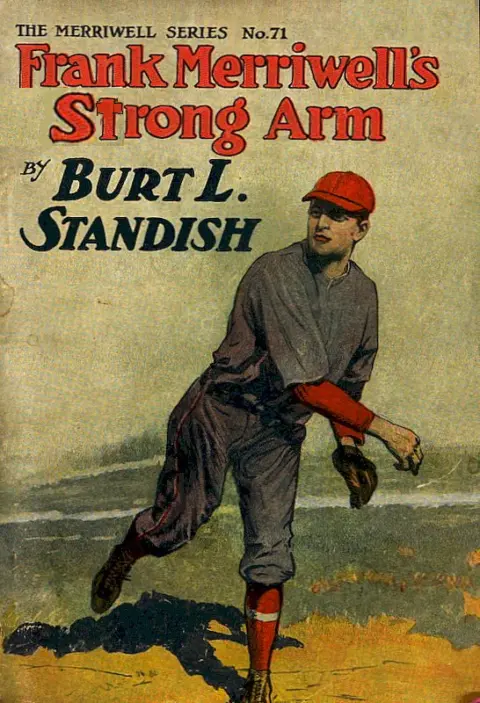
"Frank Merriwell's Strong Arm; Or, Saving an Enemy" by Burt L. Standish is a novel written in the early 20th century. This engaging story follows Frank Merriwell, a well-known athlete and moral paragon at Yale, as he navigates a series of challenges and confrontations, particularly with those envious of his success. The narrative explores themes of friendship, bravery, and integrity, showcasing Merriwell's character as he engages in sports and faces physical dangers. The beginning of the novel sets the stage for a lively spring day at Yale, where students, particularly seniors, are caught in a wave of youthful exuberance. We are introduced to Frank Merriwell and his peers spinning tops in a moment of nostalgia, reflecting on their impending transition to adulthood. Tension arises between Frank and the Chickering Set, a group that seeks to undermine him out of jealousy. The plot quickly escalates when a chaotic scene unfolds involving runaway horses, prompting Frank to heroically step in to save two women from imminent danger. This opening portion effectively captures not just the vibrant atmosphere of college life but also hints at the conflicts and rivalries that lay ahead in the story.
Introduction adapted from the source catalogue; source summaries may be automatically generated.
Free to read · English · 68,690 words · No account needed
MAKE TIME FOR A GOOD BOOK
On by default. Untick to stop anonymous reading totals. Each page counts after 10 seconds in view. How this works.
Anonymous counting is on unless you have switched it off.
Biff--the club sent Jack up against the wall.
“You should be more choice in your language, sir,” said the poet pleasantly. “How are you enjoying the fun?”
Then, having made this inquiry, he biffed Ready again. Jack tried to catch hold of the club, but failed.
“Oh, I’m having a perfectly elegant time!” he panted. “But how the dickens did you get here?”
“Me?” inquired Boltwood, in surprise. “Why shouldn’t I be here?”
“Why, you know you ought to be locked fast in that old basement.”
“What old basement?” asked the poet innocently.
“You know; but I don’t know how you escaped. Gimme that club.”
“Thanks! Take it!” Then Boltwood soaked Jack again.
But this time Ready caught hold of the club and tried to wrench it away. Boltwood held on, and they tussled for possession of the weapon, while all round them raged the battle most furiously.
“I’d give a quarter to know how you got out,” said Jack.
“I’ve never been in,” said Boltwood; “so save your quarter. You’ll need it for arnica and court-plaster.”
“Leggo!”
“Nit!”
Then Jack made a spring and tried to grapple with Boltwood.
“I’ll just toss you round a little,” he said, with confidence in
his ability to do so.
“That’s right,” said the freshman, getting Ready by the neck
somehow and kicking his feet into the air. “I shall enjoy it so
much!”
Down came Ready on the back of his neck. Boltwood placed a foot on his breast, struck a pose, and began to recite poetry.
The shock and the surprise had deprived Jack of his breath for a
moment, but he quickly recovered and grabbed Boltwood by the leg,
exclaiming:
“Come down here a moment! I want to see you!”
Boltwood came down, but he fell so that both his knees gouged into Ready and knocked the breath out of him again.
“Take a good look at me,” said the poet, “for I am the last person you’ll see on earth. You die right here.”
“I’m willing!” came faintly from Jack. “After this death will be a
keen delight!”
He had been forced to let go his hold on Boltwood, but he scrambled up as the freshman rose. Then they grappled again, but somehow Boltwood tossed Jack into the air and let him fall upon a pile of struggling sophomores, who were squirming and twisting and trying to get up. A burst of mocking laughter came from the lips of the freshman, and then a descending cloud of water struck Jack in the face and eyes, blotting out the triumphant poet from his view.
Your reading position is saved on this browser. Take it to another device with a library code. Reading pages adapt to text, rather than matching a printed edition.
Burt L. Standish
Burt L. Standish

Burt L. Standish

Burt L. Standish
BEHIND THE BOOK
This eBook is for the use of anyone anywhere in the United States and most other parts of the world at no cost and with almost no restrictions whatsoever. You may copy it, give it away or re-use it under the terms of the Project Gutenberg License included with this eBook or online at www.gutenberg.org. If you are not located in the United States, you will have to check the laws of the country where you are located before using this eBook. Read the source licence.
The original source file, including credits and licence, is retained by this library. Request an original-format copy at no charge. Please include the book title and Project Gutenberg identifier #61558.
KEEP YOUR CURIOSITY GOING
Coulson Kernahan

Maurice Baring
Frances Wright
Cécile Tormay

Frederic Jesup Stimson

W. H. P. (William Henry Pope) Jarvis