
Life of Edwin Forrest, the American Tragedian. Volume 2 (of 2)
William Rounseville Alger & Horatio, Jr. Alger
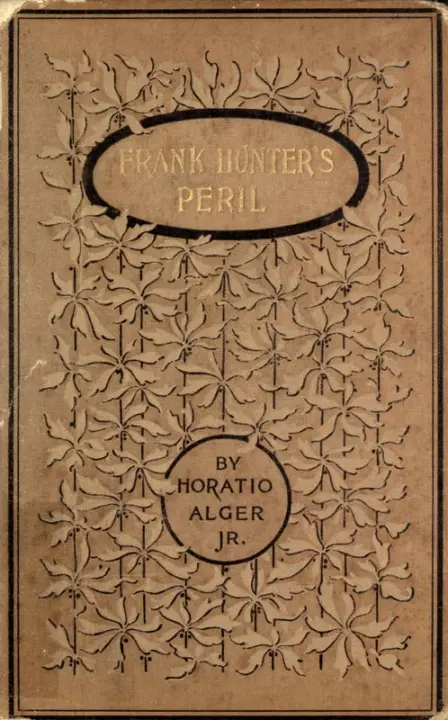
THE CLASSIC COLLECTION · 1896
"Frank Hunter's Peril" by Horatio Alger, Jr. is a novel written in the late 19th century. The story centers around Frank Hunter, a young boy grappling with insecurity about his mother's intentions to marry Mr. Craven, a man he does not trust. As tension builds surrounding the perceived threat from Craven, Frank's loyalty and love for his mother are tested, leading to a conflict where he must navigate the complexities of family, trust, and emerging adulthood. The opening portion of the book introduces Frank Hunter, who is initially enjoying a carefree moment on the lawn when his friend Ben Cameron brings up the subject of his mother’s growing relationship with Mr. Craven. Frank's palpable discomfort with the idea of Craven becoming his stepfather surfaces as he expresses concern over Craven’s frequent visits. A scene between Frank's mother and Mr. Craven reveals Craven’s intentions to propose marriage, leading to a troubling acceptance on her part despite her lack of affection for him. Through Frank's lens, we see the dynamics of this impending family change, laying the groundwork for future tensions and foreshadowing the peril that awaits Frank and his dog, Pompey, at the hands of the predatory Mr. Craven.
Introduction adapted from the source catalogue; source summaries may be automatically generated.
Free to read · English · 50,788 words · No account needed
MAKE TIME FOR A GOOD BOOK
On by default. Untick to stop anonymous reading totals. Each page counts after 10 seconds in view. How this works.
Anonymous counting is on unless you have switched it off.
"I hope you won't think me impolite," he said, "but I mean, by and by, to walk a little, and would like Frank's company. To-morrow I shall be very happy to join you."
Nothing more could be said, of course, but Henry Abercrombie whispered
to Frank:
"I'm sorry we're not going to be together to-day."
"So am I," answered Frank; "but we'll have a bully time to-morrow. I suppose I ought to stay with Colonel Sharpley."
"He isn't any relation of yours, is he?"
"Oh, no; I am only traveling in his company."
"So I thought. You don't look much alike."
"No; I suppose not."
Half an hour passed, but the Abercrombies were still there.
"Shall we go?" asked Frank.
"Not, yet," said Sharpley, shortly.
He did not mean to start till the other travelers were gone, lest he should be followed. For he had screwed his courage to the sticking point, and made up his mind that he would that day do the deed which he had covenanted with Mr. Craven to do. The sooner the better, he thought, for it would bring him nearer the large sum of money which he expected to realize as the price of our hero's murder.
Twenty minutes afterward the Abercrombies, equipped for a mountain walk, swinging their alpenstocks, started off, accompanied by a guide.
"Won't you reconsider your determination and go?" asked the father.
Sharpley shook his head.
"I don't feel equal to the exertion," he answered.
"I hope you'll have a pleasant excursion, Henry," said Frank, looking wistfully after his young friend.
"It would be pleasanter if you were going along," said Henry.
"Thank you."
Frank said no more, but waited till Sharpley had smoked another cigar. By this time twenty minutes had elapsed.
"I think we'll go now, Frank," said Sharpley.
At the welcome intimation Frank jumped up briskly.
"Shall I order some lunch to be packed for us?" he asked.
"No; we sha'n't need it," said Sharpley.
Frank laughed.
"I think I'll get some for myself," said Frank, laughing, as he added: "I've got a healthy appetite, Colonel Sharpley, and I am sure the exertion of climbing these hills will make me fearfully hungry."
"I don't want to be delayed," said Sharpley, frowning. "We sha'n't be gone long enough to need lunch."
"It won't take me a minute," said Frank, running into the inn.
"It is strange he is so much in a hurry all at once," thought our young hero, "when he has been lounging about for an hour without appearing in the least haste."
However, he did not spend much thought on Sharpley's wayward humor, which he was beginning to see was regulated by no rules.
Your reading position is saved on this browser. Take it to another device with a library code. Reading pages adapt to text, rather than matching a printed edition.
William Rounseville Alger & Horatio, Jr. Alger

William Rounseville Alger & Horatio, Jr. Alger

Horatio, Jr. Alger

Horatio, Jr. Alger
BEHIND THE BOOK
This eBook is for the use of anyone anywhere in the United States and most other parts of the world at no cost and with almost no restrictions whatsoever. You may copy it, give it away or re-use it under the terms of the Project Gutenberg License included with this eBook or online at www.gutenberg.org. If you are not located in the United States, you will have to check the laws of the country where you are located before using this eBook. Read the source licence.
The original source file, including credits and licence, is retained by this library. Request an original-format copy at no charge. Please include the book title and Project Gutenberg identifier #56602.
KEEP YOUR CURIOSITY GOING
Wilfrid Scawen Blunt
Wilfrid Scawen Blunt

E. W. (Edgar Watson) Howe
Coulson Kernahan

Maurice Baring
Frances Wright