
Life of Edwin Forrest, the American Tragedian. Volume 2 (of 2)
William Rounseville Alger & Horatio, Jr. Alger
THE CLASSIC COLLECTION · 1896
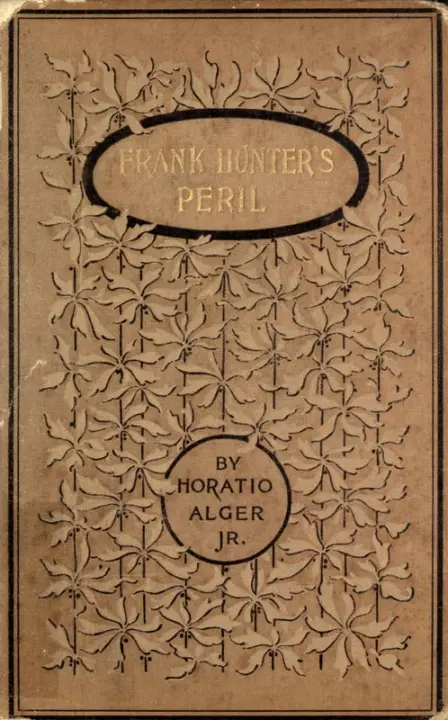
"Frank Hunter's Peril" by Horatio Alger, Jr. is a novel written in the late 19th century. The story centers around Frank Hunter, a young boy grappling with insecurity about his mother's intentions to marry Mr. Craven, a man he does not trust. As tension builds surrounding the perceived threat from Craven, Frank's loyalty and love for his mother are tested, leading to a conflict where he must navigate the complexities of family, trust, and emerging adulthood. The opening portion of the book introduces Frank Hunter, who is initially enjoying a carefree moment on the lawn when his friend Ben Cameron brings up the subject of his mother’s growing relationship with Mr. Craven. Frank's palpable discomfort with the idea of Craven becoming his stepfather surfaces as he expresses concern over Craven’s frequent visits. A scene between Frank's mother and Mr. Craven reveals Craven’s intentions to propose marriage, leading to a troubling acceptance on her part despite her lack of affection for him. Through Frank's lens, we see the dynamics of this impending family change, laying the groundwork for future tensions and foreshadowing the peril that awaits Frank and his dog, Pompey, at the hands of the predatory Mr. Craven.
Introduction adapted from the source catalogue; source summaries may be automatically generated.
Free to read · English · 50,788 words · No account needed
MAKE TIME FOR A GOOD BOOK
On by default. Untick to stop anonymous reading totals. Each page counts after 10 seconds in view. How this works.
Anonymous counting is on unless you have switched it off.
"I won't run up no bills on your account," said Mr. Tarbox; "but I'm goin' just where I please, even if you are there already. Frank here ain't no way troubled about it."
"Frank, as you call him, is under my guardianship," said Mr. Sharpley, with a sneer. "I don't wish him to associate with improper persons."
"Do you call me an improper person?" demanded Mr. Tarbox, offended.
"You can draw your own inferences, Mr.--I really don't know who."
"Tarbox, of Squashboro', State o' Maine."
"Then, Mr. Tarbox, of Squashboro', State o' Maine, I have already wasted as much time as I choose to do on you, and must close the conversation."
"All right, sir. You'd better shut up Frank in a glass case, if you don't want him to associate with any improper persons."
But Colonel Sharpley had turned on his heel and moved away.
"I can't have that fellow following us everywhere," he said to himself. "The task I have before me is one which demands secrecy, in order to avert all suspicion in case anything happens. This inquisitive, prying Yankee may spoil all. He won't take a hint, and I suspect it would be dangerous to try a kick. The trouble with these Yankees is that they are afraid of nothing, and are bent on carrying out their own purposes, however disagreeable to others. I must ask Frank about this fellow and his plans."
"Frank," he commenced, when they were alone, "I must congratulate you on this Yankee friend of yours. He has fastened on us like a leech."
"He is a good-natured fellow," said Frank.
"He is an impudent scoundrel!" said Sharpley, impatiently.
"Not so bad as that. He is not used to the ways of the world, and he seems to have taken a fancy to me."
"He ought to see that his company's not wanted."
"He is not disagreeable to me. I am rather amused by his odd ways and
talk."
"I am not. He is confoundedly disagreeable to me. We must shake him off. We can't have him following us all over Europe."
"He won't do that. He is going to the Paris Exposition."
"What's he going to do there--exhibit himself?"
"Not exactly," said Frank, good humoredly. "He's invented a plow that will take the shine off all others, so he says. So he will be detained there for some time."
"I am glad to hear that; but I mean to get rid of him beforehand. When we leave here we mustn't tell where we are going."
"I can't," answered Frank; "for I don't know, unless it is to London."
"Then I won't tell you, or you might let it out accidentally."
Your reading position is saved on this browser. Take it to another device with a library code. Reading pages adapt to text, rather than matching a printed edition.
William Rounseville Alger & Horatio, Jr. Alger

William Rounseville Alger & Horatio, Jr. Alger

Horatio, Jr. Alger

Horatio, Jr. Alger
BEHIND THE BOOK
This eBook is for the use of anyone anywhere in the United States and most other parts of the world at no cost and with almost no restrictions whatsoever. You may copy it, give it away or re-use it under the terms of the Project Gutenberg License included with this eBook or online at www.gutenberg.org. If you are not located in the United States, you will have to check the laws of the country where you are located before using this eBook. Read the source licence.
The original source file, including credits and licence, is retained by this library. Request an original-format copy at no charge. Please include the book title and Project Gutenberg identifier #56602.
KEEP YOUR CURIOSITY GOING
Wilfrid Scawen Blunt
Wilfrid Scawen Blunt

E. W. (Edgar Watson) Howe
Coulson Kernahan

Maurice Baring
Frances Wright