
Life of Edwin Forrest, the American Tragedian. Volume 2 (of 2)
William Rounseville Alger & Horatio, Jr. Alger
THE CLASSIC COLLECTION · 1896
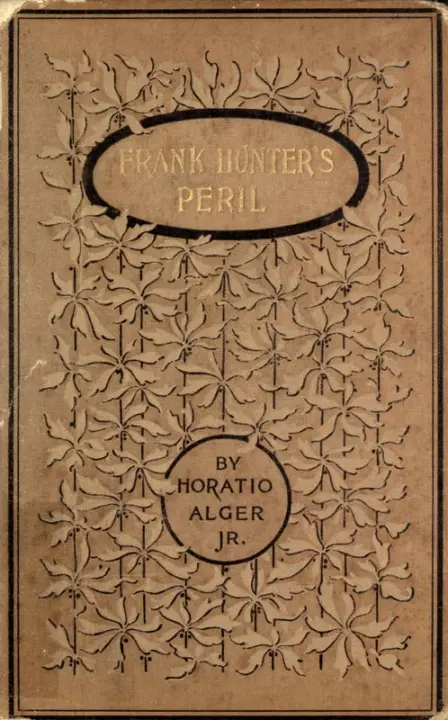
"Frank Hunter's Peril" by Horatio Alger, Jr. is a novel written in the late 19th century. The story centers around Frank Hunter, a young boy grappling with insecurity about his mother's intentions to marry Mr. Craven, a man he does not trust. As tension builds surrounding the perceived threat from Craven, Frank's loyalty and love for his mother are tested, leading to a conflict where he must navigate the complexities of family, trust, and emerging adulthood. The opening portion of the book introduces Frank Hunter, who is initially enjoying a carefree moment on the lawn when his friend Ben Cameron brings up the subject of his mother’s growing relationship with Mr. Craven. Frank's palpable discomfort with the idea of Craven becoming his stepfather surfaces as he expresses concern over Craven’s frequent visits. A scene between Frank's mother and Mr. Craven reveals Craven’s intentions to propose marriage, leading to a troubling acceptance on her part despite her lack of affection for him. Through Frank's lens, we see the dynamics of this impending family change, laying the groundwork for future tensions and foreshadowing the peril that awaits Frank and his dog, Pompey, at the hands of the predatory Mr. Craven.
Introduction adapted from the source catalogue; source summaries may be automatically generated.
Free to read · English · 50,788 words · No account needed
MAKE TIME FOR A GOOD BOOK
On by default. Untick to stop anonymous reading totals. Each page counts after 10 seconds in view. How this works.
Anonymous counting is on unless you have switched it off.
"I never insult nobody. But don't you work for a livin'? That's what I
mean."
"I am engaged in trade," answered the clerk, haughtily.
"Then you do work for a livin', and so, of course, you're a laborer."
"Sir, men in my business are not laborers--they are merchants."
"What's the difference?"
"I perceive, sir, that you are not accustomed to society. I excuse you on account of your ignorance."
"Ignorance! What do you mean by that?" demanded Mr. Tarbox, in his turn
indignant.
Jonathan looked threatening, and as he was physically the Englishman's superior, the latter answered hastily:
"I only meant to say that you were not versed in the requirements and conventionalities of society."
"Is that English?" asked Jonathan, with a puzzled look.
"I believe so."
"Well, I never heard sich jawbreakers before, but, if it's an apology, it's all right. Won't you look at the plow, then?"
"It would be of no use, Mr. Tarbox--I don't know about such things, I assure you. You had better show it to somebody else. My life has been passed in London, and I really am profoundly ignorant of agricultural implements."
As he spoke, he turned away and walked down stairs. Mr. Tarbox followed him with his eyes, ejaculating:
"That's a queer critter. He's over thirty years old, I guess, and he's never sot eyes on a plow! He'd ought to be ashamed of his ignorance."
"Well, Mr. Tarbox," said Frank, when his new friend rejoined him, "did you explain your new invention to the Englishman?"
"I was goin' to, but he said he never seed one in the whole course of
his life, and didn't take no interest in them. What do you think of
that?"
"He can't have been in the country much, I should think."
"He keeps store in London, he says; but he's a poor, ignorant creetur, and he don't want to learn. I wanted to explain all about my invention, but he wouldn't look at it."
"There are other Englishmen who will take more interest in it, Mr. Tarbox--men who live in the country and cultivate the land."
"I hope so. I hope they ain't all as ignorant as that creetur. Do you think that colonel that you're travelin' with would like to look at it?"
"I don't believe he would, Mr. Tarbox. I don't know much about him, but he seems to me like a man that has always lived in the city."
"Just as you say. I'd just as lief explain it to him."
"Are you going to put it in the exhibition?"
Your reading position is saved on this browser. Take it to another device with a library code. Reading pages adapt to text, rather than matching a printed edition.
William Rounseville Alger & Horatio, Jr. Alger

William Rounseville Alger & Horatio, Jr. Alger

Horatio, Jr. Alger

Horatio, Jr. Alger
BEHIND THE BOOK
This eBook is for the use of anyone anywhere in the United States and most other parts of the world at no cost and with almost no restrictions whatsoever. You may copy it, give it away or re-use it under the terms of the Project Gutenberg License included with this eBook or online at www.gutenberg.org. If you are not located in the United States, you will have to check the laws of the country where you are located before using this eBook. Read the source licence.
The original source file, including credits and licence, is retained by this library. Request an original-format copy at no charge. Please include the book title and Project Gutenberg identifier #56602.
KEEP YOUR CURIOSITY GOING
Wilfrid Scawen Blunt
Wilfrid Scawen Blunt

E. W. (Edgar Watson) Howe
Coulson Kernahan

Maurice Baring
Frances Wright