
Life of Edwin Forrest, the American Tragedian. Volume 2 (of 2)
William Rounseville Alger & Horatio, Jr. Alger
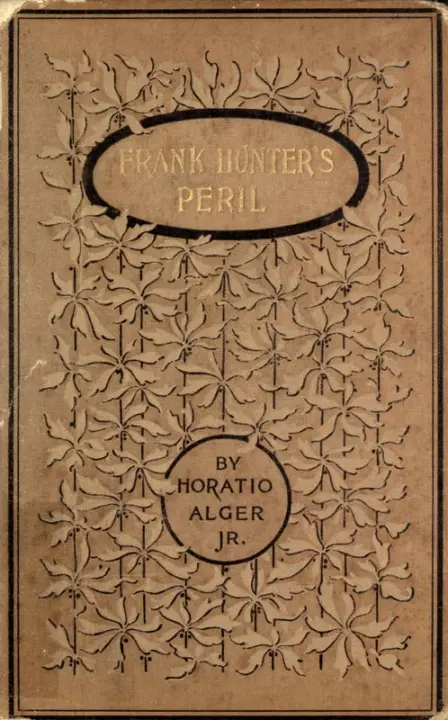
THE CLASSIC COLLECTION · 1896
"Frank Hunter's Peril" by Horatio Alger, Jr. is a novel written in the late 19th century. The story centers around Frank Hunter, a young boy grappling with insecurity about his mother's intentions to marry Mr. Craven, a man he does not trust. As tension builds surrounding the perceived threat from Craven, Frank's loyalty and love for his mother are tested, leading to a conflict where he must navigate the complexities of family, trust, and emerging adulthood. The opening portion of the book introduces Frank Hunter, who is initially enjoying a carefree moment on the lawn when his friend Ben Cameron brings up the subject of his mother’s growing relationship with Mr. Craven. Frank's palpable discomfort with the idea of Craven becoming his stepfather surfaces as he expresses concern over Craven’s frequent visits. A scene between Frank's mother and Mr. Craven reveals Craven’s intentions to propose marriage, leading to a troubling acceptance on her part despite her lack of affection for him. Through Frank's lens, we see the dynamics of this impending family change, laying the groundwork for future tensions and foreshadowing the peril that awaits Frank and his dog, Pompey, at the hands of the predatory Mr. Craven.
Introduction adapted from the source catalogue; source summaries may be automatically generated.
Free to read · English · 50,788 words · No account needed
MAKE TIME FOR A GOOD BOOK
On by default. Untick to stop anonymous reading totals. Each page counts after 10 seconds in view. How this works.
Anonymous counting is on unless you have switched it off.
"Are you going to travel much?" asked Frank.
"Wal, you see, I go mostly on business. My name's Jonathan Tarbox. My father's name is Elnathan Tarbox. He's got a nice farm in Squashboro', next to old Deacon Perkins'. Was you ever in Squashboro'?"
"No; I think not."
"It's a thrivin' place, is Squashboro'. Wal, now, I guess you are wonderin' what sets me out to go to Europe, ain't you?"
"I suppose you want to see the country, Mr. Tarbox."
"Ef that was all, you wouldn't catch me goin' over and spendin' a heap of money, all for nothin'. That ain't business."
"Then I suppose you go on business?"
"I guess I do. You see I've invented a new plow, that, I guess, is goin' to take the shine off of any other that's in use, and it kinder struck me that ef I should take it to the Paris Exhibition, I might, may be, make somethin' out of it. I've heerd that they're a good deal behind in farm tools in the old European countries, and I guess I'll open their eyes a little with my plow."
"I hope you'll succeed, Mr. Tarbox," said Frank, politely.
"I guess I shall. You see, I've risked considerable money onto it--that is, in travelin' expenses and such like. You see, my Uncle Abner--he wasn't my real uncle, that is, by blood, but he was the husband of my Aunt Matilda, my mother's oldest sister--didn't have no children of his own, so he left me two thousand dollars in his will."
Mr. Tarbox paused in order to see what effect the mention of this great inheritance would have upon his auditor.
"Indeed you were lucky, Mr. Tarbox," said Frank.
"I guess I felt tickled when I heard of it. I jist kicked like a two-year-old colt. Wal, now, dad wanted me to buy a thirty-acre farm that was for sale about half a mile from his'n, but I wouldn't. I'd about fetched my plow out right, and I wa'n't goin' to settle down on no two-thousand-dollar farm. Catch me! No; I heerd of this Paris Exhibition, and I vowed I'd come out here and see what could be did. So here I am. I ain't sorry I cum, though I was about sick enough to die. Thought I should a-turned inside out one night when the vessel was goin' every which way."
"I was sick myself that night," said Frank.
Mr. Tarbox having now communicated all his own business, naturally felt a degree of curiosity about that of his young companion.
"Are you goin' to the Paris Exhibition?" he asked.
"I suppose so. It depends upon Colonel Sharpley."
Your reading position is saved on this browser. Take it to another device with a library code. Reading pages adapt to text, rather than matching a printed edition.
William Rounseville Alger & Horatio, Jr. Alger

William Rounseville Alger & Horatio, Jr. Alger

Horatio, Jr. Alger

Horatio, Jr. Alger
BEHIND THE BOOK
This eBook is for the use of anyone anywhere in the United States and most other parts of the world at no cost and with almost no restrictions whatsoever. You may copy it, give it away or re-use it under the terms of the Project Gutenberg License included with this eBook or online at www.gutenberg.org. If you are not located in the United States, you will have to check the laws of the country where you are located before using this eBook. Read the source licence.
The original source file, including credits and licence, is retained by this library. Request an original-format copy at no charge. Please include the book title and Project Gutenberg identifier #56602.
KEEP YOUR CURIOSITY GOING
Wilfrid Scawen Blunt
Wilfrid Scawen Blunt

E. W. (Edgar Watson) Howe
Coulson Kernahan

Maurice Baring
Frances Wright