
Life of Edwin Forrest, the American Tragedian. Volume 2 (of 2)
William Rounseville Alger & Horatio, Jr. Alger
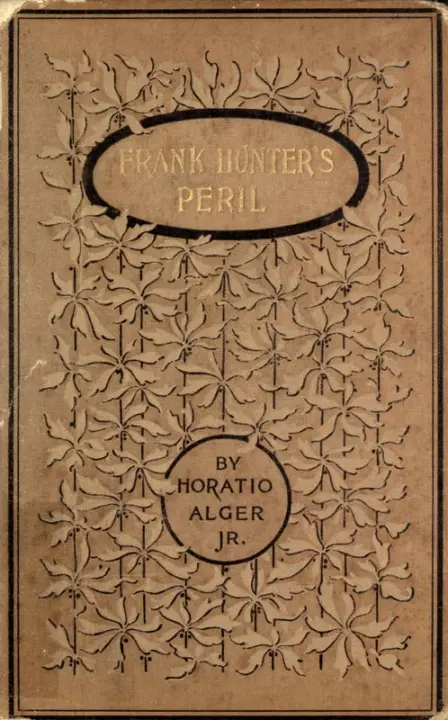
THE CLASSIC COLLECTION · 1896
"Frank Hunter's Peril" by Horatio Alger, Jr. is a novel written in the late 19th century. The story centers around Frank Hunter, a young boy grappling with insecurity about his mother's intentions to marry Mr. Craven, a man he does not trust. As tension builds surrounding the perceived threat from Craven, Frank's loyalty and love for his mother are tested, leading to a conflict where he must navigate the complexities of family, trust, and emerging adulthood. The opening portion of the book introduces Frank Hunter, who is initially enjoying a carefree moment on the lawn when his friend Ben Cameron brings up the subject of his mother’s growing relationship with Mr. Craven. Frank's palpable discomfort with the idea of Craven becoming his stepfather surfaces as he expresses concern over Craven’s frequent visits. A scene between Frank's mother and Mr. Craven reveals Craven’s intentions to propose marriage, leading to a troubling acceptance on her part despite her lack of affection for him. Through Frank's lens, we see the dynamics of this impending family change, laying the groundwork for future tensions and foreshadowing the peril that awaits Frank and his dog, Pompey, at the hands of the predatory Mr. Craven.
Introduction adapted from the source catalogue; source summaries may be automatically generated.
Free to read · English · 50,788 words · No account needed
MAKE TIME FOR A GOOD BOOK
On by default. Untick to stop anonymous reading totals. Each page counts after 10 seconds in view. How this works.
Anonymous counting is on unless you have switched it off.
"How do you do, Mr. Tarbox?" said Frank, saluting him.
"What!" gasped Mr. Tarbox, fixing his eyes upon our hero in a strange mixture of incredulity, wonder, bewilderment and joy.
"Why, Mr. Tarbox, you don't seem glad to see me," said Frank. "You haven't forgotten me, have you?"
"Are you alive?" asked Mr. Tarbox, cautiously, eying him askance.
"Alive? I rather think I am. Just give me your hand."
The Yankee mechanically extended his hand, and Frank gave him a grip which convinced him that he was flesh and blood.
"But I thought you were dead!"
"You see I am not."
"I saw the cliff where you tumbled off, and broke your neck."
"I got it mended again," said Frank, laughing. "But you say you saw the cliff. Have you been to Switzerland?"
"Yes. I mistrusted something was goin' to happen to you."
"How could you mistrust? What led to your suspicions?"
"A letter that your step-father wrote to that skunk, Sharpley, in which he talks about your meeting with an accident."
"But," inquired Frank, in surprise, "how did you get hold of such a letter? I knew nothing about it."
"You left it here one day by accident."
"Where is it? Let me read it."
"First, let me ask you a question. Didn't that skunk push you off the
cliff?"
"Yes," said Frank, gravely.
"And how did you escape?"
"Some peasants found me on a snow-covered ledge on which I had fallen. They took me home, and nursed me till I was well enough to travel."
"Are you with that skunk now?"
"No; I never would travel with him again," said Frank, shuddering.
"Where is he?"
"I don't know. But let me have the letter."
He read in silence the paragraph which has been quoted in an earlier chapter. When he had finished he looked up.
"I am afraid," he said, gravely, "there is no doubt that Mr. Craven employed Colonel Sharpley to make away with me."
"Then he is a skunk, too!"
"Mr. Tarbox, I would not mind it so much but for one thing."
"What is that, Frank?"
"He is married to my mother. If he lays this plot for me, what will he
do against her?"
"He will try to get hold of her money."
"I fear so, and if she resists I am afraid he will try to injure her."
"May be you're right, Frank."
"I think I ought to go home at once; don't you think so?"
"I don't know but you're right, Frank. I'm almost ready to go too."
"Oh, I forgot to ask you what luck you had met with."
Your reading position is saved on this browser. Take it to another device with a library code. Reading pages adapt to text, rather than matching a printed edition.
William Rounseville Alger & Horatio, Jr. Alger

William Rounseville Alger & Horatio, Jr. Alger

Horatio, Jr. Alger

Horatio, Jr. Alger
BEHIND THE BOOK
This eBook is for the use of anyone anywhere in the United States and most other parts of the world at no cost and with almost no restrictions whatsoever. You may copy it, give it away or re-use it under the terms of the Project Gutenberg License included with this eBook or online at www.gutenberg.org. If you are not located in the United States, you will have to check the laws of the country where you are located before using this eBook. Read the source licence.
The original source file, including credits and licence, is retained by this library. Request an original-format copy at no charge. Please include the book title and Project Gutenberg identifier #56602.
KEEP YOUR CURIOSITY GOING
Wilfrid Scawen Blunt
Wilfrid Scawen Blunt

E. W. (Edgar Watson) Howe
Coulson Kernahan

Maurice Baring
Frances Wright