
Last letters from the living dead man
David Patterson (Spirit) Hatch
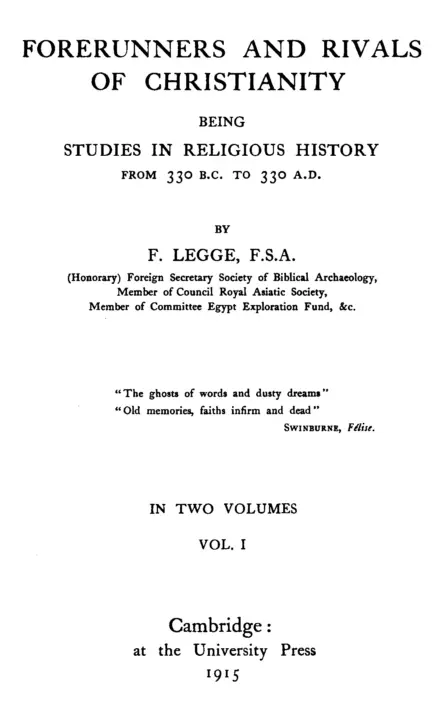
THE CLASSIC COLLECTION · 1915
"Forerunners and Rivals of Christianity: Being Studies in Religious History" by F. Legge is a scholarly historical account likely written in the early 20th century. The book explores documents crucial for understanding the origins and developments of Christianity, highlighting lesser-known religious movements and texts. Its focus is on the interplay between early Christianity and its contemporaries, including various Gnostic sects and Eastern religions. The opening of the work introduces the author's intent to compile and elucidate documents that, while previously translated, remain obscure and misunderstood in contemporary discourse. Legge expresses his desire to foster a clearer understanding of these religious fragments by providing context and commentary, which he believes will clarify their significance. He acknowledges the challenges presented by historical interpretations and notes his efforts to make these texts accessible to both scholars and the general public. Through his methodical approach, he aims to shed light on the diverse influences that shaped early Christianity.
Introduction adapted from the source catalogue; source summaries may be automatically generated.
Free to read · English · 99,528 words · No account needed
MAKE TIME FOR A GOOD BOOK
On by default. Untick to stop anonymous reading totals. Each page counts after 10 seconds in view. How this works.
Anonymous counting is on unless you have switched it off.
This is, perhaps, the only satisfactory reason that can be assigned for the secrecy with which the Mysteries of Eleusis, of the Great Mother, and the rest were surrounded. The notion put forward by the Fathers that the mystic rites were kept secret because of their obscenity has little weight when we consider the Phallophoria and the Terms, or street statues of Hermes, which were publicly exhibited. The existence of secret rites among primitive folk like the black races of Africa and the native Australians can be explained in the same way.
Footnote 429:
Purser, ubi cit. supra, speaks of it as “an ascetic religious brotherhood,” as did K. O. Müller, Introduction to a Scientific System of Mythology (Eng. ed.), p. 318, and Litt. of Ant. Greece, I. p. 307. Döllinger, Jud. und Heid. I. p. 161, says truly that there is no evidence that at any time there existed a regularly formed association of Orphici in Greece. So Monceaux in Daremberg and Saglio, s.v. Orpheus.
Footnote 430:
This was the opinion of Guigniaut, Religions de l’Antiquité, Paris, 1825, t. III. p. 1203.
Footnote 431:
Plato, Republic, Bk II. c. 7, is the classical passage. Cf. Döllinger, op. cit. I. pp. 165-167, and references there given.
Footnote 432:
See Döllinger as in last note.
Footnote 433:
Theophrastus, Characteres, c. XVI.
Footnote 434:
There are 88 in the text published by Abel (Orphica, pp. 55-102). This includes the Hymn to Ares generally classed among the Homeric Hymns.
Footnote 435:
The celebrated Thomas Taylor the Platonist. Pausanias, Bk IX. cc. 27 and 30, says that the Hymns of Orpheus were short and few, and that the Lycomidae knew and sung them in the Mysteries.
Footnote 436:
Abel, Orphica, p. 55, n. 1.
Footnote 437:
Dieterich, de Hymnis Orphicis, Marp. Catt. 1891. Otto Kern in the Festschrift presented to Prof. Carl Robert, 1910, points out that there is no trace of the worship of the Emperor in the Hymns, and that these must therefore all be anterior to the Christian era; also that the Egyptian deities are so seldom named in them, that the collection cannot have been made in Egypt. He thinks it comes from Asia Minor.
Footnote 438:
The collection may have been used as an oracle or divining-book like any other poems written in hexameters. See a curious instance of this in Kenyon, Greek Papyri in British Museum, pp. 83 sqq.
Footnote 439:
This is numbered XXIX. in Abel’s text. This, and the hymns of Hecate, Pluto, the Curetes, Dionysos Bassareus, the Ever-living Deliverer (Bacchus), Aphrodite, Nemesis, Nomos, and the doubtful one to Ares are the only hymns out of the original collection which have not the note appended as to the perfume to be burnt.
Footnote 440:
Μουνογένεια, “Unique,” see n. 3 p. 124, supra.
Footnote 441:
Your reading position is saved on this browser. Take it to another device with a library code. Reading pages adapt to text, rather than matching a printed edition.
BEHIND THE BOOK
This eBook is for the use of anyone anywhere in the United States and most other parts of the world at no cost and with almost no restrictions whatsoever. You may copy it, give it away or re-use it under the terms of the Project Gutenberg License included with this eBook or online at www.gutenberg.org. If you are not located in the United States, you will have to check the laws of the country where you are located before using this eBook. Read the source licence.
The original source file, including credits and licence, is retained by this library. Request an original-format copy at no charge. Please include the book title and Project Gutenberg identifier #71384.
KEEP YOUR CURIOSITY GOING
David Patterson (Spirit) Hatch

David Patterson (Spirit) Hatch

David Patterson (Spirit) Hatch
Cécile Tormay

Moritz Busch
John L. Ransom