
Last letters from the living dead man
David Patterson (Spirit) Hatch
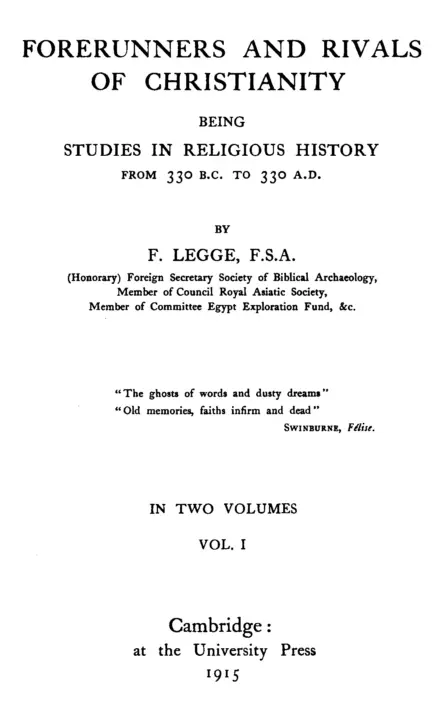
THE CLASSIC COLLECTION · 1915
"Forerunners and Rivals of Christianity: Being Studies in Religious History" by F. Legge is a scholarly historical account likely written in the early 20th century. The book explores documents crucial for understanding the origins and developments of Christianity, highlighting lesser-known religious movements and texts. Its focus is on the interplay between early Christianity and its contemporaries, including various Gnostic sects and Eastern religions. The opening of the work introduces the author's intent to compile and elucidate documents that, while previously translated, remain obscure and misunderstood in contemporary discourse. Legge expresses his desire to foster a clearer understanding of these religious fragments by providing context and commentary, which he believes will clarify their significance. He acknowledges the challenges presented by historical interpretations and notes his efforts to make these texts accessible to both scholars and the general public. Through his methodical approach, he aims to shed light on the diverse influences that shaped early Christianity.
Introduction adapted from the source catalogue; source summaries may be automatically generated.
Free to read · English · 99,528 words · No account needed
MAKE TIME FOR A GOOD BOOK
On by default. Untick to stop anonymous reading totals. Each page counts after 10 seconds in view. How this works.
Anonymous counting is on unless you have switched it off.
So Clement of Alexandria, Protrept. c. II. speaks of “the mysteries of Demeter, and Zeus’ wanton embraces of his mother and the wrath of Demeter ... also the entreaties of Zeus, and the drink of gall, the plucking-out of the hearts of sacrifices and deeds we dare not name.” Arnobius, adv. Gentes, Bk V. cc. 20, 21, tells substantially the same story.
Footnote 442:
See n. 2 p. 133, supra. In these hymns it is used always as an epithet either of Bacchus or Hades with whom the mystic Bacchus was identified.
Footnote 443:
No. XLII. in Abel’s Orphica. Persephone was called Mise Kore at Pergamum (C. Radet, Revue des Études anciennes, January-March, 1911, p. 77), which shows how closely she had become identified with her consort. Otherwise the word is only known, I believe, as a name of Dionysos.
Footnote 444:
τε ... τε.
Footnote 445:
Λύσειος.
Footnote 446:
Doubtless the bees, who throughout Asia Minor were said to be the attendants of the Great Goddess. The priestesses of the Ephesian Artemis were called Μέλισσαι or Bees, and there were Μέλισσαι at Eleusis. See Foucart, Grds. Myst. pp. 66, 67. Cf. Aristophanes, Frogs, l. 1274. So were those of Cybele: cf. Lactantius, Div. Inst. Bk I. c. 22. Cf. also, A. B. Cook, “The Bee in Greek Mythology” in J.H.S. XV. (1895), pp. 17 sqq.
Footnote 447:
διφυῆ. See Orphic Hymn VI. in Abel’s Orphica.
Footnote 448:
As in the Orphic Hymn to Mise quoted above. Cf. Dyer, op. cit. pp.
178, 179.
Footnote 449:
That this may have been thought to be the result of the mystic union of the initiate with Dionysos seems possible from the statement of Plutarch, that this last was born as a man, but by his merit was translated from this earthly and suffering body, Life of Pelopidas, c. XVI. Cf. Budge, Pseudo-Callisthenes’ Life of Alexander the Great, p. 135.
Footnote 450:
A sort of echo of this is perhaps to be found in the idea prevalent in the primitive Church that martyrs for the faith passed direct to a state of blessedness without waiting like the rest of the faithful for the Last Judgment. Cf. Revelation vi. 9-11; Neander, Ch. Hist. I. p. 463.
Footnote 451:
Zeus Chthonios or the Zeus below the earth. The serpent was always to the Orphic poets a symbol or pictorial representation of earth.
Footnote 452:
This seems to be the upshot of the remarks in Pseudo-Callisthenes (Budge, op. cit. supra), pp. 8, 12, 40-48, 127, 135. The same idea is specially marked in the writings of Proclus and other Neo-Platonists and by them attributed to Orpheus. Cf. Abel’s Orphica, s.v. Teletai, passim.
Footnote 453:
Plato, Republ. Bk II. c. 7.
Footnote 454:
No. XXXVII. in Abel’s Orphica, p. 78.
Footnote 455:
Your reading position is saved on this browser. Take it to another device with a library code. Reading pages adapt to text, rather than matching a printed edition.
BEHIND THE BOOK
This eBook is for the use of anyone anywhere in the United States and most other parts of the world at no cost and with almost no restrictions whatsoever. You may copy it, give it away or re-use it under the terms of the Project Gutenberg License included with this eBook or online at www.gutenberg.org. If you are not located in the United States, you will have to check the laws of the country where you are located before using this eBook. Read the source licence.
The original source file, including credits and licence, is retained by this library. Request an original-format copy at no charge. Please include the book title and Project Gutenberg identifier #71384.
KEEP YOUR CURIOSITY GOING
David Patterson (Spirit) Hatch

David Patterson (Spirit) Hatch

David Patterson (Spirit) Hatch
Cécile Tormay

Moritz Busch
John L. Ransom