
Last letters from the living dead man
David Patterson (Spirit) Hatch
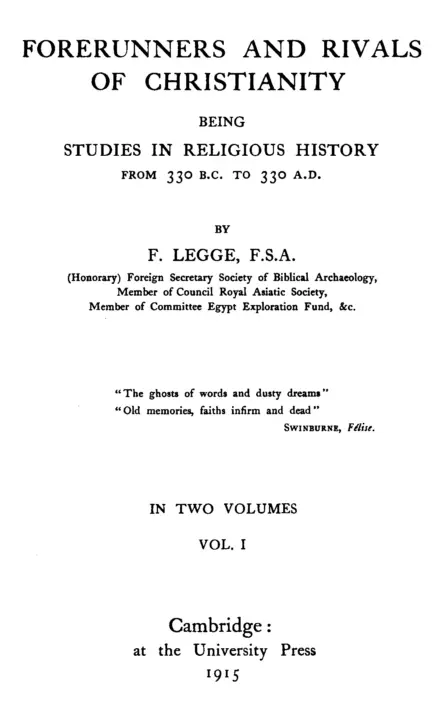
THE CLASSIC COLLECTION · 1915
"Forerunners and Rivals of Christianity: Being Studies in Religious History" by F. Legge is a scholarly historical account likely written in the early 20th century. The book explores documents crucial for understanding the origins and developments of Christianity, highlighting lesser-known religious movements and texts. Its focus is on the interplay between early Christianity and its contemporaries, including various Gnostic sects and Eastern religions. The opening of the work introduces the author's intent to compile and elucidate documents that, while previously translated, remain obscure and misunderstood in contemporary discourse. Legge expresses his desire to foster a clearer understanding of these religious fragments by providing context and commentary, which he believes will clarify their significance. He acknowledges the challenges presented by historical interpretations and notes his efforts to make these texts accessible to both scholars and the general public. Through his methodical approach, he aims to shed light on the diverse influences that shaped early Christianity.
Introduction adapted from the source catalogue; source summaries may be automatically generated.
Free to read · English · 99,528 words · No account needed
MAKE TIME FOR A GOOD BOOK
On by default. Untick to stop anonymous reading totals. Each page counts after 10 seconds in view. How this works.
Anonymous counting is on unless you have switched it off.
Such as the Mysteries of Samothrace, held in honour, according to one account, of Pluto, Demeter, and Persephone, together with Hermes. See Maury, op. cit. II. pp. 306 sqq. for authorities. It was at these mysteries that Philip of Macedon was said to have first seen and loved Olympias (Plutarch, Alexander, c. 2).
Footnote 418:
Herodotus, Bk V. c. 4.
Footnote 419:
See Maury, Rel. de la Grèce, II. p. 203, for authorities.
Footnote 420:
As in the Orphic Hymn to Mise given on p. 143, infra, where the Eleusinian Dionysos, called also Eubuleus and Iacchos, is identified with Cybele, the Cyprian Aphrodite, and the Egyptian Isis. See, too, the Hymn “of the Great Mysteries” given in the Philosophumena of Hippolytus, where Dionysos is equated with Adonis, Osiris, the god of Samothrace, Attis, and others. See n. 1 p. 139, and Chap. VIII, infra.
Footnote 421:
See last note; Proclus, in Plat. Polit. p. 353 (Abel’s Orphica,
Frag. 184).
Footnote 422:
πανκοίρανος. C.I.G. t. II. No. 3791 (Bö.). Cf. the Aeschylean description of Zagreus as the “Highest of All” (πανυπέρτατε πάντων) quoted by Gaisford in his notes to Etymologicum Magnum (see Cycli Fragmenta of Didot, s.v. Epigoni vel Alemaeonis).
Footnote 423:
Cf. the Σαβάζιε ... ὂς Βάκχον Διόνυσον of Hymn XLVIII. Abel’s Orphica.
Footnote 424:
Lysistrata, ll. 386-390. Cf. Foucart, Les Ass. Rel. pp. 61-64, who quotes nearly all the available authorities in his notes. See also Monceaux in Daremberg and Saglio’s Dict. des Antiq. s.v. Sabazios.
Footnote 425:
Demosthenes, de Corona, pp. 259 sqq. Cf. Foucart, Les Ass. Rel.
p. 67, n. 1.
Footnote 426:
In the Orphic Hymn to Hippa (Hymn XLIX. Abel’s Orphica, p. 84), the mysteries of the “pure Sabos?” (ἁγνοῦ Σάβου) are alluded to in terms which make it possible that the name was one of the epithets of the Iacchos of Eleusis.
Footnote 427:
In a hymn preserved for us by Hippolytus (Philosophumena, Bk V. c. 1, p. 176, Cruice) the “multiform Attis,” who has just been declared “in a hymn of the Great Mysteries” to be the god who is called Adonis, Osiris, Adam (by the Samothracians), Corybas and Pappas, is thus addressed: “I will sing Attis, son of Rhea, not with the sound of trumpets, nor with the Idaean flutes in harmony with the songs of the Curetes. But I will mingle with my lay Phoebus’ music of lutes. Evoe Evan, since thou art Pan, since thou art Bacchus, since thou art the shepherd of white stars.” In the address to Musaeus with which the collection of Orphic Hymns begins, the Mother of the Gods, Attis, Men, Aphrodite Urania, and Adonis are invoked together. See Abel’s Orphica, p. 58. In Roman times Attis and Sabazius seem to be identified, while Adonis is often confounded with them. See Maury, Rel. de la Grèce, III. p. 102 and n. 4.
Footnote 428:
Your reading position is saved on this browser. Take it to another device with a library code. Reading pages adapt to text, rather than matching a printed edition.
BEHIND THE BOOK
This eBook is for the use of anyone anywhere in the United States and most other parts of the world at no cost and with almost no restrictions whatsoever. You may copy it, give it away or re-use it under the terms of the Project Gutenberg License included with this eBook or online at www.gutenberg.org. If you are not located in the United States, you will have to check the laws of the country where you are located before using this eBook. Read the source licence.
The original source file, including credits and licence, is retained by this library. Request an original-format copy at no charge. Please include the book title and Project Gutenberg identifier #71384.
KEEP YOUR CURIOSITY GOING
David Patterson (Spirit) Hatch

David Patterson (Spirit) Hatch

David Patterson (Spirit) Hatch
Cécile Tormay

Moritz Busch
John L. Ransom