
Last letters from the living dead man
David Patterson (Spirit) Hatch
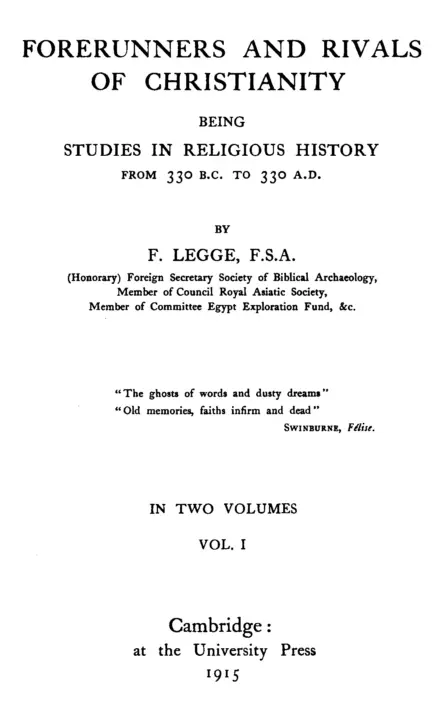
THE CLASSIC COLLECTION · 1915
"Forerunners and Rivals of Christianity: Being Studies in Religious History" by F. Legge is a scholarly historical account likely written in the early 20th century. The book explores documents crucial for understanding the origins and developments of Christianity, highlighting lesser-known religious movements and texts. Its focus is on the interplay between early Christianity and its contemporaries, including various Gnostic sects and Eastern religions. The opening of the work introduces the author's intent to compile and elucidate documents that, while previously translated, remain obscure and misunderstood in contemporary discourse. Legge expresses his desire to foster a clearer understanding of these religious fragments by providing context and commentary, which he believes will clarify their significance. He acknowledges the challenges presented by historical interpretations and notes his efforts to make these texts accessible to both scholars and the general public. Through his methodical approach, he aims to shed light on the diverse influences that shaped early Christianity.
Introduction adapted from the source catalogue; source summaries may be automatically generated.
Free to read · English · 99,528 words · No account needed
MAKE TIME FOR A GOOD BOOK
On by default. Untick to stop anonymous reading totals. Each page counts after 10 seconds in view. How this works.
Anonymous counting is on unless you have switched it off.
As Foucart, Culte de Dionysos, p. 34, n. 3, has pointed out, this cannot refer to the Titanic part of man, which he was enjoined by the Orphics to mortify as far as possible. There is something to be said for M. Foucart’s view that the dead is here shown as another Osiris, son of the earth-god Geb and the sky-goddess Nut. It is curious that this last is always portrayed on Egyptian monuments with a star-spangled body, while I know of no Greek representation of Uranos which connects him with the stars.
Footnote 407:
“Of good counsel.” A name of Dionysos, as appears from the Orphic Hymns given later in this chapter.
Footnote 408:
A name of Demeter, Persephone, and some other Chthonian goddesses. See Aristophanes, Thesmophoriazusae, l. 286. It probably means merely “mistress.”
Footnote 409:
It has been suggested that this is a figure for the initiated dead receiving all that they wish. It should be noted, however, that in the Zoroastrian religion the flood of molten metal which is to burn the wicked is to feel to the faithful like warm milk. So N. Söderblom, La Vie Future d’après la Mazdéisme, Paris, 1901, p. 266, quoting the Dinkard and the Bundahish. The phrase is discussed by M. Salomon Reinach in Revue Archéol. 1901, II. pp. 202-213, and Cultes, Mythes et Religions, Paris, 1909, t. II. pp. 123-134. M. Alline, in Xenia, Athens, 1912, connects it with the supposed Orphic idea that blessed souls inhabit the Milky Way.
Footnote 410:
Perhaps not directly. There is some reason for thinking that the soul of the true Orphic was supposed to pass through the intermediate stages of hero and demon: see Hild, Étude sur les Démons, Paris, 1881, p. 144, where the subject is excellently treated. Cf. Pindar, Threnoi, Frag. X. 4, p. 98, Cod. Bö. The deification of the dead was also a Pythagorean doctrine, as appears in the Aurea Carmina, ll. 70, 71, ed. Gaisford.
Footnote 411:
This is the suggestion of Foucart, Myst. d’Él. p. 72. That the Egyptian dead was supposed to become one with Osiris himself is an idea that appears as early as the Pyramid Texts, cf. Maspero, Les Pyramides de Saqqarah, passim, where the dead kings are each in turn hailed as “this Osiris.”
Footnote 412:
Buddhism, for instance, which can hardly have reached the West before the death of Onomacritos.
Footnote 413:
As in the Pistis Sophia, where Jesus says to his disciples, “Know ye not that ye are all gods ...”, p. 247 (Copt.).
Footnote 414:
For Damascius, Quaest. de primis principiis, see Abel’s Orphica, Frag. 48. Cf. as to Rhapsodists, Maury, Rel. de la Grèce, I. pp. 240, 345, 346.
Footnote 415:
See Maury, op. cit. II. pp. 370 sqq.
Footnote 416:
Maury, op. cit. II. p. 374.
Footnote 417:
Your reading position is saved on this browser. Take it to another device with a library code. Reading pages adapt to text, rather than matching a printed edition.
BEHIND THE BOOK
This eBook is for the use of anyone anywhere in the United States and most other parts of the world at no cost and with almost no restrictions whatsoever. You may copy it, give it away or re-use it under the terms of the Project Gutenberg License included with this eBook or online at www.gutenberg.org. If you are not located in the United States, you will have to check the laws of the country where you are located before using this eBook. Read the source licence.
The original source file, including credits and licence, is retained by this library. Request an original-format copy at no charge. Please include the book title and Project Gutenberg identifier #71384.
KEEP YOUR CURIOSITY GOING
David Patterson (Spirit) Hatch

David Patterson (Spirit) Hatch

David Patterson (Spirit) Hatch
Cécile Tormay

Moritz Busch
John L. Ransom