
Last letters from the living dead man
David Patterson (Spirit) Hatch
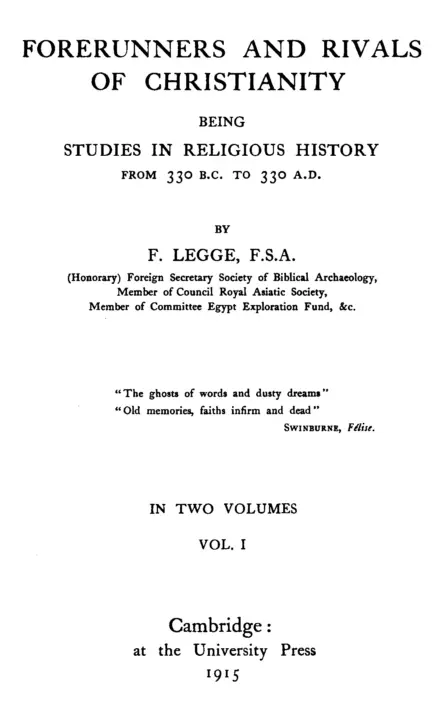
THE CLASSIC COLLECTION · 1915
"Forerunners and Rivals of Christianity: Being Studies in Religious History" by F. Legge is a scholarly historical account likely written in the early 20th century. The book explores documents crucial for understanding the origins and developments of Christianity, highlighting lesser-known religious movements and texts. Its focus is on the interplay between early Christianity and its contemporaries, including various Gnostic sects and Eastern religions. The opening of the work introduces the author's intent to compile and elucidate documents that, while previously translated, remain obscure and misunderstood in contemporary discourse. Legge expresses his desire to foster a clearer understanding of these religious fragments by providing context and commentary, which he believes will clarify their significance. He acknowledges the challenges presented by historical interpretations and notes his efforts to make these texts accessible to both scholars and the general public. Through his methodical approach, he aims to shed light on the diverse influences that shaped early Christianity.
Introduction adapted from the source catalogue; source summaries may be automatically generated.
Free to read · English · 99,528 words · No account needed
MAKE TIME FOR A GOOD BOOK
On by default. Untick to stop anonymous reading totals. Each page counts after 10 seconds in view. How this works.
Anonymous counting is on unless you have switched it off.
So Ramsay, Cities and Bishoprics of Phrygia, Oxford, 1895, I. p. 92, says that “the essential idea” of the mysteries was that all the gods there worshipped were but different forms of the one. In the “Greek Worship of Serapis and Isis,” I have endeavoured to show how this idea was elaborated in the cult of the Alexandrian divinities.
Footnote 182:
Homer, Iliad, XXI. 462 (translation by Lang, Leaf and Myers).
Footnote 183:
Cf. Penelope’s speech on the jealousy of the gods, Odyssey, XXIII.
208.
Footnote 184:
Sayce, Religions of Ancient Egypt and Babylonia (Gifford Lectures), Edin. 1902, p. 201; Naville, The Old Egyptian Faith, pp. 308, 309; Maspero, Ét. Égyptol. I. p. 163 and II. p. 277.
Footnote 185:
Apuleius, Met. Bk XI. c. 15.
Footnote 186:
Ibid. c. 25.
Footnote 187:
Aristides, in Serapid. p. 89.
Footnote 188:
Ibid. loc. cit.
Footnote 189:
Ibid. p. 90.
Footnote 190:
Ibid. p. 97.
Footnote 191:
Ibid. loc. cit.
Footnote 192:
Ibid. p. 100.
Footnote 193:
Odyssey, XI. 491 sqq. (Butcher and Lang’s translation).
Footnote 194:
Pindar, Threnoi, Frag. X. p. 102, Cod. Bö.
Footnote 195:
Sophocles, Triptolemus (Plutarch, de Audiendis Poetis, 21 F),
Frag. 348 of Didot.
Footnote 196:
Homeric Hymn to Demeter, ll. 480 sqq. So an inscription on the statue of a hierophant quoted by M. Foucart, Myst. d’El. p. 55, says that death to the initiated is not an evil but a good.
Footnote 197:
Apuleius, Met. Bk XI. c. 6.
Footnote 198:
Aristides, in Serapid. p. 93.
Footnote 199:
Ibid. p. 95.
Footnote 200:
Ibid. p. 96.
Footnote 201:
Maspero says (“Les Hypogées Royaux de Thebes,” Ét. Égyptol. II. p. 178) that “if ever there were in Pharaonic Egypt mysteries and initiates, as there were in Greece and Greek Egypt,” it was in the time of decay evidenced by the rare books preserved in the tombs of the kings of the XXth and later Dynasties. Later, ibid. p. 180, he says that they must have been confined to a very small class. Cf. ibid. p. 278.
Footnote 202:
E.g. the mystic marriage of Zeus or Dionysos with Demeter, which according to Hippolytus, Philosophumena, Bk V. c. 1, § 8, p. 171, Cruice, and Clement of Alexandria, Protrept. c. II., formed the crowning scene of the Eleusinian Mysteries. At Dendera, the corresponding union of Osiris and Isis, from which, according to M. Foucart, the Eleusinian legend was derived, was depicted in the most realistic way on the temple walls. See Mariette, Dendérah, Paris, 1875, t. IV. pl. 65 sqq., or Budge, G.E. pp. 132-137.
Footnote 203:
Apuleius, Met. Bk XI. c. 21, queis tamen tuto possint magna religionis committi silentia, numen deae soleat elicere.
Footnote 204:
Ibid. cc. 22, 23.
Footnote 205:
Op. cit. end of c. 23.
Footnote 206:
Perhaps this is the meaning of the formula said by Clement of Alexandria, Protrept. c. II., to be repeated by the initiates at Eleusis: “I have fasted ... I have drunk of the cyceon ... I have entered into the chest (παστός).”
Footnote 207:
Apuleius, Met. c. 24.
Footnote 208:
Your reading position is saved on this browser. Take it to another device with a library code. Reading pages adapt to text, rather than matching a printed edition.
BEHIND THE BOOK
This eBook is for the use of anyone anywhere in the United States and most other parts of the world at no cost and with almost no restrictions whatsoever. You may copy it, give it away or re-use it under the terms of the Project Gutenberg License included with this eBook or online at www.gutenberg.org. If you are not located in the United States, you will have to check the laws of the country where you are located before using this eBook. Read the source licence.
The original source file, including credits and licence, is retained by this library. Request an original-format copy at no charge. Please include the book title and Project Gutenberg identifier #71384.
KEEP YOUR CURIOSITY GOING
David Patterson (Spirit) Hatch

David Patterson (Spirit) Hatch

David Patterson (Spirit) Hatch
Cécile Tormay

Moritz Busch
John L. Ransom