
Last letters from the living dead man
David Patterson (Spirit) Hatch
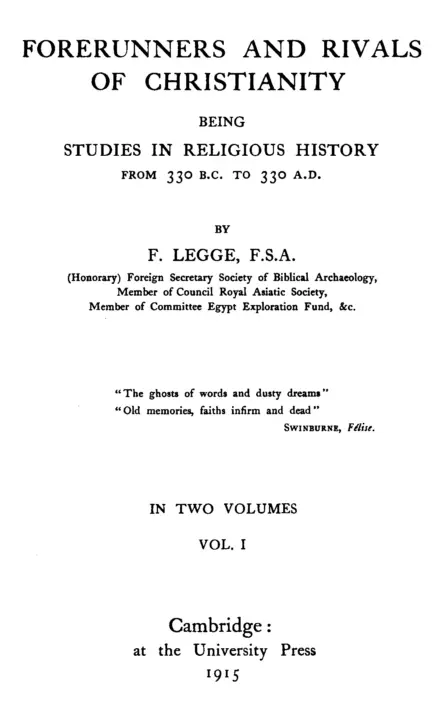
THE CLASSIC COLLECTION · 1915
"Forerunners and Rivals of Christianity: Being Studies in Religious History" by F. Legge is a scholarly historical account likely written in the early 20th century. The book explores documents crucial for understanding the origins and developments of Christianity, highlighting lesser-known religious movements and texts. Its focus is on the interplay between early Christianity and its contemporaries, including various Gnostic sects and Eastern religions. The opening of the work introduces the author's intent to compile and elucidate documents that, while previously translated, remain obscure and misunderstood in contemporary discourse. Legge expresses his desire to foster a clearer understanding of these religious fragments by providing context and commentary, which he believes will clarify their significance. He acknowledges the challenges presented by historical interpretations and notes his efforts to make these texts accessible to both scholars and the general public. Through his methodical approach, he aims to shed light on the diverse influences that shaped early Christianity.
Introduction adapted from the source catalogue; source summaries may be automatically generated.
Free to read · English · 99,528 words · No account needed
MAKE TIME FOR A GOOD BOOK
On by default. Untick to stop anonymous reading totals. Each page counts after 10 seconds in view. How this works.
Anonymous counting is on unless you have switched it off.
Macrobius, Saturn. Bk I. c. 7.
Footnote 162:
Foucart, Les Associations Religieuses, p. 207, Inscr. 24; C.I.G. No. 120. The tablet is now in the British Museum.
Footnote 163:
Lafaye, Culte, etc. p. 35; Pausanias, Bk I. c. 18, 4.
Footnote 164:
Lafaye, op. cit. pp. 35-388; id. Dictionnaire des Antiquités of Daremberg and Saglio, s.v. Isis; Drexler in Roscher’s Lexikon der Mythologie, s.v. Isis, esp. p. 379.
Footnote 165:
Lafaye, op. cit. p. 40; C.I.L. I. 577.
Footnote 166:
Lafaye, see last note.
Footnote 167:
Lafaye, op. cit. pp. 44 sqq.
Footnote 168:
Lafaye, op. cit. pp. 44-47. For the story of Marcus Volusius see Appian, de Bello Civili, Bk IV. c. 6, § 47.
Footnote 169:
Tibullus, Elegiacs, I. iii. 23; ibid. I. vii. 27; Ovid, Am. II. xiii. 7; id. op. cit. II. xiv. The story of the expulsion is told by Josephus, Antiquities, XVIII. c. 3. Cf. Lafaye, op. cit. chap. III passim.
Footnote 170:
Comicor. Graecor. Fragmenta of Didot, pp. 517 and 629, and Lafaye,
op. cit. p. 31.
Footnote 171:
Lafaye, op. et loc. cit. and especially p. 62.
Footnote 172:
So Parisotti, Ricerche sul culto de Iside e Serapide, Roma, 1888, p. 52 sqq.; and Dill, Nero to Marcus, pp. 564, 565: “The history of the Isiac cult at Rome from Sulla to Nero is really the history of a great popular religious movement....”
Footnote 173:
See Chapter I, supra, pp. 12, 14. Cf. Droysen, op. cit. II. p.
471.
Footnote 174:
Macrobius, Saturn. Bk I. c. 20. Bouché-Leclercq (R.H.R. 1902, t. XLVI. p. 19, n. 1) says these lines are a forgery of late date. Krall, Tacitus, etc. Th. I, Bk iv., is of the contrary opinion. Nicocreon of Cyprus was certainly a contemporary of Ptolemy Soter, and helped him against Perdiccas.
Footnote 175:
Clem. Alex. Strom. Bk V. c. 14. So Ælius Aristides, in Serapidem, p. 91 (Dindorf), says that Serapis “is present in all things and fills the universe.”
Footnote 176:
Lafaye, Culte, etc., pp. 306, 307, 324, 325, for examples. Cf. Inscription from Kios in Bithynia given by Robiou in Mélanges Graux, Paris, 1884, pp. 601, 602; Parisotti, op. cit. p. 55.
Footnote 177:
Theocritus, Idyll, XV.; Damascius, Vit. Isidor. 106; Socrates, Hist. Eccl. Bk III. c. 23. In Le Culte d’Adonis-Thammuz, Paris, 1901 (pp. 51-54, 69, 109), M. Ch. Vellay has shown the fusion in early Christian times of the legends of Adonis, Atys and Osiris.
Footnote 178:
Frazer, Golden Bough, Part IV, p. 357 and n. 1; cf. Stephen of Byzantium, s.v. Ἀμαθοῦς; Döllinger, Jud. und Heid. I. p. 145; Decharme in Daremberg and Saglio, s.v. Cybele for authorities.
Footnote 179:
Julian, ad Reg. Sol. Orat. IV. cc. 135, 136; Eusebius, Praep. Ev. Bk III. c. 15; Kenyon, Greek Papyri in British Museum, 1893, p. 65; Wessely, Griechische Zauberpapyri von Paris, etc., Wien, 1888, pp. 61 sqq.; Leemans, Papyri Graeci Mus. Ant. Pub. Lugduni-Batavi, Leyden, 1885, II. pp. 26, 27; Parthey, Zwei griech. Zauberpapyri, Berlin, 1866, p. 127.
Footnote 180:
Apuleius, Metamorphoses, Bk XI. c. 5.
Footnote 181:
Your reading position is saved on this browser. Take it to another device with a library code. Reading pages adapt to text, rather than matching a printed edition.
BEHIND THE BOOK
This eBook is for the use of anyone anywhere in the United States and most other parts of the world at no cost and with almost no restrictions whatsoever. You may copy it, give it away or re-use it under the terms of the Project Gutenberg License included with this eBook or online at www.gutenberg.org. If you are not located in the United States, you will have to check the laws of the country where you are located before using this eBook. Read the source licence.
The original source file, including credits and licence, is retained by this library. Request an original-format copy at no charge. Please include the book title and Project Gutenberg identifier #71384.
KEEP YOUR CURIOSITY GOING
David Patterson (Spirit) Hatch

David Patterson (Spirit) Hatch

David Patterson (Spirit) Hatch
Cécile Tormay

Moritz Busch
John L. Ransom