
Last letters from the living dead man
David Patterson (Spirit) Hatch
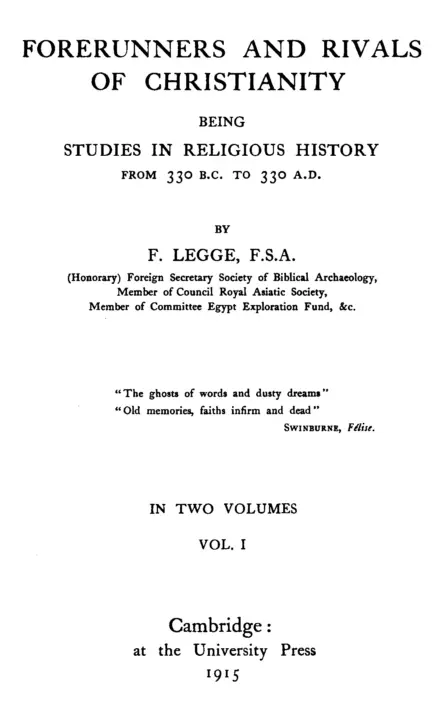
THE CLASSIC COLLECTION · 1915
"Forerunners and Rivals of Christianity: Being Studies in Religious History" by F. Legge is a scholarly historical account likely written in the early 20th century. The book explores documents crucial for understanding the origins and developments of Christianity, highlighting lesser-known religious movements and texts. Its focus is on the interplay between early Christianity and its contemporaries, including various Gnostic sects and Eastern religions. The opening of the work introduces the author's intent to compile and elucidate documents that, while previously translated, remain obscure and misunderstood in contemporary discourse. Legge expresses his desire to foster a clearer understanding of these religious fragments by providing context and commentary, which he believes will clarify their significance. He acknowledges the challenges presented by historical interpretations and notes his efforts to make these texts accessible to both scholars and the general public. Through his methodical approach, he aims to shed light on the diverse influences that shaped early Christianity.
Introduction adapted from the source catalogue; source summaries may be automatically generated.
Free to read · English · 99,528 words · No account needed
MAKE TIME FOR A GOOD BOOK
On by default. Untick to stop anonymous reading totals. Each page counts after 10 seconds in view. How this works.
Anonymous counting is on unless you have switched it off.
See last note.
Footnote 209:
Ra was always the material sun; while Horus was probably in ancient times the god of the sky: Maspero, Ét. Égyptol. t. II. p. 229. With the Middle Empire the emblem of Ra began to be added to that of Horus as the “crest” of the Pharaoh’s cognizance, showing that the king was himself regarded as the representative of a composite divinity, Horus-Ra. Cf. “Titles of Thinite Kings,” P.S.B.A. 1908, p. 89.
Footnote 210:
Proclus, in Timaeum Platonia, I. 30 D. (Schneidewin).
Footnote 211:
Minucius Felix, Octavius, c. XXI.; Arnobius, adv. Gentes, Bk I. c. 36; Athenagoras, Presbeia, c. XXII. Cf. also Griffith and Thompson, Stories of High Priests of Memphis, pp. 107, 121; Maspero, Ét. Égyptol. II. p. 246, and especially p. 361; P.S.B.A. 1914, pp. 92, 93.
Footnote 212:
Apuleius, Met. Bk XI. c. 27.
Footnote 213:
Op. cit. c. 28.
Footnote 214:
Ælius Aristides (in Serapid. p. 88) refuses to discuss this; but Athenagoras (see note 5 p. 63, supra) says that when the members of the body of Osiris were found, they were presented to Isis with the remark that they were the fruits of the vine Dionysus and that Semele was the vine itself. But see p. 65, infra. Plutarch, de Is. et Os. c. LXXIX. says that “the priests of these days,” meaning, as is evident from the context, the priests of the Alexandrian divinities, “try to conceal” the fact that Osiris rules over the dead. The old religion of Egypt never did; but perhaps this, too, was part of the secret teaching of the Alexandrian Mysteries.
Footnote 215:
Maspero, Ét. Égyptol. II. pp. 254-255, 361, 446; P.S.B.A. 1914, p.
92.
Footnote 216:
Apuleius, Met. c. 27.
Footnote 217:
“Osiris-Bacchus” in Ägypt. Zeitschr. 1878, p. 106.
Footnote 218:
Unless we suppose that the statue was one of those used in the mysteries, see note 3 p. 64, supra. Plutarch, however, in his address to Klea makes no secret of the identification. See de Is. et Os. c. XXXV.
Footnote 219:
Plato, Phaedr. in Abel’s Orphica, Fragm. 228. Olympiodorus says that the verse comes from Orpheus.
Footnote 220:
Dyer, Gods in Greece, p. 209. He thinks the crowd sometimes numbered 30,000, relying upon the story in Herodotus, Bk VIII. c. 65, of the Spartan who before the battle of Marathon heard the Iacchos-song sung “as if by 30,000 persons.” Cf. Foucart, Les Gds. Myst. p. 136.
Footnote 221:
Moret, Le Culte Divin Journalier en Égypte, Paris, 1902, p. 9.
Footnote 222:
Apuleius, Met. c. 20. Lafaye, Culte, etc. p. 136, gives the “trousseau” of a statue of Isis found in Spain including earrings, necklaces, etc.
Footnote 223:
See the scene in the Herculaneum fresco described on p. 68, infra.
Footnote 224:
Your reading position is saved on this browser. Take it to another device with a library code. Reading pages adapt to text, rather than matching a printed edition.
BEHIND THE BOOK
This eBook is for the use of anyone anywhere in the United States and most other parts of the world at no cost and with almost no restrictions whatsoever. You may copy it, give it away or re-use it under the terms of the Project Gutenberg License included with this eBook or online at www.gutenberg.org. If you are not located in the United States, you will have to check the laws of the country where you are located before using this eBook. Read the source licence.
The original source file, including credits and licence, is retained by this library. Request an original-format copy at no charge. Please include the book title and Project Gutenberg identifier #71384.
KEEP YOUR CURIOSITY GOING
David Patterson (Spirit) Hatch

David Patterson (Spirit) Hatch

David Patterson (Spirit) Hatch
Cécile Tormay

Moritz Busch
John L. Ransom