
Last letters from the living dead man
David Patterson (Spirit) Hatch
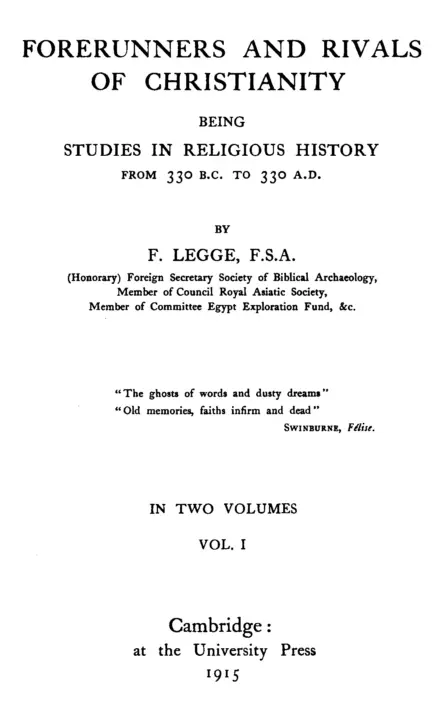
THE CLASSIC COLLECTION · 1915
"Forerunners and Rivals of Christianity: Being Studies in Religious History" by F. Legge is a scholarly historical account likely written in the early 20th century. The book explores documents crucial for understanding the origins and developments of Christianity, highlighting lesser-known religious movements and texts. Its focus is on the interplay between early Christianity and its contemporaries, including various Gnostic sects and Eastern religions. The opening of the work introduces the author's intent to compile and elucidate documents that, while previously translated, remain obscure and misunderstood in contemporary discourse. Legge expresses his desire to foster a clearer understanding of these religious fragments by providing context and commentary, which he believes will clarify their significance. He acknowledges the challenges presented by historical interpretations and notes his efforts to make these texts accessible to both scholars and the general public. Through his methodical approach, he aims to shed light on the diverse influences that shaped early Christianity.
Introduction adapted from the source catalogue; source summaries may be automatically generated.
Free to read · English · 99,528 words · No account needed
MAKE TIME FOR A GOOD BOOK
On by default. Untick to stop anonymous reading totals. Each page counts after 10 seconds in view. How this works.
Anonymous counting is on unless you have switched it off.
As in the Orphic verse: “Zeus is a male, Zeus is an immortal virgin,” Abel, Orphica, Fr. 46. Hatch, Hibbert Lectures, p. 140, points out that Xenocrates and the Stoics both made the same assertion. Cf. authorities quoted by him and Euripides, Bacchae, ll. 330-350. A statue from Smyrna showing a markedly effeminate type of Dionysos is to be seen at the Ashmolean Museum.
Footnote 153:
Macrobius, Saturnalia, lib. I. c. 18, for authorities; also Pindar, Threnoi, X. 8, p. 116 (Bergk); Plutarch, On the E at Delphi, c. IX.
Footnote 154:
Lafaye, Culte des Divinités d’Alexandrie, Paris, 1884, pp. 6-12, and authorities there quoted. Cf. Foucart, Culte de Dion. pp. 66, 67.
Footnote 155:
So Plutarch and Tacitus where before quoted. The conflicting traditions on the subject have been reconciled by Krall, Tacitus und der Orient, Th. I. Bd iv. 83, 84. Cf. Bouché-Leclercq, Hist. de la Divination, t. III. p. 378, n. 1; id. Hist. de Lagides, t. I. p. 118; Lafaye, Culte, etc. pp. 16, 17. There is little doubt that the statue of Bryaxis represented Asklepios as Bouché-Leclercq (Rev. Hist. Rel. 1902, pp. 26, 27) surmises. Isidore Lévy sums up the whole question in the Revue last quoted, 1911, pp. 146, 147, and 1913, pp. 308 sqq. So Ad. Reinach, Rev. cit. pt 2, p. 69. The statue is described by Rufinus Aquilensis, Hist. Eccl. Bk II. c. 23. Cf. Dionysius, Periegetes, ll. 254, 256 (Didot, Geogr. Gr. mi. t. II. p. 116); Amelung, Rev. Archéol., 1903, pt 2, pp. 187-204.
Footnote 156:
Probably it had some reference to his character as god of vegetation, as shown by his epithet of “Frugifer.” The explanation of Macrobius, Saturnalia, I. c. 20, which refers it to the sun, is absurd. Perhaps it may be connected with his epithet of πολυδέγμων “receiver of many.” So Æl. Aristides speaks of him as the receiver of souls. See p. 60 infra.
Footnote 157:
See last note. The eagle was adopted as a kind of family crest by the Ptolemies and appears on all their coins. See examples in Mahaffy, Emp. of the Ptolemies, passim. What is probably a reproduction of Bryaxis’ statue is now at Naples and is described by Lafaye, op. cit. p. 274.
Footnote 158:
See Lafaye, pp. 259, 260. Except in amulets, representations of Harpocrates are not very common. Cf. P.S.B.A. 1914, p. 92.
Footnote 159:
Maury in Revue des Deux Mondes, Sept. 1855, p. 1073; Mariette, Le Sérapeum de Memphis, ed. Maspero, Paris, 1882, I. pp. 114, 115, 124.
Footnote 160:
Bouché-Leclercq, Hist. des Lagides, I. pp. 232, 233. Cf. Mahaffy, Empire of Ptolemies, pp. 204 sqq. The Egyptianizing tendencies of the later Ptolemies shown by the decrees of the priests on the Rosetta and Canopus Stones were first pointed out by Revillout in the Revue Archéologique, 1877, pp. 331 sqq. A new decree of the same kind under Epiphanes has been published by M. Daressy, Recueil de Travaux etc., 1911, pp. 1 sqq.
Footnote 161:
Your reading position is saved on this browser. Take it to another device with a library code. Reading pages adapt to text, rather than matching a printed edition.
BEHIND THE BOOK
This eBook is for the use of anyone anywhere in the United States and most other parts of the world at no cost and with almost no restrictions whatsoever. You may copy it, give it away or re-use it under the terms of the Project Gutenberg License included with this eBook or online at www.gutenberg.org. If you are not located in the United States, you will have to check the laws of the country where you are located before using this eBook. Read the source licence.
The original source file, including credits and licence, is retained by this library. Request an original-format copy at no charge. Please include the book title and Project Gutenberg identifier #71384.
KEEP YOUR CURIOSITY GOING
David Patterson (Spirit) Hatch

David Patterson (Spirit) Hatch

David Patterson (Spirit) Hatch
Cécile Tormay

Moritz Busch
John L. Ransom