
Last letters from the living dead man
David Patterson (Spirit) Hatch
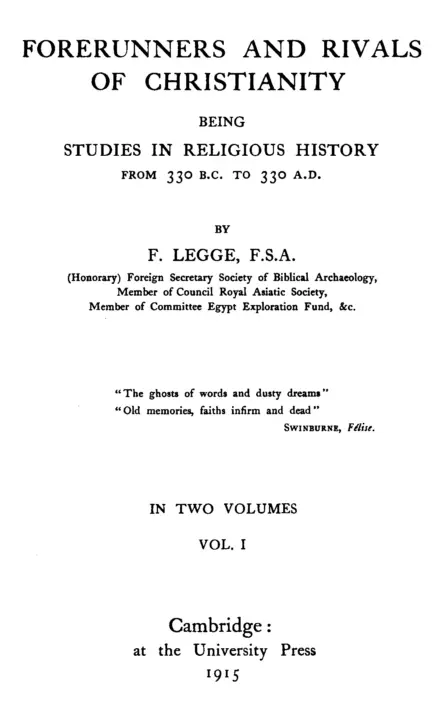
THE CLASSIC COLLECTION · 1915
"Forerunners and Rivals of Christianity: Being Studies in Religious History" by F. Legge is a scholarly historical account likely written in the early 20th century. The book explores documents crucial for understanding the origins and developments of Christianity, highlighting lesser-known religious movements and texts. Its focus is on the interplay between early Christianity and its contemporaries, including various Gnostic sects and Eastern religions. The opening of the work introduces the author's intent to compile and elucidate documents that, while previously translated, remain obscure and misunderstood in contemporary discourse. Legge expresses his desire to foster a clearer understanding of these religious fragments by providing context and commentary, which he believes will clarify their significance. He acknowledges the challenges presented by historical interpretations and notes his efforts to make these texts accessible to both scholars and the general public. Through his methodical approach, he aims to shed light on the diverse influences that shaped early Christianity.
Introduction adapted from the source catalogue; source summaries may be automatically generated.
Free to read · English · 99,528 words · No account needed
MAKE TIME FOR A GOOD BOOK
On by default. Untick to stop anonymous reading totals. Each page counts after 10 seconds in view. How this works.
Anonymous counting is on unless you have switched it off.
Maspero, “La Fille du Prince de Bakhtan” in Contes Populaires de l’Ancienne Égypte, Paris, p. 159.
Footnote 55:
Pater, Plato and Platonism, 1901, pp. 85, 86.
Footnote 56:
Aristotle, Metaphysica, Bk XI. c. 6.
Footnote 57:
Xenophon, Memorabilia, Bk I. c. 1, § 1-5.
Footnote 58:
Plutarch, Alexander, c. VII.
Footnote 59:
So F. H. Woods, The Hope of Israel, Edinburgh, 1896, p. 205, where he speaks of the religion of the Prophets and Psalmists, as “giving, on the whole, by far the most perfect and, as compared with other ancient literature, practically a unique example of monotheism.” Yet as Winwood Reade points out, Solomon must have thought there were other gods than Yahweh, because he worshipped other gods; op. cit. supra, p. 201.
Footnote 60:
Aristotle, Politica, Bk I. c. 2, § 7. Cf. Max Müller, Religions of India (Hibbert Lectures), 1880, p. 292.
Footnote 61:
Arrian, op. cit. Bk VI. c. 27.
Footnote 62:
See his repudiation of the night attack advised at Arbela: οὐ κλέπτω τὴν νίκην, “I steal no victory!” Plutarch, Alexander, c. XXXI.
Footnote 63:
Plutarch, op. cit. c. XXI. and c. XXX.
Footnote 64:
The wry neck or, in Mr Hogarth’s words, “the famous inclination of his beautiful head towards the left shoulder” was imitated by dandies as late as the time of Severus. For authorities see Hogarth, Philip and Alexander of Macedon, 1897, p. 278, n. 2.
Footnote 65:
Droysen, op. cit. I. p. 218 and p. 479, n. 1. Major P. H. Sykes lately found an inscription in Khorassan to Sulayman Shah who reigned from 1667-1694 A.D. containing the words “His audience-chamber is the Sun; his Army the Stars; his authority is like Alexander’s,” Journal of the Royal Asiatic Society, 1910, pp. 1152, 1153.
Footnote 66:
Bouché-Leclercq, Hist. des Lagides, Paris, t. I. p. 130, n. 2, points out that there was hardly a philosopher during the next three centuries who did not write a treatise Περὶ τῆς βασιλείας.
Footnote 67:
A parallel movement seems to have taken place in Babylonia, where all the gods were at one period identified with Marduk or Merodach. See Pinches, “Religious Ideas of the Babylonians,” Transactions of the Victoria Institute, 1893, p. 10.
Footnote 68:
Maury, Histoire des Religions de la Grèce Antique, Paris, 1857, III.
p. 73.
Footnote 69:
Demosthenes, v. Midias, p. 53; Herodotus, Bk VII. c. 189. Such gods were called by the peculiar epithet of πυθόχρηστοι. See inscription from Smyrna quoted by Rayet, Revue Archéologique, 1877, pp. 115-128.
Footnote 70:
Xenophon, Hellenica, Bk II. c. 4.
Footnote 71:
Plutarch, Alcibiades, c. CXVIII. Cf. Aristophanes, Lysistrata, ll.
387 sqq.
Footnote 72:
Homeric Hymn to Demeter, passim.
Footnote 73:
Herodotus, Bk II. c. 50.
Footnote 74:
Droysen, op. cit. I. p. 698.
Footnote 75:
Your reading position is saved on this browser. Take it to another device with a library code. Reading pages adapt to text, rather than matching a printed edition.
BEHIND THE BOOK
This eBook is for the use of anyone anywhere in the United States and most other parts of the world at no cost and with almost no restrictions whatsoever. You may copy it, give it away or re-use it under the terms of the Project Gutenberg License included with this eBook or online at www.gutenberg.org. If you are not located in the United States, you will have to check the laws of the country where you are located before using this eBook. Read the source licence.
The original source file, including credits and licence, is retained by this library. Request an original-format copy at no charge. Please include the book title and Project Gutenberg identifier #71384.
KEEP YOUR CURIOSITY GOING
David Patterson (Spirit) Hatch

David Patterson (Spirit) Hatch

David Patterson (Spirit) Hatch
Cécile Tormay

Moritz Busch
John L. Ransom