
Last letters from the living dead man
David Patterson (Spirit) Hatch
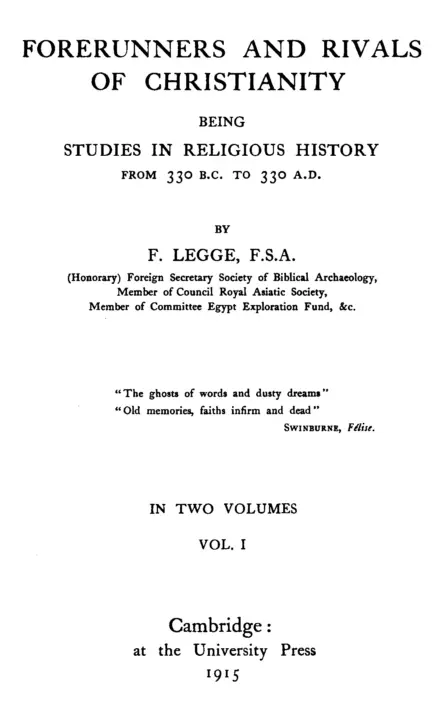
THE CLASSIC COLLECTION · 1915
"Forerunners and Rivals of Christianity: Being Studies in Religious History" by F. Legge is a scholarly historical account likely written in the early 20th century. The book explores documents crucial for understanding the origins and developments of Christianity, highlighting lesser-known religious movements and texts. Its focus is on the interplay between early Christianity and its contemporaries, including various Gnostic sects and Eastern religions. The opening of the work introduces the author's intent to compile and elucidate documents that, while previously translated, remain obscure and misunderstood in contemporary discourse. Legge expresses his desire to foster a clearer understanding of these religious fragments by providing context and commentary, which he believes will clarify their significance. He acknowledges the challenges presented by historical interpretations and notes his efforts to make these texts accessible to both scholars and the general public. Through his methodical approach, he aims to shed light on the diverse influences that shaped early Christianity.
Introduction adapted from the source catalogue; source summaries may be automatically generated.
Free to read · English · 99,528 words · No account needed
MAKE TIME FOR A GOOD BOOK
On by default. Untick to stop anonymous reading totals. Each page counts after 10 seconds in view. How this works.
Anonymous counting is on unless you have switched it off.
See Maury, Rel. de la Grèce, t. III. cc. 15, 16. Aristophanes, Horae fragment 1 of Didot, and Aves, l. 874, is practically the earliest witness for their introduction into Athens. Cf. the Scholiast upon the last passage quoted, for their identification with Greek deities. M. Paul Foucart, Les Associations Religieuses chez les Grecs, Paris, 1873, pp. 57 and 85, shows the great rush of foreign gods into Attica after the Persian War and the mode in which their worship was propagated.
Footnote 76:
Percy Gardner, Catalogue of Coins, etc., passim. Goblet d’Alviella, Ce que l’Inde doit à la Grèce, Paris, 1897, p. 73, notes that these coins reproduce “the usual type of the classical divinities Hercules, Dionysos, Poseidon, Helios, Pallas, Artemis, Niké.”
Footnote 77:
Droysen, op. cit. III. p. 73.
Footnote 78:
Callisthenes appears to have used this argument against the deification of Alexander during his lifetime, Arrian, Anabasis, Bk IV. c. 11. Cf. Budge, Pseudo Callisthenes’ History of Alexander the Great, Cambridge, 1889, Bk III. c. 19, p. 135; Plutarch, Pelopidas, c. XVI.
Footnote 79:
Droysen, op. cit. I. p. 668.
Footnote 80:
Maspero, “Comment Alexandre devenait Dieu.” Annuaire de l’École des Hautes Études, Paris, 1897; id. Ét. Égyptol. t. VI. pp. 286 sqq.
Footnote 81:
Mr Hogarth, Philip and Alexander, pp. 197 sqq., rightly points out that he never instituted any cult of himself, as did Demetrius Poliorcetes.
Footnote 82:
Plutarch, Alexander, c. XXVIII.; Arrian, Anabasis, Bk VII. c. 29.
Footnote 83:
Plutarch, de Is. et Os. c. XXIV.; id. Apophthegmata Antigon. 7. Cf. Droysen, op. cit. II. p. 295. Mr Tarn in his Antigonos Gonatas, Oxford, 1913, p. 251, would transfer the story to his grandson, but his reasoning is not convincing.
Footnote 84:
Athenaeus, Deipnosoph. Bk VI. c. 62.
Footnote 85:
Droysen, op. cit. III. p. 22 and note 2.
Footnote 86:
Euhemerus’ work was one of the first Greek books to be translated into Latin. See Cicero, De Nat. Deor. c. 42.
Footnote 87:
Droysen, op. cit. III. p. 341, n. 3. Rhys Davids, Buddhist India, 1903, p. 298, thinks it possible that the missions although duly recorded on stone were never sent.
Footnote 88:
See Chapter II infra.
Footnote 89:
Foucart, Les Associations Religieuses, etc., pp. 66-84. Cf. Maury, Rel. de la Grèce, II. p. 427. The composition of hymns was peculiarly the care of these associations; Foucart, op. cit. p. 114.
Footnote 90:
Foucart, op. cit. p. 85.
Footnote 91:
Franz Cumont, “Hypsistos,” Revue de l’Instruction publique en Belgique, 1897, pp. 5-6; id. Les Religions Orientales dans le Paganisme Romain, Paris, 1906, p. 155 and note.
Footnote 92:
Foucart, Ass. Rel. pp. 135, 136, 158.
Footnote 93:
See Chapter IV infra.
Footnote 94:
Plutarch, Alexander, c. II.
Footnote 95:
See Foucart, op. cit. p. 158, for the cases of Ninos and Theoris, priestesses who were condemned for such traffic.
Footnote 96:
Plutarch, Pythian Responses, c. XXV.
Footnote 97:
Lucian, Alexander or Pseudomantis, passim. The story is well summarized by Sir Samuel Dill, in Nero to Marcus, pp. 473 sqq.
Footnote 98:
Your reading position is saved on this browser. Take it to another device with a library code. Reading pages adapt to text, rather than matching a printed edition.
BEHIND THE BOOK
This eBook is for the use of anyone anywhere in the United States and most other parts of the world at no cost and with almost no restrictions whatsoever. You may copy it, give it away or re-use it under the terms of the Project Gutenberg License included with this eBook or online at www.gutenberg.org. If you are not located in the United States, you will have to check the laws of the country where you are located before using this eBook. Read the source licence.
The original source file, including credits and licence, is retained by this library. Request an original-format copy at no charge. Please include the book title and Project Gutenberg identifier #71384.
KEEP YOUR CURIOSITY GOING
David Patterson (Spirit) Hatch

David Patterson (Spirit) Hatch

David Patterson (Spirit) Hatch
Cécile Tormay

Moritz Busch
John L. Ransom