
Last letters from the living dead man
David Patterson (Spirit) Hatch
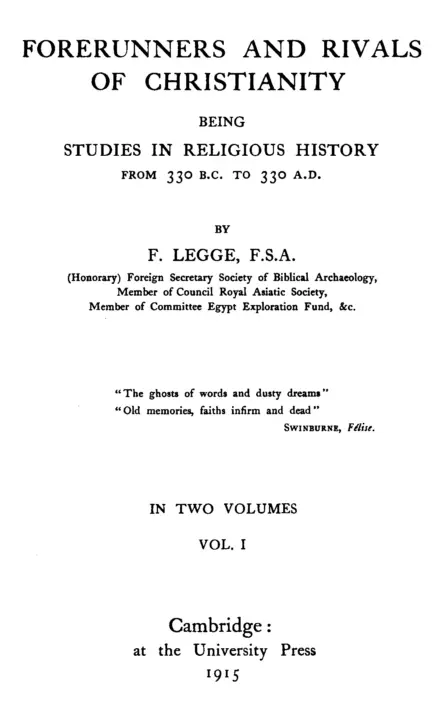
THE CLASSIC COLLECTION · 1915
"Forerunners and Rivals of Christianity: Being Studies in Religious History" by F. Legge is a scholarly historical account likely written in the early 20th century. The book explores documents crucial for understanding the origins and developments of Christianity, highlighting lesser-known religious movements and texts. Its focus is on the interplay between early Christianity and its contemporaries, including various Gnostic sects and Eastern religions. The opening of the work introduces the author's intent to compile and elucidate documents that, while previously translated, remain obscure and misunderstood in contemporary discourse. Legge expresses his desire to foster a clearer understanding of these religious fragments by providing context and commentary, which he believes will clarify their significance. He acknowledges the challenges presented by historical interpretations and notes his efforts to make these texts accessible to both scholars and the general public. Through his methodical approach, he aims to shed light on the diverse influences that shaped early Christianity.
Introduction adapted from the source catalogue; source summaries may be automatically generated.
Free to read · English · 99,528 words · No account needed
MAKE TIME FOR A GOOD BOOK
On by default. Untick to stop anonymous reading totals. Each page counts after 10 seconds in view. How this works.
Anonymous counting is on unless you have switched it off.
Khojend was probably Alexandria eschata or the furthest (East). Samarcand, of which the ancient name was Maracanda, is said by Baber to be a foundation of Alexander’s. Herat was Alexandria Ariana, and Merv probably Alexandria Margiana, while Cabul seems to have been Ortospana. Among the other Alexandrias which have retained their old importance are Alexandria Arachosiana or Candahar, Alexandria Caucasiana or Begram, and Alexandria Sogdiana or Hyderabad. See J. W. McCrindle, Invasion of India by Alexander the Great, 1896, pp. 36 sqq., and Droysen, Histoire de l’Hellénisme, (French edition), Paris, 1883, I. pp. 408 sqq.
Footnote 41:
Droysen, op. cit. p. 481.
Footnote 42:
See last note. The second marriage is dramatically described by Droysen, op. cit. I. pp. 638, 639. Cf. Arrian, Anabasis, Bk VII. c. 4; Plutarch, Alexander, c. LXX.
Footnote 43:
Arrian, op. cit. Bk VII. c. 6; Plutarch, Alexander, c. LXXI. Cf. Droysen, op. cit. I. p. 646.
Footnote 44:
Droysen, op. cit. I. p. 660. It was probably the fear of this mixture that caused the quarrel between him and his Macedonians at Opis. See Arrian, op. cit. Bk VII. c. 8; Plutarch, Alexander, c. LXXI.
Footnote 45:
Droysen, op. cit. II. p. 34. Mahaffy, Alexander’s Empire, 1887, p. 38, thinks that the Romans could never have withstood Alexander’s cavalry and siege artillery, although he notes that Livy patriotically decided otherwise.
Footnote 46:
Droysen, op. cit. I., pp. 186, 240, 333. There were 30,000 Greek mercenaries fighting on the side of Darius at Issus, and 4000 of these remained faithful till his death. Ibid. I. p. 368.
Footnote 47:
Plutarch, Themistocles, c. XXVI.
Footnote 48:
Plutarch, Crassus, c. XXXIII. The play acted was the Bacchae, and a Greek tragic actor, one Jason of Tralles, had been imported for the principal part. In the essay De Alex. fortitudine, I. c. 5, Plutarch says that no sooner had Alexander subdued Asia than Homer became a favourite reading-book, and Persian, Susianan, and Gedrosian boys learned to chant the tragedies of Sophocles and Euripides.
Footnote 49:
Droysen, op. cit. III. pp. 244, 255.
Footnote 50:
Sylvain Lévi, “Bouddhisme et les Grecs,” Revue de l’Histoire des Religions, 1891, p. 2; Percy Gardner, Catalogue of Bactrian and Indian Coins in British Museum. Arts other than the plastic also received attention. Amitrochates, son of the famous Chandragupta or Sandracottus, wrote to Antiochus (Soter?) to buy him some sweet wine, dried figs, and a sophist. He received the other commodities, but was told that it was not lawful to sell sophists in Greece. See Athenaeus, Deipnosophistae, Bk XIV. c. 67 quoting Hegesander.
Footnote 51:
Droysen, op. cit. III. p. 66. Cf. the Omnis Oriens loquitur of St Jerome Prol. ad Epist. ad Galatas; and Deissmann, New Light on the New Testament (English edition), 1907, p. 30.
Footnote 52:
1 Kings xx. 23.
Footnote 53:
1 Sam. iv. 6, 7.
Footnote 54:
Your reading position is saved on this browser. Take it to another device with a library code. Reading pages adapt to text, rather than matching a printed edition.
BEHIND THE BOOK
This eBook is for the use of anyone anywhere in the United States and most other parts of the world at no cost and with almost no restrictions whatsoever. You may copy it, give it away or re-use it under the terms of the Project Gutenberg License included with this eBook or online at www.gutenberg.org. If you are not located in the United States, you will have to check the laws of the country where you are located before using this eBook. Read the source licence.
The original source file, including credits and licence, is retained by this library. Request an original-format copy at no charge. Please include the book title and Project Gutenberg identifier #71384.
KEEP YOUR CURIOSITY GOING
David Patterson (Spirit) Hatch

David Patterson (Spirit) Hatch

David Patterson (Spirit) Hatch
Cécile Tormay

Moritz Busch
John L. Ransom