
Last letters from the living dead man
David Patterson (Spirit) Hatch
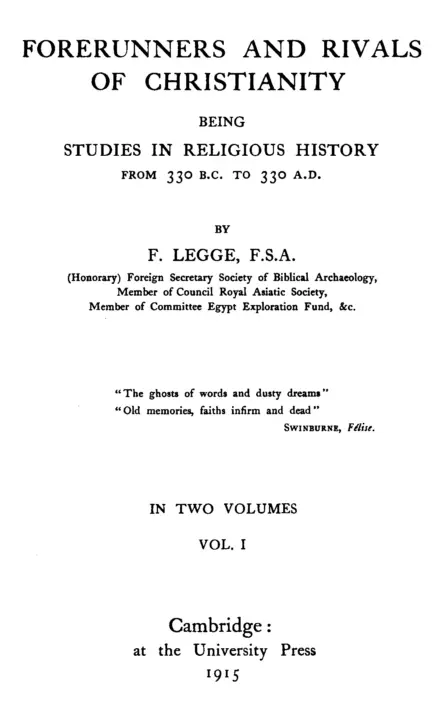
THE CLASSIC COLLECTION · 1915
"Forerunners and Rivals of Christianity: Being Studies in Religious History" by F. Legge is a scholarly historical account likely written in the early 20th century. The book explores documents crucial for understanding the origins and developments of Christianity, highlighting lesser-known religious movements and texts. Its focus is on the interplay between early Christianity and its contemporaries, including various Gnostic sects and Eastern religions. The opening of the work introduces the author's intent to compile and elucidate documents that, while previously translated, remain obscure and misunderstood in contemporary discourse. Legge expresses his desire to foster a clearer understanding of these religious fragments by providing context and commentary, which he believes will clarify their significance. He acknowledges the challenges presented by historical interpretations and notes his efforts to make these texts accessible to both scholars and the general public. Through his methodical approach, he aims to shed light on the diverse influences that shaped early Christianity.
Introduction adapted from the source catalogue; source summaries may be automatically generated.
Free to read · English · 99,528 words · No account needed
MAKE TIME FOR A GOOD BOOK
On by default. Untick to stop anonymous reading totals. Each page counts after 10 seconds in view. How this works.
Anonymous counting is on unless you have switched it off.
Footnote 30:
Such as the Arimaspi or one-eyed inhabitants of Russia, about whom Herodotus (Bk III. c. 116) quotes the legend that they stole gold from its griffin guardians, and those myrmeces or great ants whom Megasthenes (Strabo, Bk XV. c. 1, § 44) and other writers describe as digging for gold on the Thibetan frontier—a story of which more than one rationalistic explanation has been suggested.
Footnote 31:
Rawlinson’s Herodotus (1862 edition), II. p. 462 for authorities.
Footnote 32:
Maspero, Histoire ancienne des Peuples de l’Orient, Paris, 1904, p. 706. Rawlinson, op. cit. p. 463, thinks this practice lapsed early, but Xenophon seems clear that it was in force in his time (Cyropaedia, Bk VIII. c. 6).
Footnote 33:
He was probably allowed a reasonable sum for the maintenance of his court and government; but if he exceeded this, was liable to severe punishment. This appears from the execution by Alexander, on his return from India, of the satraps who had been guilty of extortion. He seems to have purposely preserved the Persian laws and customs on this point unaltered.
Footnote 34:
This is the opinion of Rawlinson, op. cit. pp. 460 sqq.
Footnote 35:
Rawlinson, op. cit. p. 464; Winwood Reade, Martyrdom of Man, 1910, p. 56; Sayce, Ancient Empires of the East, 1884, pp. 250, 251; Maspero, op. cit. p. 721.
Footnote 36:
Oppert, Le Peuple et la Langue des Mèdes, Paris, pp. 17 sqq.; Maspero, op. cit. p. 559, n. 11.
Footnote 37:
Sir Thomas Holdich, in his excellent book The Gates of India (p. 104), says that when he defeated the Aspasians or Yusufzai in the Kuner Valley he sent the pick of their cattle back to Macedonia to improve the native breed. Arrian, Anabasis, Bk IV. c. 25, however, in quoting the story from Ptolemy, says only that Alexander “wished to send them” to till the soil. It seems impossible that they could have survived the journey before the days of steamships. Still more incredible is the story in Plutarch, Life of Alexander, c. L. that when Alexander was at Prophthasia (probably Farrah in Seistan), he received some grapes grown on the coast of Greece. But such stories, although coloured by age, may serve to show how perfect his communications were always thought to have been.
Footnote 38:
Holdich, op. cit. passim, says that he must have had information from Persian sources, and that his route must have been laid beforehand. Sir Thomas’ opinion, as that of a soldier as well as a student, is entitled to much respect. Yet the instances of Genghiz Khan and other Oriental invaders are perhaps against any such necessity.
Footnote 39:
Freeman, Historical Essays, 1873, second series, pp. 192, 193.
Footnote 40:
Your reading position is saved on this browser. Take it to another device with a library code. Reading pages adapt to text, rather than matching a printed edition.
BEHIND THE BOOK
This eBook is for the use of anyone anywhere in the United States and most other parts of the world at no cost and with almost no restrictions whatsoever. You may copy it, give it away or re-use it under the terms of the Project Gutenberg License included with this eBook or online at www.gutenberg.org. If you are not located in the United States, you will have to check the laws of the country where you are located before using this eBook. Read the source licence.
The original source file, including credits and licence, is retained by this library. Request an original-format copy at no charge. Please include the book title and Project Gutenberg identifier #71384.
KEEP YOUR CURIOSITY GOING
David Patterson (Spirit) Hatch

David Patterson (Spirit) Hatch

David Patterson (Spirit) Hatch
Cécile Tormay

Moritz Busch
John L. Ransom