THE CLASSIC COLLECTION✦An outlaw’s diary: the CommuneCLASSIC FREE BOOKS
An outlaw’s diary: the Commune
Cécile Tormay
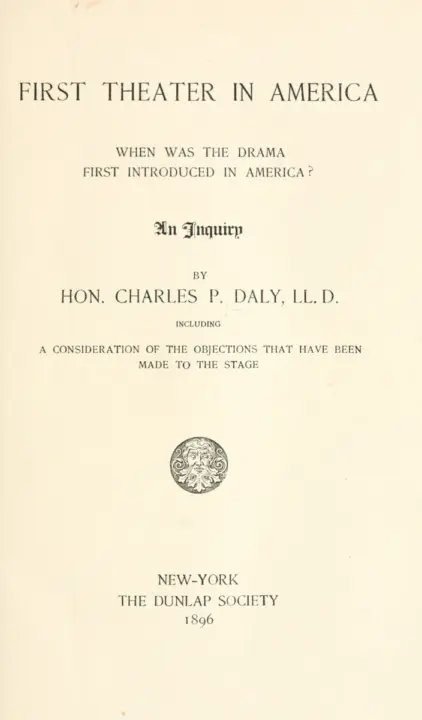
THE CLASSIC COLLECTION · 1896
"First Theater in America" by Charles P. Daly is a historical account written in the late 19th century. The work investigates the origins of drama in the United States, particularly focusing on the establishment of theaters and performances in the colonial period. It discusses significant figures and events, aiming to unravel the often-misunderstood timeline of theatrical developments in early America. The opening of this work presents Daly's introduction to the topic, detailing his initial research that sparked his inquiry into the history of theater in America. He recounts an early debate about the introduction of drama, acknowledging the contributions of notable figures like William Hallam, who is often credited with leading the first theatrical company to America. As Daly dives into archival newspaper references from the colonial period, he begins to illuminate evidence of theatrical performances that predate Hallam's arrival. Throughout this opening section, Daly lays the groundwork for a comprehensive exploration of the dramatic arts’ evolution in America, setting up a detailed chronicle of significant events, plays, and individuals involved in the establishment of the American stage.
Introduction adapted from the source catalogue; source summaries may be automatically generated.
Free to read · English · 30,704 words · No account needed
MAKE TIME FOR A GOOD BOOK
On by default. Untick to stop anonymous reading totals. Each page counts after 10 seconds in view. How this works.
Anonymous counting is on unless you have switched it off.
“One moment, madam,” said Mr. Effingham; “I am really dying with curiosity to know you. ’Tis very rude to say so, of course--but I am acquainted with every lady in the neighborhood, and I do not recall any former occasion upon which I had the pleasure--”
“It is very easily explained, sir,” the young girl said.
“Madam!”
“I do not live in the neighborhood.”
“Ah! no?”
“And I am not a lady, sir. Does not that explain it?”
Mr. Effingham scarcely believed his ears. These astounding words were uttered with such perfect calmness that there was no possible room to suppose that they were meant for a jest.
“You are surprised, sir,” the young girl said quite simply and gravely.
“Upon my word, madam,--never have I,--really--”
“Your surprise will not last long, sir.”
“How, madam?”
“Do you ever visit the town of Williamsburg?”
“Frequently.”
“Well, sir, I think you will see me again. Now I must continue my way, having returned my sincere thanks for your kindness.”
With which words, uttered in that wondrous voice of immovable calmness, the young girl again inclined her head, touched her white horse with the whip, and slowly rode out of sight.
The young man continued his journey to Riverhead; arrived there, and after an animated conversation with the two attractive young ladies, he encountered the father, a fine, portly old gentleman, who met him.
“Good morning, glad to see you.”
Effingham bowed and said:
“The morning was so fine that I thought I could not spend it more agreeably than in a ride to Riverhead, sir.”
“Delightful! These August days are excellent for the corn; what news?”
“Nothing, sir. I have not seen the ‘Gazette.’”
“Oh, the ‘Gazette’ never contains any intelligence; sometimes, it is true, we hear what is going on in Parliament, but it never condescends to afford us any news from Virginia. The tobacco on the south side may be all gone to the devil for anything you read in the ‘Gazette.’ Here it is--an abominable sheet! Ah, I see we are to have a theatrical performance in Williamsburg next week,” added the old gentleman, on glancing over the paper. “Mr. Hallam and his Virginia company of comedians--very politic that addition of Virginia--are to perform ‘The Merchant of Venice,’ by permission of his worship, the Mayor, at the old theater near the capital, he announces. Truly we are improving, really becoming civilized, in this barbarous terra incognita.”
Your reading position is saved on this browser. Take it to another device with a library code. Reading pages adapt to text, rather than matching a printed edition.
BEHIND THE BOOK
This eBook is for the use of anyone anywhere in the United States and most other parts of the world at no cost and with almost no restrictions whatsoever. You may copy it, give it away or re-use it under the terms of the Project Gutenberg License included with this eBook or online at www.gutenberg.org. If you are not located in the United States, you will have to check the laws of the country where you are located before using this eBook. Read the source licence.
The original source file, including credits and licence, is retained by this library. Request an original-format copy at no charge. Please include the book title and Project Gutenberg identifier #67716.
KEEP YOUR CURIOSITY GOING
Cécile Tormay

Moritz Busch
John L. Ransom
Frances Wright
Cécile Tormay

Mabel Potter Daggett