THE CLASSIC COLLECTION✦An outlaw’s diary: the CommuneCLASSIC FREE BOOKS
An outlaw’s diary: the Commune
Cécile Tormay
THE CLASSIC COLLECTION · 1896
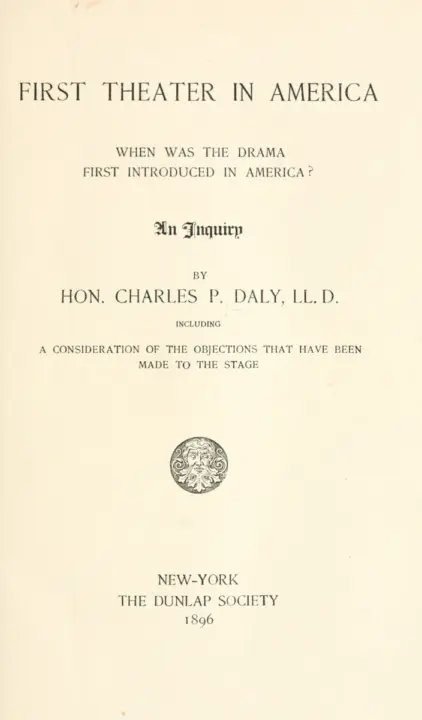
"First Theater in America" by Charles P. Daly is a historical account written in the late 19th century. The work investigates the origins of drama in the United States, particularly focusing on the establishment of theaters and performances in the colonial period. It discusses significant figures and events, aiming to unravel the often-misunderstood timeline of theatrical developments in early America. The opening of this work presents Daly's introduction to the topic, detailing his initial research that sparked his inquiry into the history of theater in America. He recounts an early debate about the introduction of drama, acknowledging the contributions of notable figures like William Hallam, who is often credited with leading the first theatrical company to America. As Daly dives into archival newspaper references from the colonial period, he begins to illuminate evidence of theatrical performances that predate Hallam's arrival. Throughout this opening section, Daly lays the groundwork for a comprehensive exploration of the dramatic arts’ evolution in America, setting up a detailed chronicle of significant events, plays, and individuals involved in the establishment of the American stage.
Introduction adapted from the source catalogue; source summaries may be automatically generated.
Free to read · English · 30,704 words · No account needed
MAKE TIME FOR A GOOD BOOK
On by default. Untick to stop anonymous reading totals. Each page counts after 10 seconds in view. How this works.
Anonymous counting is on unless you have switched it off.
The rider was a young girl about eighteen, and of rare and extraordinary beauty. Her hair--so much of it as was visible beneath her hood--seemed to be dark chestnut, and her complexion was dazzling. The eyes were large, full, and dark--instinct with fire and softness, feminine modesty and collected firmness, the firmness, however, predominating. But the lips were different. They were the lips of a child--soft, guileless, tender, and confiding; they were purity and innocence itself, and seemed to say that however much the brain might become hard and worldly, the heart of this young woman never could be other than the tender and delicately sensitive heart of a child.
She was clad in a riding-dress of pearl color, and from the uniformity of this tint, it seemed to be a favorite with her. The hood was of silk, and the delicately gloved hand held a little ivory-handled riding-whip, which now dangled at her side. The other gloved hand supported her cheek; and in this position the unknown lady calmly awaited Mr. Effingham’s approach still nearer, though he was already near touching her.
Mr. Effingham took off his hat and bowed with elegant courtesy. The lady returned the inclination by a graceful movement of the head.
“Would you be kind enough to point out the road to the town of Williamsburg, sir?” she said, in a calm and clear voice.
“With great pleasure, madam,” replied Mr. Effingham. “You have lost
your way?”
“Yes, sir, and very strangely; and as evening drew on I was afraid of
being benighted.”
“You have but to follow the road until you reach Effingham Hall, madam,” he said,--“the house in the distance yonder; then turn to the left, and you are in the highway to town.”
“Thanks, sir,” the young girl said, with another calm inclination of her head, and she touched her horse with the whip.
“But cannot I accompany you?” asked Mr. Effingham, whose curiosity was greatly aroused, and found his eyes, he knew not why, riveted to the rare beauty of his companion’s face; “do you not need me as a guide?”
“Indeed, I think not, sir,” she said, with the same calmness. “Your direction is very plain, and I am accustomed to ride by myself.”
“But, really,” began Mr. Effingham, somewhat piqued, “I know it is intrusive--I know I have not the honor--”
She interrupted him with her immovable calmness.
“You would say you do not know me, and that your offer is intrusive. I believe, sir, I do not consider it so--it is very kind; but I am not a fearful girl, and need not trouble you at all.”
And so bowed.
Your reading position is saved on this browser. Take it to another device with a library code. Reading pages adapt to text, rather than matching a printed edition.
BEHIND THE BOOK
This eBook is for the use of anyone anywhere in the United States and most other parts of the world at no cost and with almost no restrictions whatsoever. You may copy it, give it away or re-use it under the terms of the Project Gutenberg License included with this eBook or online at www.gutenberg.org. If you are not located in the United States, you will have to check the laws of the country where you are located before using this eBook. Read the source licence.
The original source file, including credits and licence, is retained by this library. Request an original-format copy at no charge. Please include the book title and Project Gutenberg identifier #67716.
KEEP YOUR CURIOSITY GOING
Cécile Tormay

Moritz Busch
John L. Ransom
Frances Wright
Cécile Tormay

Mabel Potter Daggett