THE CLASSIC COLLECTION✦An outlaw’s diary: the CommuneCLASSIC FREE BOOKS
An outlaw’s diary: the Commune
Cécile Tormay
THE CLASSIC COLLECTION · 1896
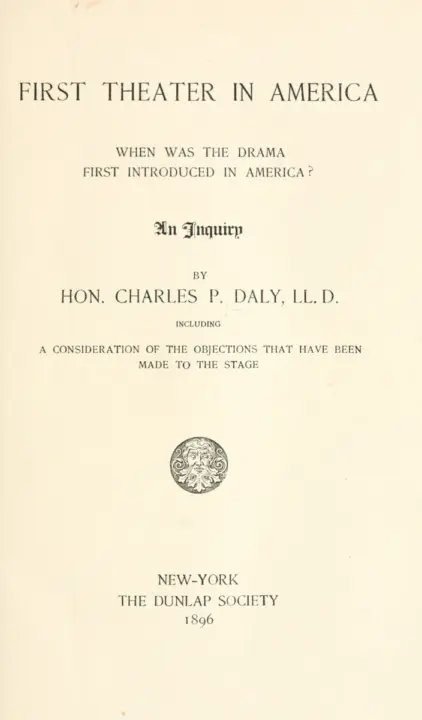
"First Theater in America" by Charles P. Daly is a historical account written in the late 19th century. The work investigates the origins of drama in the United States, particularly focusing on the establishment of theaters and performances in the colonial period. It discusses significant figures and events, aiming to unravel the often-misunderstood timeline of theatrical developments in early America. The opening of this work presents Daly's introduction to the topic, detailing his initial research that sparked his inquiry into the history of theater in America. He recounts an early debate about the introduction of drama, acknowledging the contributions of notable figures like William Hallam, who is often credited with leading the first theatrical company to America. As Daly dives into archival newspaper references from the colonial period, he begins to illuminate evidence of theatrical performances that predate Hallam's arrival. Throughout this opening section, Daly lays the groundwork for a comprehensive exploration of the dramatic arts’ evolution in America, setting up a detailed chronicle of significant events, plays, and individuals involved in the establishment of the American stage.
Introduction adapted from the source catalogue; source summaries may be automatically generated.
Free to read · English · 30,704 words · No account needed
MAKE TIME FOR A GOOD BOOK
On by default. Untick to stop anonymous reading totals. Each page counts after 10 seconds in view. How this works.
Anonymous counting is on unless you have switched it off.
Mr. Effingham winced; he had more than once expressed a similar opinion of Virginia in good faith, not ironically, and the good old gentleman’s words seemed directed to himself. A moment’s reflection, however, persuaded him that this could not be the case; He had not visited Riverhead a dozen times since his arrival from Oxford and London, and on these occasions he never touched upon the subject of Virginia and its dreadful deficiencies.
“A play,” he said; “that is really good news; but the ‘Merchant of Venice,’ that is not one of my acquaintances.”
“Ah! you young men are wrong in giving up Will. Shakespeare for the Steeles, Addisons, and Vanbrughs. Mr. Addison’s essays are very pleasant and entertaining reading, and surely there never was a finer gentleman than Sir Roger; but in the drama Will. Shakespeare distances him all to nothing.”
“Let us go to the play,” said Henrietta.
“Oh, yes,” said Clara.
The old gentleman tenderly smoothed the bright golden hair.
“Certainly, if you wish it,” he said.
“And may I request permission to accompany the party, ladies,” said Mr. Effingham, languidly.
“How modest,” said Henrietta, laughing; “certainly you may go, sir. You will tell us when to hiss or applaud, you know, as you are just from London.”
“What a quick tongue she has,” said Mr. Lee, fondly; well, we will all go, and see what the Virginia company of comedians is like; not much I fear.”
At the appointed day the young man appears at Mr. Lee’s mansion and the young ladies come down to meet him, the elder, Henrietta, being described as “radiant in a dress of surpassing elegance--flowered satin, yellow lace, jewels, powdered hair, with pendants and rich furbelows,--the bright beauty of her laughing face assorting well with her flashing and glittering costume,” while the costume of the younger sister was more subdued, as her manner was more quiet.
A lively conversation follows, the subject of which ends with an inquiry on the part of the young man to the elder sister.
“Do you anticipate much pleasure?” referring to the play, to which the
other replies:
“Oh, it will be delightful.” Then to the younger, “And you, Cousin Clara, do you think that these Virginia Comedians, as they call themselves, will afford you a very pleasant entertainment?”
“Oh, yes--I am sure I shall be pleased--you know I have never seen a
play.”
“But read a plenty?”
“Oh, yes; and I like the ‘Merchant of Venice.’ The character of Portia is so delicate and noble.”
“Quite true; an excellent criticism; better than anything in Congreve I think, though I should hesitate to advance such an opinion in London.”
Your reading position is saved on this browser. Take it to another device with a library code. Reading pages adapt to text, rather than matching a printed edition.
BEHIND THE BOOK
This eBook is for the use of anyone anywhere in the United States and most other parts of the world at no cost and with almost no restrictions whatsoever. You may copy it, give it away or re-use it under the terms of the Project Gutenberg License included with this eBook or online at www.gutenberg.org. If you are not located in the United States, you will have to check the laws of the country where you are located before using this eBook. Read the source licence.
The original source file, including credits and licence, is retained by this library. Request an original-format copy at no charge. Please include the book title and Project Gutenberg identifier #67716.
KEEP YOUR CURIOSITY GOING
Cécile Tormay

Moritz Busch
John L. Ransom
Frances Wright
Cécile Tormay

Mabel Potter Daggett