The Principles of Biology, Volume 2 (of 2)
Herbert Spencer
THE CLASSIC COLLECTION · 1860
"First Principles" by Herbert Spencer is a philosophical treatise written in the mid-19th century. The work is part of a larger series that aims to establish a systematic understanding of philosophy grounded in science, religion, and human experience. It explores the interplay between religion and science, seeking to reconcile their seemingly opposing views on existence and knowledge, and discusses the underlying truths present across various belief systems. The opening of the treatise introduces the ambitious scope of Spencer’s work, as he presents a framework for his philosophical inquiry. He begins with a discussion on the nature of human beliefs, suggesting that even widely-held misconceptions may contain elements of truth. By analyzing the historical perspectives on authority and governance, Spencer underscores the evolution of political thought from divine kingship to modern democratic ideals. He proposes that there is a common thread among all religions and philosophies — the acknowledgment of fundamental truths concerning existence that are often obscured by dogma. Thus, the groundwork is laid for his exploration of "the unknowable" and the "laws of the knowable," setting the stage for a deeper analysis of both the limitations and possibilities of human understanding.
Introduction adapted from the source catalogue; source summaries may be automatically generated.
Free to read · English · 166,659 words · No account needed
MAKE TIME FOR A GOOD BOOK
On by default. Untick to stop anonymous reading totals. Each page counts after 10 seconds in view. How this works.
Anonymous counting is on unless you have switched it off.
How the degree of absolute frequency of a relation affects the recognition of its uniformity, we see in contrasting certain biological facts. Death and disease are near akin in most of their relations to us; while in respect of complexity, conspicuousness, and the directness with which they personally concern us, diseases in general may be put pretty nearly on a level with each other. But there are great differences in the times at which the natural sequences they severally exhibit are recognized as such. The connexion between death and bodily injury, constantly displayed not only in men but in all inferior creatures, was known as an established uniformity while yet diseases were thought supernatural. Among diseases themselves, it is observable that comparatively unusual ones were regarded as of demoniacal origin during ages when the more frequent were ascribed to ordinary causes: a truth paralleled indeed among our own peasantry, who by the use of charms show a lingering superstition with respect to rare disorders, which they do not show with respect to common ones, such as colds. Passing to physical illustrations, we may note that within the historic period, whirlpools were accounted for by the agency of water-spirits; but we do not find that within the same period the disappearance of water on exposure either to the sun or to artificial heat was interpreted in an analogous way: though a much more marvellous occurrence, and a much more complex one, its great frequency led to the early establishment of it as a natural uniformity. Rainbows and comets do not differ greatly in conspicuousness, and a rainbow is intrinsically the more involved phenomenon; but chiefly because of their far greater commonness, rainbows were perceived to have a direct dependence on sun and rain while yet comets were regarded as supernatural appearances.
That races living inland must long have remained ignorant of the daily and monthly sequences of the tides, and that intertropical races could not early have comprehended the phenomena of northern winters, are extreme illustrations of the influence which relative frequency has on the recognition of uniformities. Animals which, where they are indigenous, call forth no surprise by their structure or habits, because these are so familiar, when taken to a part of the earth where they have never been seen, are looked at with an astonishment approaching to awe—are even thought supernatural: a fact which will suggest numerous others that show how the localization of phenomena, in part controls the order in which they are reduced to law. Not only however does their localization in space affect the progression, but also their localization in time. Facts which are rarely if ever manifested during one era, are rendered very frequent in another, simply through the changes wrought by civilization. The lever, of which the properties are illustrated in the use of sticks and weapons, is vaguely understood by every savage—on applying it in a certain way he rightly anticipates certain effects; but the action of the equally simple wedge, which is not commonly displayed till tool-making has made some progress, is less early generalized; while the wheel and axle, pulley, and screw, cannot have their powers either empirically or rationally known till the advance of the arts has more or less familiarized them. Through those various means of exploration which we have inherited and are ever increasing, we have become acquainted with a vast range of chemical relations that were relatively non-existent to the primitive man: to highly developed industries we owe both the substances and the apparatus that have disclosed to us countless uniformities which our ancestors had no opportunity of seeing, and therefore could not recognize. These and sundry like instances that will occur to the reader, show that the accumulated materials, and processes, and appliances, and products, which characterize the environments of complex societies, greatly increase the accessibility of various classes of relations; and by so multiplying the experiences of them, or making them relatively frequent, facilitate their generalization. To which add, that various classes of phenomena presented by society itself, as for instance those which political economy formulates, become relatively frequent and therefore recognizable in advanced social states; while in less advanced ones they are too rarely displayed to have their relations perceived, or, as in the least advanced ones, are not displayed at all.
Your reading position is saved on this browser. Take it to another device with a library code. Reading pages adapt to text, rather than matching a printed edition.
Herbert Spencer
Herbert Spencer
Herbert Spencer
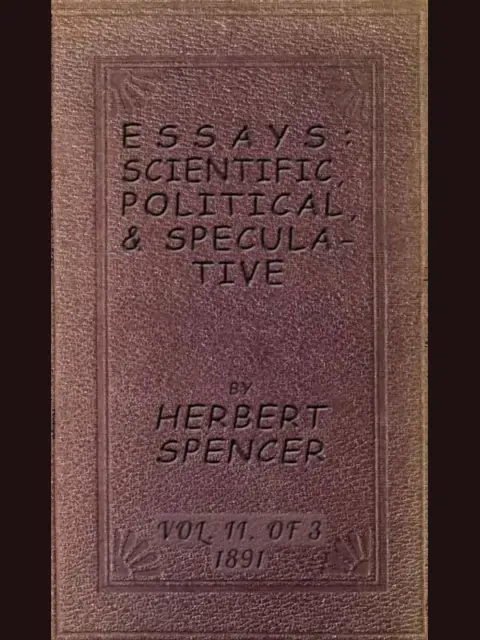
Herbert Spencer
BEHIND THE BOOK
This eBook is for the use of anyone anywhere in the United States and most other parts of the world at no cost and with almost no restrictions whatsoever. You may copy it, give it away or re-use it under the terms of the Project Gutenberg License included with this eBook or online at www.gutenberg.org. If you are not located in the United States, you will have to check the laws of the country where you are located before using this eBook. Read the source licence.
The original source file, including credits and licence, is retained by this library. Request an original-format copy at no charge. Please include the book title and Project Gutenberg identifier #55046.
KEEP YOUR CURIOSITY GOING

David Patterson (Spirit) Hatch

David Patterson (Spirit) Hatch

David Patterson (Spirit) Hatch
Coulson Kernahan

Ralph Waldo Emerson
Frances Wright