The Principles of Biology, Volume 2 (of 2)
Herbert Spencer
THE CLASSIC COLLECTION · 1860
"First Principles" by Herbert Spencer is a philosophical treatise written in the mid-19th century. The work is part of a larger series that aims to establish a systematic understanding of philosophy grounded in science, religion, and human experience. It explores the interplay between religion and science, seeking to reconcile their seemingly opposing views on existence and knowledge, and discusses the underlying truths present across various belief systems. The opening of the treatise introduces the ambitious scope of Spencer’s work, as he presents a framework for his philosophical inquiry. He begins with a discussion on the nature of human beliefs, suggesting that even widely-held misconceptions may contain elements of truth. By analyzing the historical perspectives on authority and governance, Spencer underscores the evolution of political thought from divine kingship to modern democratic ideals. He proposes that there is a common thread among all religions and philosophies — the acknowledgment of fundamental truths concerning existence that are often obscured by dogma. Thus, the groundwork is laid for his exploration of "the unknowable" and the "laws of the knowable," setting the stage for a deeper analysis of both the limitations and possibilities of human understanding.
Introduction adapted from the source catalogue; source summaries may be automatically generated.
Free to read · English · 166,659 words · No account needed
MAKE TIME FOR A GOOD BOOK
On by default. Untick to stop anonymous reading totals. Each page counts after 10 seconds in view. How this works.
Anonymous counting is on unless you have switched it off.
§ 93. When the pennant of a vessel lying becalmed first shows the coming breeze, it does so by gentle undulations that travel from its fixed to its free end. Presently the sails begin to flap; and their blows against the mast increase in rapidity as the breeze rises. Even when, being fully bellied out, they are in great part steadied by the strain of the yards and cordage, their free edges tremble with each stronger gust. And should there come a gale, the jar that is felt on laying hold of the shrouds shows that the rigging vibrates; while the rush and whistle of the wind prove that in it, also, rapid undulations are generated. Ashore the conflict between the current of air and the things it meets results in a like rhythmical action. The leaves all shiver in the blast; each branch oscillates; and every exposed tree sways to and fro. The blades of grass and dried bents in the meadows, and still better the stalks in the neighbouring corn-fields, exhibit the same rising and falling movement. Nor do the more stable objects fail to do the like, though in a less manifest fashion; as witness the shudder that may be felt throughout a house during the paroxysms of a violent storm. Streams of water produce in opposing objects the same general effects as do streams of air. Submerged weeds growing in the middle of a brook, undulate from end to end. Branches brought down by the last flood, and left entangled at the bottom where the current is rapid, are thrown into a state of up and down movement that is slow or quick in proportion as they are large or small; and where, as in great rivers like the Mississippi, whole trees are thus held, the name “sawyers,” by which they are locally known, sufficiently describes the rhythm produced in them. Note again the effect of the antagonism between the current and its channel. In shallow places, where the action of the bottom on the water flowing over it is visible, we see a ripple produced—a series of undulations. And if we study the action and re-action going on between the moving fluid and its banks, we still find the principle illustrated, though in a different way. For in every rivulet, as in the mapped-out course of every great river, the bends of the stream from side to side throughout its tortuous course constitute a lateral undulation—an undulation so inevitable that even an artificially straightened channel is eventually changed into a serpentine one. Analogous phenomena may be observed where the water is stationary and the solid matter moving. A stick drawn laterally through the water with much force, proves by the throb which it communicates to the hand that it is in a state of vibration. Even where the moving body is massive, it only requires that great force should be applied to get a sensible effect of like kind: instance the screw of a screw-steamer, which instead of a smooth rotation falls into a rapid rhythm that sends a tremor through the whole vessel. The sound which results when a bow is drawn over a violin-string, shows us vibrations produced by the movement of a solid over a solid. In lathes and planing machines, the attempt to take off a thick shaving causes a violent jar of the whole apparatus, and the production of a series of waves on the iron or wood that is cut. Every boy in scraping his slate-pencil finds it scarcely possible to help making a ridged surface. If you roll a ball along the ground or over the ice, there is always more or less up and down movement—a movement that is visible while the velocity is considerable, but becomes too small and rapid to be seen by the unaided eye as the velocity diminishes. However smooth the rails, and however perfectly built the carriages, a railway-train inevitably gets into oscillations, both lateral and vertical. Even where moving matter is suddenly arrested by collision, the law is still illustrated; for both the body striking and the body struck are made to tremble; and trembling is rhythmical movement. Little as we habitually observe it, it is yet certain that the impulses our actions impress from moment to moment on surrounding objects, are propagated through them in vibrations. It needs but to look through a telescope of high power, to be convinced that each pulsation of the heart gives a jar to the whole room. If we pass to motions of another order—those namely which take place in the etherial medium—we still find the same thing. Every fresh discovery confirms the hypothesis that light consists of undulations. The rays of heat, too, are now found to have a like fundamental nature; their undulations differing from those of light only in their comparative length. Nor do the movements of electricity fail to furnish us with an illustration; though one of a different order. The northern aurora may often be observed to pulsate with waves of greater brightness; and the electric discharge through a vacuum shows us by its stratified appearance that the current is not uniform, but comes in gushes of greater and lesser intensity. Should it be said that at any rate there are some motions, as those of projectiles, which are not rhythmical, the reply is, that the exception is apparent only; and that these motions would be rhythmical if they were not interrupted. It is common to assert that the trajectory of a cannon ball is a parabola; and it is true that (omitting atmospheric resistance) the curve described differs so slightly from a parabola that it may practically be regarded as one. But, strictly speaking, it is a portion of an extremely eccentric ellipse, having the Earth’s centre of gravity for its remoter focus; and but for its arrest by the substance of the Earth, the cannon ball would travel round that focus and return to the point whence it started; again to repeat this slow rhythm. Indeed, while seeming at first sight to do the reverse, the discharge of a cannon furnishes one of the best illustrations of the principle enunciated. The explosion produces violent undulations in the surrounding air. The whizz of the shot, as it flies towards its mark, is due to another series of atmospheric undulations. And the movement to and from the Earth’s centre, which the cannon ball is beginning to perform, being checked by solid matter, is transformed into a rhythm of another order; namely, the vibration which the blow sends through neighbouring bodies.[15]
Your reading position is saved on this browser. Take it to another device with a library code. Reading pages adapt to text, rather than matching a printed edition.
Herbert Spencer
Herbert Spencer
Herbert Spencer
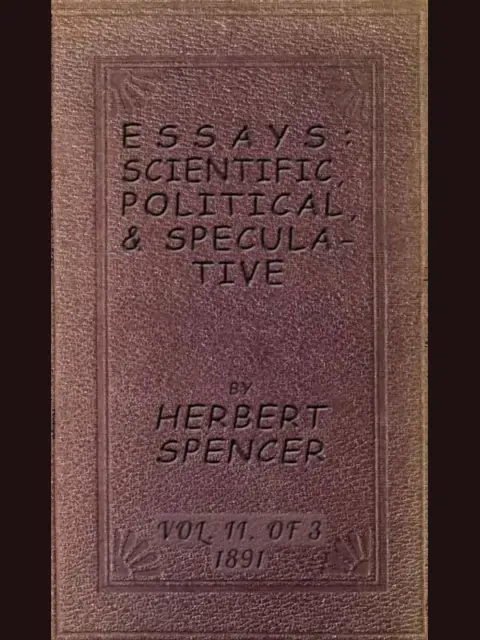
Herbert Spencer
BEHIND THE BOOK
This eBook is for the use of anyone anywhere in the United States and most other parts of the world at no cost and with almost no restrictions whatsoever. You may copy it, give it away or re-use it under the terms of the Project Gutenberg License included with this eBook or online at www.gutenberg.org. If you are not located in the United States, you will have to check the laws of the country where you are located before using this eBook. Read the source licence.
The original source file, including credits and licence, is retained by this library. Request an original-format copy at no charge. Please include the book title and Project Gutenberg identifier #55046.
KEEP YOUR CURIOSITY GOING

David Patterson (Spirit) Hatch

David Patterson (Spirit) Hatch

David Patterson (Spirit) Hatch
Coulson Kernahan

Ralph Waldo Emerson
Frances Wright