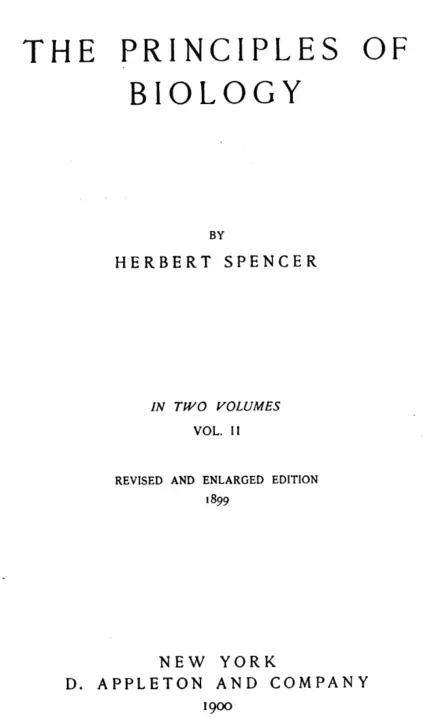
The Principles of Biology, Volume 2 (of 2)
Herbert Spencer
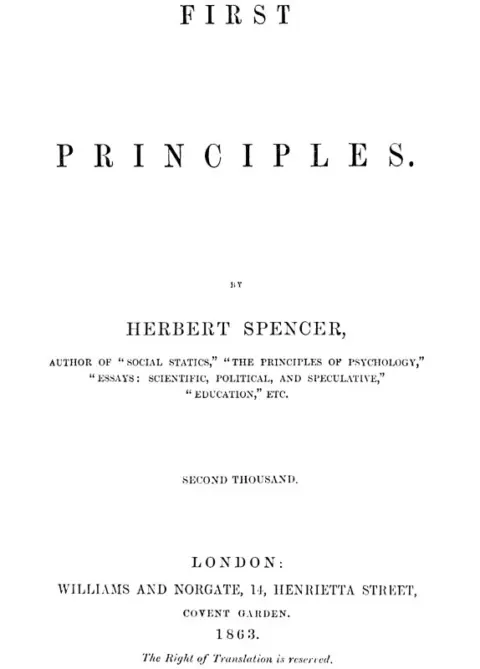
THE CLASSIC COLLECTION · 1860
"First Principles" by Herbert Spencer is a philosophical treatise written in the mid-19th century. The work is part of a larger series that aims to establish a systematic understanding of philosophy grounded in science, religion, and human experience. It explores the interplay between religion and science, seeking to reconcile their seemingly opposing views on existence and knowledge, and discusses the underlying truths present across various belief systems. The opening of the treatise introduces the ambitious scope of Spencer’s work, as he presents a framework for his philosophical inquiry. He begins with a discussion on the nature of human beliefs, suggesting that even widely-held misconceptions may contain elements of truth. By analyzing the historical perspectives on authority and governance, Spencer underscores the evolution of political thought from divine kingship to modern democratic ideals. He proposes that there is a common thread among all religions and philosophies — the acknowledgment of fundamental truths concerning existence that are often obscured by dogma. Thus, the groundwork is laid for his exploration of "the unknowable" and the "laws of the knowable," setting the stage for a deeper analysis of both the limitations and possibilities of human understanding.
Introduction adapted from the source catalogue; source summaries may be automatically generated.
Free to read · English · 166,659 words · No account needed
MAKE TIME FOR A GOOD BOOK
On by default. Untick to stop anonymous reading totals. Each page counts after 10 seconds in view. How this works.
Anonymous counting is on unless you have switched it off.
§ 123. The general interpretation of Evolution is far from being completed in the preceding chapters. We must contemplate its changes under yet another aspect, before we can form a definite conception of the process constituted by them. Though the laws already set forth, furnish a key to the re-arrangement of parts which Evolution exhibits, in so far as it is an advance from the uniform to the multiform; they furnish no key to this re-arrangement in so far as it is an advance from the indefinite to the definite. On studying the actions and re-actions everywhere going on, we have found it to follow inevitably from a certain primordial truth, that the homogeneous must lapse into the heterogeneous, and that the heterogeneous must become more heterogeneous; but we have not discovered why the differently-affected parts of any simple whole, become clearly marked off from each other, at the same time that they become unlike. Thus far no reason has been assigned why there should not ordinarily arise a vague chaotic heterogeneity, in place of that orderly heterogeneity displayed in Evolution. It still remains to find out the cause of that integration of parts which accompanies their differentiation—that gradually-completed segregation of like units into a group, distinctly separated from neighbouring groups which are severally made up of other kinds of units. The rationale will be conveniently introduced by a few instances in which we may watch this segregative process taking place.
When towards the end of September, the trees are gaining their autumn colours, and we are hoping shortly to see a further change increasing still more the beauty of the landscape, we are not uncommonly disappointed by the occurrence of an equinoxial gale. Out of the mixed mass of foliage on each branch, the strong current of air carries away the decaying and brightly-tinted leaves, but fails to detach those which are still green. And while these last, frayed and seared by long-continued beatings against each other, and the twigs around them, give a sombre colour to the woods, the red and yellow and orange leaves are collected together in ditches and behind walls and in corners where eddies allow them to settle. That is to say, by the action of that uniform force which the wind exerts on both kinds, the dying leaves are picked out from among their still living companions and gathered in places by themselves. Again, the separation of particles of different sizes, as dust and sand from pebbles, may be similarly effected; as we see on every road in March. And from the days of Homer downwards, the power of currents of air, natural and artificial, to part from one another units of unlike specific gravities, has been habitually utilized in the winnowing of chaff from wheat. In every river we see how the mixed materials carried down, are separately deposited—how in rapids the bottom gives rest to nothing but boulders and pebbles; how where the current is not so strong, sand is let fall; and how, in still places, there is a sediment of mud. This selective action of moving water, is commonly applied in the arts to obtain masses of particles of different degrees of fineness. Emery, for example, after being ground, is carried by a slow current through successive compartments; in the first of which the largest grains subside; in the second of which the grains that reach the bottom before the water has escaped, are somewhat smaller; in the third smaller still; until in the last there are deposited only those finest particles which fall so slowly through the water, that they have not previously been able to reach the bottom. And in a way that is different though equally significant, this segregative effect of water in motion, is exemplified in the carrying away of soluble from insoluble matters—an application of it hourly made in every laboratory. The effects of the uniform forces which aerial and aqueous currents exercise, are paralleled by those of uniform forces of other orders. Electric attraction will separate small bodies from large, or light bodies from heavy. By magnetism, grains of iron may be selected from among other grains; as by the Sheffield grinder, whose magnetized gauze mask filters out the steel-dust which his wheel gives off, from the stone-dust that accompanies it. And how the affinity of any agent acting differently on the components of a given body, enables us to take away some component and leave the rest behind, is shown in almost every chemical experiment.
Your reading position is saved on this browser. Take it to another device with a library code. Reading pages adapt to text, rather than matching a printed edition.
Herbert Spencer
Herbert Spencer
Herbert Spencer
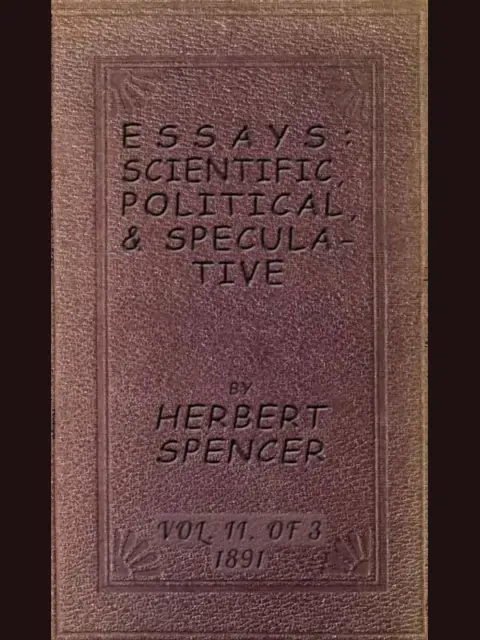
Herbert Spencer
BEHIND THE BOOK
This eBook is for the use of anyone anywhere in the United States and most other parts of the world at no cost and with almost no restrictions whatsoever. You may copy it, give it away or re-use it under the terms of the Project Gutenberg License included with this eBook or online at www.gutenberg.org. If you are not located in the United States, you will have to check the laws of the country where you are located before using this eBook. Read the source licence.
The original source file, including credits and licence, is retained by this library. Request an original-format copy at no charge. Please include the book title and Project Gutenberg identifier #55046.
KEEP YOUR CURIOSITY GOING

David Patterson (Spirit) Hatch

David Patterson (Spirit) Hatch

David Patterson (Spirit) Hatch
Coulson Kernahan

Ralph Waldo Emerson
Frances Wright