READ · DISCOVER · ENJOYClassic literature · Always free
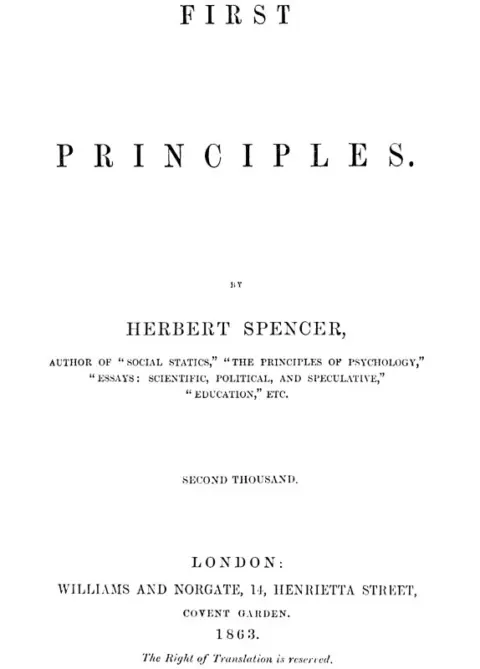
First Principles — digital edition cover

THE CLASSIC COLLECTION · 1860

First Principles

"First Principles" by Herbert Spencer is a philosophical treatise written in the mid-19th century. The work is part of a larger series that aims to establish a systematic understanding of philosophy grounded in science, religion, and human experience. It explores the interplay between religion and science, seeking to reconcile their seemingly opposing views on existence and knowledge, and discusses the underlying truths present across various belief systems. The opening of the treatise introduces the ambitious scope of Spencer’s work, as he presents a framework for his philosophical inquiry. He begins with a discussion on the nature of human beliefs, suggesting that even widely-held misconceptions may contain elements of truth. By analyzing the historical perspectives on authority and governance, Spencer underscores the evolution of political thought from divine kingship to modern democratic ideals. He proposes that there is a common thread among all religions and philosophies — the acknowledgment of fundamental truths concerning existence that are often obscured by dogma. Thus, the groundwork is laid for his exploration of "the unknowable" and the "laws of the knowable," setting the stage for a deeper analysis of both the limitations and possibilities of human understanding.

Introduction adapted from the source catalogue; source summaries may be automatically generated.

Start reading ↓

Free to read · English · 166,659 words · No account needed

MAKE TIME FOR A GOOD BOOK

First Principles

On by default. Untick to stop anonymous reading totals. Each page counts after 10 seconds in view. How this works.

Anonymous counting is on unless you have switched it off.

First Principles

This is by no means all that has to be said for such protests. There is a much deeper meaning in them. They do not simply express the natural repugnance to a revolution of belief, here made specially intense by the vital importance of the belief to be revolutionized; but they also express an instinctive adhesion to a belief that is in one sense the best—the best for those who thus cling to it, though not abstractedly the best. For here let me remark that what were above spoken of as the imperfections of Religion, at first great but gradually diminishing, have been imperfections only as measured by an absolute standard; and not as measured by a relative one. Speaking generally, the religion current in each age and among each people, has been as near an approximation to the truth as it was then and there possible for men to receive: the more or less concrete forms in which it has embodied the truth, have simply been the means of making thinkable what would otherwise have been unthinkable; and so have for the time being served to increase its impressiveness. If we consider the conditions of the case, we shall find this to be an unavoidable conclusion. During each stage of evolution, men must think in such terms of thought as they possess. While all the conspicuous changes of which they can observe the origins, have men and animals as antecedents, they are unable to think of antecedents in general under any other shapes; and hence creative agencies are of necessity conceived by them in these shapes. If during this phase, these concrete conceptions were taken from them, and the attempt made to give them comparatively abstract conceptions, the result would be to leave their minds with none at all; since the substituted ones could not be mentally represented. Similarly with every successive stage of religious belief, down to the last. Though, as accumulating experiences slowly modify the earliest ideas of causal personalities, there grow up more general and vague ideas of them; yet these cannot be at once replaced by others still more general and vague. Further experiences must supply the needful further abstractions, before the mental void left by the destruction of such inferior ideas can be filled by ideas of a superior order. And at the present time, the refusal to abandon a relatively concrete notion for a relatively abstract one, implies the inability to frame the relatively abstract one; and so proves that the change would be premature and injurious. Still more clearly shall we see the injuriousness of any such premature change, on observing that the effects of a belief upon conduct must be diminished in proportion as the vividness with which it is realized becomes less. Evils and benefits akin to those which the savage has personally felt, or learned from those who have felt them, are the only evils and benefits he can understand; and these must be looked for as coming in ways, like those of which he has had experience. His deities must be imagined to have like motives and passions and methods with the beings around him; for motives and passions and methods of a higher character, being unknown to him, and in great measure unthinkable by him, cannot be so realized in thought as to influence his deeds. During every phase of civilization, the actions of the Unseen Reality, as well as the resulting rewards and punishments, being conceivable only in such forms as experience furnishes, to supplant them by higher ones before wider experiences have made higher ones conceivable, is to set up vague and uninfluential motives for definite and influential ones. Even now, for the great mass of men, unable through lack of culture to trace out with due clearness those good and bad consequences which conduct brings round through the established order of the Unknowable, it is needful that there should be vividly depicted future torments and future joys—pains and pleasures of a definite kind, produced in a manner direct and simple enough to be clearly imagined. Nay still more must be conceded. Few if any are as yet fitted wholly to dispense with such conceptions as are current. The highest abstractions take so great a mental power to realize with any vividness, and are so inoperative upon conduct unless they are vividly realized, that their regulative effects must for a long period to come be appreciable on but a small minority. To see clearly how a right or wrong act generates consequences, internal and external, that go on branching out more widely as years progress, requires a rare power of analysis. To mentally represent even a single series of these consequences, as it stretches out into the remote future, requires an equally rare power of imagination. And to estimate these consequences in their totality, ever multiplying in number while diminishing in intensity, requires a grasp of thought possessed by none. Yet it is only by such analysis, such imagination, and such grasp, that conduct can be rightly guided in the absence of all other control: only so can ultimate rewards and penalties be made to outweigh proximate pains and pleasures. Indeed, were it not that throughout the progress of the race, men’s experiences of the effects of conduct have been slowly generalized into principles—were it not that these principles have been from generation to generation insisted on by parents, upheld by public opinion, sanctified by religion, and enforced by threats of eternal damnation for disobedience—were it not that under these potent influences, habits have been modified, and the feelings proper to them made innate—were it not, in short, that we have been rendered in a considerable degree organically moral; it is certain that disastrous results would ensue from the removal of those strong and distinct motives which the current belief supplies. Even as it is, those who relinquish the faith in which they have been brought up, for this most abstract faith in which Science and Religion unite, may not uncommonly fail to act up to their convictions. Left to their organic morality, enforced only by general reasonings imperfectly wrought out and difficult to keep before the mind, their defects of nature will often come out more strongly than they would have done under their previous creed. The substituted creed can become adequately operative only when it becomes, like the present one, an element in early education, and has the support of a strong social sanction. Nor will men be quite ready for it until, through the continuance of a discipline which has already partially moulded them to the conditions of social existence, they are completely moulded to those conditions.

Your reading position is saved on this browser. Take it to another device with a library code. Reading pages adapt to text, rather than matching a printed edition.

More from this author

BEHIND THE WORDS

About Herbert Spencer

Herbert Spencer (1820–1903). Explore The Principles of Biology, Volume 2 (of 2), First Principles, The Principles of Biology, Volume 1 (of 2) and other works in this collection. These books span science & nature, philosophy, religion & spirituality.

Explore this author’s books →

THE READERS’ VERDICT

How did this story stay with you?

Not rated yet
Your rating for First Principles

Be the first to share your verdict.

One rating per browser, which you can change or remove. A necessary browser identifier remembers your vote. How ratings work

A GOOD STORY DESERVES COMPANY

Pass this book along.

A great read is even better when it’s shared.

SEND A LITTLE INSPIRATION

Share this book

BEHIND THE BOOK

Edition & source details.

Title
First Principles
Author
Herbert Spencer
First publication (Open Library catalogue match)
1860
Digital edition publisher
Project Gutenberg
Gutenberg release date
2017-07-05
Language
English
Source edition imprint
Not stated in source catalogue
Source identifier
Project Gutenberg #55046
Contributors
No additional named contributors in source metadata

Public-domain source & licence

This eBook is for the use of anyone anywhere in the United States and most other parts of the world at no cost and with almost no restrictions whatsoever. You may copy it, give it away or re-use it under the terms of the Project Gutenberg License included with this eBook or online at www.gutenberg.org. If you are not located in the United States, you will have to check the laws of the country where you are located before using this eBook. Read the source licence.

Full source licence and obtaining an original copy

The original source file, including credits and licence, is retained by this library. Request an original-format copy at no charge. Please include the book title and Project Gutenberg identifier #55046.

the full Project Gutenberg License must appear
prominently whenever any copy of a Project Gutenberg work (any work
on which the phrase “Project Gutenberg” appears, or with which the
phrase “Project Gutenberg” is associated) is accessed, displayed,
performed, viewed, copied or distributed:

This eBook is for the use of anyone anywhere in the United States and most
other parts of the world at no cost and with almost no restrictions
whatsoever. You may copy it, give it away or re-use it under the terms
of the Project Gutenberg™ License included with this eBook or online
at www.gutenberg.org. If you
are not located in the United States, you will have to check the laws
of the country where you are located before using this eBook.

1.E.2. If an individual Project Gutenberg electronic work is
derived from texts not protected by U.S. copyright law (does not
contain a notice indicating that it is posted with permission of the
copyright holder), the work can be copied and distributed to anyone in
the United States without paying any fees or charges. If you are
redistributing or providing access to a work with the phrase “Project
Gutenberg” associated with or appearing on the work, you must comply
either with the requirements of paragraphs 1.E.1 through 1.E.7 or
obtain permission for the use of the work and the Project Gutenberg
trademark as set forth in paragraphs 1.E.8 or 1.E.9.

1.E.3. If an individual Project Gutenberg electronic work is posted
with the permission of the copyright holder, your use and distribution
must comply with both paragraphs 1.E.1 through 1.E.7 and any
additional terms imposed by the copyright holder. Additional terms
will be linked to the Project Gutenberg License for all works
posted with the permission of the copyright holder found at the
beginning of this work.

1.E.4. Do not unlink or detach or remove the full Project Gutenberg
License terms from this work, or any files containing a part of this
work or any other work associated with Project Gutenberg.

1.E.5. Do not copy, display, perform, distribute or redistribute this
electronic work, or any part of this electronic work, without
prominently displaying the sentence set forth in paragraph 1.E.1 with
active links or immediate access to the full terms of the Project
Gutenberg License.

1.E.6. You may convert to and distribute this work in any binary,
compressed, marked up, nonproprietary or proprietary form, including
any word processing or hypertext form. However, if you provide access
to or distribute copies of a Project Gutenberg work in a format
other than “Plain Vanilla ASCII” or other format used in the official
version posted on the official Project Gutenberg website
(www.gutenberg.org), you must, at no additional cost, fee or expense
to the user, provide a copy, a means of exporting a copy, or a means
of obtaining a copy upon request, of the work in its original “Plain
Vanilla ASCII” or other form. Any alternate format must include the
full Project Gutenberg License as specified in paragraph 1.E.1.

1.E.7. Do not charge a fee for access to, viewing, displaying,
performing, copying or distributing any Project Gutenberg works
unless you comply with paragraph 1.E.8 or 1.E.9.

1.E.8. You may charge a reasonable fee for copies of or providing
access to or distributing Project Gutenberg electronic works
provided that:

• You pay a royalty fee of 20% of the gross profits you derive from
the use of Project Gutenberg works calculated using the method
you already use to calculate your applicable taxes. The fee is owed
to the owner of the Project Gutenberg trademark, but he has
agreed to donate royalties under this paragraph to the Project
Gutenberg Literary Archive Foundation. Royalty payments must be paid
within 60 days following each date on which you prepare (or are
legally required to prepare) your periodic tax returns. Royalty
payments should be clearly marked as such and sent to the Project
Gutenberg Literary Archive Foundation at the address specified in
Section 4, “Information about donations to the Project Gutenberg
Literary Archive Foundation.”

• You provide a full refund of any money paid by a user who notifies
you in writing (or by e-mail) within 30 days of receipt that s/he
does not agree to the terms of the full Project Gutenberg™
License. You must require such a user to return or destroy all
copies of the works possessed in a physical medium and discontinue
all use of and all access to other copies of Project Gutenberg™
works.

• You provide, in accordance with paragraph 1.F.3, a full refund of
any money paid for a work or a replacement copy, if a defect in the
electronic work is discovered and reported to you within 90 days of
receipt of the work.

• You comply with all other terms of this agreement for free
distribution of Project Gutenberg™ works.


1.E.9. If you wish to charge a fee or distribute a Project
Gutenberg™ electronic work or group of works on different terms than
are set forth in this agreement, you must obtain permission in writing
from the Project Gutenberg Literary Archive Foundation, the manager of
the Project Gutenberg™ trademark. Contact the Foundation as set
forth in Section 3 below.

1.F.

1.F.1. Project Gutenberg volunteers and employees expend considerable
effort to identify, do copyright research on, transcribe and proofread
works not protected by U.S. copyright law in creating the Project
Gutenberg™ collection. Despite these efforts, Project Gutenberg™
electronic works, and the medium on which they may be stored, may
contain “Defects,” such as, but not limited to, incomplete, inaccurate
or corrupt data, transcription errors, a copyright or other
intellectual property infringement, a defective or damaged disk or
other medium, a computer virus, or computer codes that damage or
cannot be read by your equipment.

1.F.2. LIMITED WARRANTY, DISCLAIMER OF DAMAGES - Except for the “Right
of Replacement or Refund” described in paragraph 1.F.3, the Project
Gutenberg Literary Archive Foundation, the owner of the Project
Gutenberg™ trademark, and any other party distributing a Project
Gutenberg™ electronic work under this agreement, disclaim all
liability to you for damages, costs and expenses, including legal
fees. YOU AGREE THAT YOU HAVE NO REMEDIES FOR NEGLIGENCE, STRICT
LIABILITY, BREACH OF WARRANTY OR BREACH OF CONTRACT EXCEPT THOSE
PROVIDED IN PARAGRAPH 1.F.3. YOU AGREE THAT THE FOUNDATION, THE
TRADEMARK OWNER, AND ANY DISTRIBUTOR UNDER THIS AGREEMENT WILL NOT BE
LIABLE TO YOU FOR ACTUAL, DIRECT, INDIRECT, CONSEQUENTIAL, PUNITIVE OR
INCIDENTAL DAMAGES EVEN IF YOU GIVE NOTICE OF THE POSSIBILITY OF SUCH
DAMAGE.

1.F.3. LIMITED RIGHT OF REPLACEMENT OR REFUND - If you discover a
defect in this electronic work within 90 days of receiving it, you can
receive a refund of the money (if any) you paid for it by sending a
written explanation to the person you received the work from. If you
received the work on a physical medium, you must return the medium
with your written explanation. The person or entity that provided you
with the defective work may elect to provide a replacement copy in
lieu of a refund. If you received the work electronically, the person
or entity providing it to you may choose to give you a second
opportunity to receive the work electronically in lieu of a refund. If
the second copy is also defective, you may demand a refund in writing
without further opportunities to fix the problem.

1.F.4. Except for the limited right of replacement or refund set forth
in paragraph 1.F.3, this work is provided to you ‘AS-IS’, WITH NO
OTHER WARRANTIES OF ANY KIND, EXPRESS OR IMPLIED, INCLUDING BUT NOT
LIMITED TO WARRANTIES OF MERCHANTABILITY OR FITNESS FOR ANY PURPOSE.

1.F.5. Some states do not allow disclaimers of certain implied
warranties or the exclusion or limitation of certain types of
damages. If any disclaimer or limitation set forth in this agreement
violates the law of the state applicable to this agreement, the
agreement shall be interpreted to make the maximum disclaimer or
limitation permitted by the applicable state law. The invalidity or
unenforceability of any provision of this agreement shall not void the
remaining provisions.

1.F.6. INDEMNITY - You agree to indemnify and hold the Foundation, the
trademark owner, any agent or employee of the Foundation, anyone
providing copies of Project Gutenberg™ electronic works in
accordance with this agreement, and any volunteers associated with the
production, promotion and distribution of Project Gutenberg™
electronic works, harmless from all liability, costs and expenses,
including legal fees, that arise directly or indirectly from any of
the following which you do or cause to occur: (a) distribution of this
or any Project Gutenberg work, (b) alteration, modification, or
additions or deletions to any Project Gutenberg work, and (c) any
Defect you cause.

Section 2. Information about the Mission of Project Gutenberg

Project Gutenberg is synonymous with the free distribution of
electronic works in formats readable by the widest variety of
computers including obsolete, old, middle-aged and new computers. It
exists because of the efforts of hundreds of volunteers and donations
from people in all walks of life.

Volunteers and financial support to provide volunteers with the
assistance they need are critical to reaching Project Gutenberg’s
goals and ensuring that the Project Gutenberg collection will
remain freely available for generations to come. In 2001, the Project
Gutenberg Literary Archive Foundation was created to provide a secure
and permanent future for Project Gutenberg and future
generations. To learn more about the Project Gutenberg Literary
Archive Foundation and how your efforts and donations can help, see
Sections 3 and 4 and the Foundation information page at www.gutenberg.org.

Section 3. Information about the Project Gutenberg Literary Archive Foundation

The Project Gutenberg Literary Archive Foundation is a non-profit
501(c)(3) educational corporation organized under the laws of the
state of Mississippi and granted tax exempt status by the Internal
Revenue Service. The Foundation’s EIN or federal tax identification
number is 64-6221541. Contributions to the Project Gutenberg Literary
Archive Foundation are tax deductible to the full extent permitted by
U.S. federal laws and your state’s laws.

The Foundation’s business office is located at 41 Watchung Plaza #516,
Montclair NJ 07042, USA, +1 (862) 621-9288. Email contact links and up
to date contact information can be found at the Foundation’s website
and official page at www.gutenberg.org/contact

Section 4. Information about Donations to the Project Gutenberg
Literary Archive Foundation

Project Gutenberg™ depends upon and cannot survive without widespread
public support and donations to carry out its mission of
increasing the number of public domain and licensed works that can be
freely distributed in machine-readable form accessible by the widest
array of equipment including outdated equipment. Many small donations
($1 to $5,000) are particularly important to maintaining tax exempt
status with the IRS.

The Foundation is committed to complying with the laws regulating
charities and charitable donations in all 50 states of the United
States. Compliance requirements are not uniform and it takes a
considerable effort, much paperwork and many fees to meet and keep up
with these requirements. We do not solicit donations in locations
where we have not received written confirmation of compliance. To SEND
DONATIONS or determine the status of compliance for any particular state
visit www.gutenberg.org/donate.

While we cannot and do not solicit contributions from states where we
have not met the solicitation requirements, we know of no prohibition
against accepting unsolicited donations from donors in such states who
approach us with offers to donate.

International donations are gratefully accepted, but we cannot make
any statements concerning tax treatment of donations received from
outside the United States. U.S. laws alone swamp our small staff.

Please check the Project Gutenberg web pages for current donation
methods and addresses. Donations are accepted in a number of other
ways including checks, online payments and credit card donations. To
donate, please visit: www.gutenberg.org/donate.

Section 5. General Information About Project Gutenberg electronic works

Professor Michael S. Hart was the originator of the Project
Gutenberg concept of a library of electronic works that could be
freely shared with anyone. For forty years, he produced and
distributed Project Gutenberg eBooks with only a loose network of
volunteer support.

Project Gutenberg eBooks are often created from several printed
editions, all of which are confirmed as not protected by copyright in
the U.S. unless a copyright notice is included. Thus, we do not
necessarily keep eBooks in compliance with any particular paper
edition.

Most people start at our website which has the main PG search
facility: www.gutenberg.org.

This website includes information about Project Gutenberg,
including how to make donations to the Project Gutenberg Literary
Archive Foundation, how to help produce our new eBooks, and how to
subscribe to our email newsletter to hear about new eBooks.


KEEP YOUR CURIOSITY GOING

Your next chapter awaits.