The Principles of Biology, Volume 2 (of 2)
Herbert Spencer
THE CLASSIC COLLECTION · 1860
"First Principles" by Herbert Spencer is a philosophical treatise written in the mid-19th century. The work is part of a larger series that aims to establish a systematic understanding of philosophy grounded in science, religion, and human experience. It explores the interplay between religion and science, seeking to reconcile their seemingly opposing views on existence and knowledge, and discusses the underlying truths present across various belief systems. The opening of the treatise introduces the ambitious scope of Spencer’s work, as he presents a framework for his philosophical inquiry. He begins with a discussion on the nature of human beliefs, suggesting that even widely-held misconceptions may contain elements of truth. By analyzing the historical perspectives on authority and governance, Spencer underscores the evolution of political thought from divine kingship to modern democratic ideals. He proposes that there is a common thread among all religions and philosophies — the acknowledgment of fundamental truths concerning existence that are often obscured by dogma. Thus, the groundwork is laid for his exploration of "the unknowable" and the "laws of the knowable," setting the stage for a deeper analysis of both the limitations and possibilities of human understanding.
Introduction adapted from the source catalogue; source summaries may be automatically generated.
Free to read · English · 166,659 words · No account needed
MAKE TIME FOR A GOOD BOOK
On by default. Untick to stop anonymous reading totals. Each page counts after 10 seconds in view. How this works.
Anonymous counting is on unless you have switched it off.
“This contradiction, again, admits of the same explanation as the former. Our whole notion of existence is necessarily relative; for it is existence as conceived by us. But Existence, as we conceive it, is but a name for the several ways in which objects are presented to our consciousness,—a general term, embracing a variety of relations. The Absolute, on the other hand, is a term expressing no object of thought, but only a denial of the relation by which thought is constituted. To assume absolute existence as an object of thought, is thus to suppose a relation existing when the related terms exist no longer. An object of thought exists, as such, in and through its relation to a thinker; while the Absolute, as such, is independent of all relation. The Conception of the Absolute thus implies at the same time the presence and absence of the relation by which thought is constituted; and our various endeavours to represent it are only so many modified forms of the contradiction involved in our original assumption. Here, too, the contradiction is one which we ourselves have made. It does not imply that the Absolute cannot exist; but it implies, most certainly, that we cannot conceive it as existing.”
Here let me point out how the same general inference may be evolved from another fundamental condition of thought, omitted by Sir W. Hamilton, and not supplied by Mr Mansel;—a condition which, under its obverse aspect, we have already contemplated in the last section. Every complete act of consciousness, besides distinction and relation, also implies likeness. Before it can become an idea, or constitute a piece of knowledge, a mental state must not only be known as separate in kind from certain foregoing states to which it is known as related by succession; but it must further be known as of the same kind with certain other foregoing states. That organization of changes which constitutes thinking, involves continuous integration as well as continuous differentiation. Were each new affection of the mind perceived simply as an affection in some way contrasted with the preceding ones—were there but a chain of impressions, each of which as it arose was merely distinguished from its predecessors; consciousness would be an utter chaos. To produce that orderly consciousness which we call intelligence, there requires the assimilation of each impression to others, that occurred earlier in the series. Both the successive mental states, and the successive relations which they bear to each other, must be classified; and classification involves not only a parting of the unlike, but also a binding together of the like. In brief, a true cognition is possible only through an accompanying recognition. Should it be objected that if so, there cannot be a first cognition, and hence there can be no cognition; the reply is, that cognition proper arises gradually—that during the first stage of incipient intelligence, before the feelings produced by intercourse with the outer world have been put into order, there are no cognitions, strictly so called; and that, as every infant shows us, these slowly emerge out of the confusion of unfolding consciousness as fast as the experiences are arranged into groups—as fast as the most frequently repeated sensations, and their relations to each other, become familiar enough to admit of their recognition as such or such, whenever they recur. Should it be further objected that if cognition pre-supposes recognition, there can be, no cognition, even by an adult, of an object never before seen; there is still the sufficient answer that in so far as it is not assimilated to previously-seen objects, it is not known, and that it is known in so far as it is assimilated to them. Of this paradox the interpretation is, that an object is classifiable in various ways, with various degrees of completeness. An animal hitherto unknown (mark the word), though not referable to any established species or genus, is yet recognized as belonging to one of the larger divisions—mammals, birds, reptiles, or fishes; or should it be so anomalous that its alliance with any of these is not determinable, it may yet be classed as vertebrate or invertebrate; or if it be one of those organisms of which it is doubtful whether the animal or vegetal characteristics predominate, it is still known as a living body; even should it be questioned whether it is organic, it remains beyond question that it is a material object, and it is cognized by being recognized as such. Whence it is manifest that a thing is perfectly known only when it is in all respects like certain things previously observed; that in proportion to the number of respects in which it is unlike them, is the extent to which it is unknown; and that hence when it has absolutely no attribute in common with anything else, it must be absolutely beyond the bounds of knowledge.
Your reading position is saved on this browser. Take it to another device with a library code. Reading pages adapt to text, rather than matching a printed edition.
Herbert Spencer
Herbert Spencer
Herbert Spencer
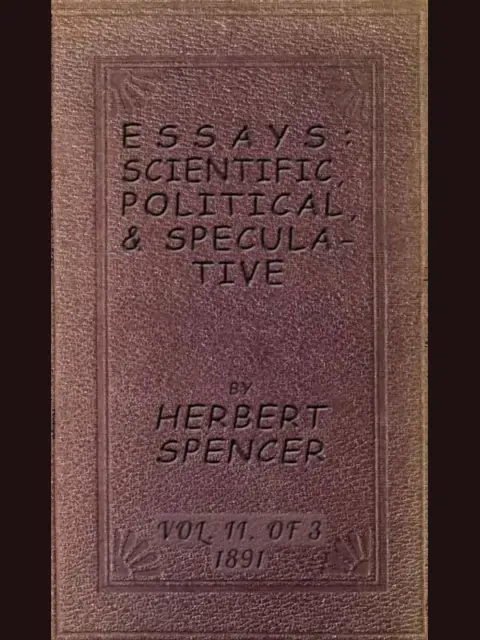
Herbert Spencer
BEHIND THE BOOK
This eBook is for the use of anyone anywhere in the United States and most other parts of the world at no cost and with almost no restrictions whatsoever. You may copy it, give it away or re-use it under the terms of the Project Gutenberg License included with this eBook or online at www.gutenberg.org. If you are not located in the United States, you will have to check the laws of the country where you are located before using this eBook. Read the source licence.
The original source file, including credits and licence, is retained by this library. Request an original-format copy at no charge. Please include the book title and Project Gutenberg identifier #55046.
KEEP YOUR CURIOSITY GOING

David Patterson (Spirit) Hatch

David Patterson (Spirit) Hatch

David Patterson (Spirit) Hatch
Coulson Kernahan

Ralph Waldo Emerson
Frances Wright