The Principles of Biology, Volume 2 (of 2)
Herbert Spencer
THE CLASSIC COLLECTION · 1860
"First Principles" by Herbert Spencer is a philosophical treatise written in the mid-19th century. The work is part of a larger series that aims to establish a systematic understanding of philosophy grounded in science, religion, and human experience. It explores the interplay between religion and science, seeking to reconcile their seemingly opposing views on existence and knowledge, and discusses the underlying truths present across various belief systems. The opening of the treatise introduces the ambitious scope of Spencer’s work, as he presents a framework for his philosophical inquiry. He begins with a discussion on the nature of human beliefs, suggesting that even widely-held misconceptions may contain elements of truth. By analyzing the historical perspectives on authority and governance, Spencer underscores the evolution of political thought from divine kingship to modern democratic ideals. He proposes that there is a common thread among all religions and philosophies — the acknowledgment of fundamental truths concerning existence that are often obscured by dogma. Thus, the groundwork is laid for his exploration of "the unknowable" and the "laws of the knowable," setting the stage for a deeper analysis of both the limitations and possibilities of human understanding.
Introduction adapted from the source catalogue; source summaries may be automatically generated.
Free to read · English · 166,659 words · No account needed
MAKE TIME FOR A GOOD BOOK
On by default. Untick to stop anonymous reading totals. Each page counts after 10 seconds in view. How this works.
Anonymous counting is on unless you have switched it off.
There remains to be examined the commonly-received or theistic hypothesis—creation by external agency. Alike in the rudest creeds and in the cosmogony long current among ourselves, it is assumed that the genesis of the Heavens and the Earth is effected somewhat after the manner in which a workman shapes a piece of furniture. And this assumption is made not by theologians only, but by the immense majority of philosophers, past and present. Equally in the writings of Plato, and in those of not a few living men of science, we find it taken for granted that there is an analogy between the process of creation and the process of manufacture. Now in the first place, not only is this conception one that cannot by any cumulative process of thought, or the fulfilment of predictions based on it, be shown to answer to anything actual; and not only is it that in the absence of all evidence respecting the process of creation, we have no proof of correspondence even between this limited conception and some limited portion of the fact; but it is that the conception is not even consistent with itself—cannot be realized in thought, when all its assumptions are granted. Though it is true that the proceedings of a human artificer may vaguely symbolize to us a method after which the Universe might be shaped, yet they do not help us to comprehend the real mystery; namely, the origin of the material of which the Universe consists. The artizan does not make the iron, wood, or stone, he uses; but merely fashions and combines them. If we suppose suns, and planets, and satellites, and all they contain to have been similarly formed by a “Great Artificer,” we suppose merely that certain pre-existing elements were thus put into their present arrangement. But whence the pre-existing elements? The comparison helps us not in the least to understand that; and unless it helps us to understand that, it is worthless. The production of matter out of nothing is the real mystery, which neither this simile nor any other enables us to conceive; and a simile which does not enable us to conceive this, may just as well be dispensed with. Still more manifest does the insufficiency of this theory of creation become, when we turn from material objects to that which contains them—when instead of matter we contemplate space. Did there exist nothing but an immeasurable void, explanation would be needed as much as now. There would still arise the question—how came it so? If the theory of creation by external agency were an adequate one, it would supply an answer; and its answer would be—space was made in the same manner that matter was made. But the impossibility of conceiving this is so manifest, that no one dares to assert it. For if space was created, it must have been previously non-existent. The non-existence of space cannot, however, by any mental effort be imagined. It is one of the most familiar truths that the idea of space as surrounding us on all sides, is not for a moment to be got rid of—not only are we compelled to think of space as now everywhere present, but we are unable to conceive its absence either in the past or the future. And if the non-existence of space is absolutely inconceivable, then, necessarily, its creation is absolutely inconceivable. Lastly, even supposing that the genesis of the Universe could really be represented in thought as the result of an external agency, the mystery would be as great as ever; for there would still arise the question—how came there to be an external agency? To account for this only the same three hypotheses are possible—self-existence, self-creation, and creation by external agency. Of these the last is useless: it commits us to an infinite series of such agencies, and even then leaves us where we were. By the second we are practically involved in the same predicament; since, as already shown, self-creation implies an infinite series of potential existences. We are obliged therefore to fall back upon the first, which is the one commonly accepted and commonly supposed to be satisfactory. Those who cannot conceive a self-existent universe; and who therefore assume a creator as the source of the universe; take for granted that they can conceive a self-existent creator. The mystery which they recognize in this great fact surrounding them on every side, they transfer to an alleged source of this great fact; and then suppose that they have solved the mystery. But they delude themselves. As was proved at the outset of the argument, self-existence is rigorously inconceivable; and this holds true whatever be the nature of the object of which it is predicated. Whoever agrees that the atheistic hypothesis is untenable because it involves the impossible idea of self-existence, must perforce admit that the theistic hypothesis is untenable if it contains the same impossible idea.
Your reading position is saved on this browser. Take it to another device with a library code. Reading pages adapt to text, rather than matching a printed edition.
Herbert Spencer
Herbert Spencer
Herbert Spencer
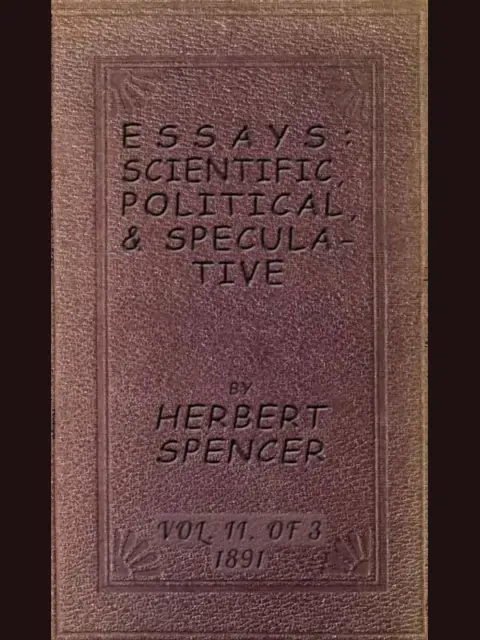
Herbert Spencer
BEHIND THE BOOK
This eBook is for the use of anyone anywhere in the United States and most other parts of the world at no cost and with almost no restrictions whatsoever. You may copy it, give it away or re-use it under the terms of the Project Gutenberg License included with this eBook or online at www.gutenberg.org. If you are not located in the United States, you will have to check the laws of the country where you are located before using this eBook. Read the source licence.
The original source file, including credits and licence, is retained by this library. Request an original-format copy at no charge. Please include the book title and Project Gutenberg identifier #55046.
KEEP YOUR CURIOSITY GOING

David Patterson (Spirit) Hatch

David Patterson (Spirit) Hatch

David Patterson (Spirit) Hatch
Coulson Kernahan

Ralph Waldo Emerson
Frances Wright