READ · DISCOVER · ENJOYClassic literature · Always free
First Principles — digital edition cover

THE CLASSIC COLLECTION · 1860

First Principles

"First Principles" by Herbert Spencer is a philosophical treatise written in the mid-19th century. The work is part of a larger series that aims to establish a systematic understanding of philosophy grounded in science, religion, and human experience. It explores the interplay between religion and science, seeking to reconcile their seemingly opposing views on existence and knowledge, and discusses the underlying truths present across various belief systems. The opening of the treatise introduces the ambitious scope of Spencer’s work, as he presents a framework for his philosophical inquiry. He begins with a discussion on the nature of human beliefs, suggesting that even widely-held misconceptions may contain elements of truth. By analyzing the historical perspectives on authority and governance, Spencer underscores the evolution of political thought from divine kingship to modern democratic ideals. He proposes that there is a common thread among all religions and philosophies — the acknowledgment of fundamental truths concerning existence that are often obscured by dogma. Thus, the groundwork is laid for his exploration of "the unknowable" and the "laws of the knowable," setting the stage for a deeper analysis of both the limitations and possibilities of human understanding.

Introduction adapted from the source catalogue; source summaries may be automatically generated.

Start reading ↓

Free to read · English · 166,659 words · No account needed

MAKE TIME FOR A GOOD BOOK

First Principles

On by default. Untick to stop anonymous reading totals. Each page counts after 10 seconds in view. How this works.

Anonymous counting is on unless you have switched it off.

First Principles

From ideas let us turn to emotions. In a young child, a father’s anger produces little else than vague fear—a disagreeable sense of impending evil, taking various shapes of physical suffering or deprivation of pleasures. In elder children, the same harsh words will arouse additional feelings: sometimes a sense of shame, of penitence, or of sorrow for having offended; at other times, a sense of injustice, and a consequent anger. In the wife, yet a further range of feelings may come into existence—perhaps wounded affection, perhaps self-pity for ill-usage, perhaps contempt for groundless irritability, perhaps sympathy for some suffering which the irritability indicates, perhaps anxiety about an unknown misfortune which she thinks has produced it. Nor are we without evidence that among adults, the like differences of development are accompanied by like differences in the number of emotions that are aroused, in combination or rapid succession—the lower natures being characterized by that impulsiveness which results from the uncontrolled action of a few feelings; and the higher natures being characterized by the simultaneous action of many secondary feelings, modifying those first awakened.

Possibly it will be objected that the illustrations here given, are drawn from the functional changes of the nervous system, not from its structural changes; and that what is proved among the first, does not necessarily hold among the last. This must be admitted. Those, however, who recognize the truth that the structural changes are the slowly accumulated results of the functional changes, will readily draw the corollary, that a part-cause of the evolution of the nervous system, as of other evolution, is this multiplication of effects which becomes ever greater as the development becomes higher.

* * * * *

§ 121. If the advance of Man towards greater heterogeneity in both body and mind, is in part traceable to the production of many effects by one cause, still more clearly may the advance of Society towards greater heterogeneity be so explained. Consider the growth of an industrial organization. When, as must occasionally happen, some individual of a tribe displays unusual aptitude for making an article of general use (a weapon, for instance) which was before made by each man for himself, there arises a tendency towards the differentiation of that individual into a maker of weapons. His companions (warriors and hunters all of them) severally wish to have the best weapons that can be made; and are therefore certain to offer strong inducements to this skilled individual to make weapons for them. He, on the other hand, having both an unusual faculty, and an unusual liking, for making weapons (the capacity and the desire for any occupation being commonly associated), is predisposed to fulfil these commissions on the offer of adequate rewards: especially as his love of distinction is also gratified. This first specialization of function, once commenced, tends ever to become more decided. On the side of the weapon-maker, continued practice gives increased skill—increased superiority to his products. On the side of his clients, cessation of practice entails decreased skill. Thus the influences that determine this division of labour grow stronger in both ways: this social movement tends ever to become more decided in the direction in which it was first set up; and the incipient heterogeneity is, on the average of cases, likely to become permanent for that generation, if no longer. Such a process, besides differentiating the social mass into two parts, the one monopolizing, or almost monopolizing, the performance of a certain function, and the other having lost the habit, and in some measure the power, of performing that function, has a tendency to initiate other differentiations. The advance described implies the introduction of barter: the maker of weapons has, on each occasion, to be paid in such other articles as he agrees to take in exchange. Now he will not habitually take in exchange one kind of article, but many kinds. He does not want mats only, or skins, or fishing-gear; but he wants all these; and on each occasion will bargain for the particular things he most needs. What follows? If among the members of the tribe there exist any slight differences of skill in the manufacture of these various things, as there are almost sure to do, the weapon-maker will take from each one the thing which that one excels in making: he will exchange for mats with him whose mats are superior, and will bargain for the fishing-gear of whoever has the best. But he who has bartered away his mats or his fishing-gear, must make other mats or fishing-gear for himself; and in so doing must, in some degree, further develop his aptitude. Thus it results that the small specialities of faculty possessed by various members of the tribe will tend to grow more decided. If such transactions are from time to time repeated, these specializations may become appreciable. And whether or not there ensue distinct differentiations of other individuals into makers of particular articles, it is clear that incipient differentiations take place throughout the tribe: the one original cause produces not only the first dual effect, but a number of secondary dual effects, like in kind but minor in degree. This process, of which traces may be seen among groups of school-boys, cannot well produce a lasting distribution of functions in an unsettled tribe; but where there grows up a fixed and multiplying community, such differentiations become permanent, and increase with each generation. An addition to the number of citizens, involving a greater demand for every commodity, intensifies the functional activity of each specialized person or class; and this renders the specialization more definite where it already exists, and establishes it where it is but nascent. By increasing the pressure on the means of subsistence, a larger population again augments these results; since every individual is forced more and more to confine himself to that which he can do best, and by which he can gain most. And this industrial progress, by aiding future production, opens the way for further growth of population, which reacts as before. Presently, under the same stimuli, new occupations arise. Competing workers, severally aiming to produce improved articles, occasionally discover better processes or better materials. In weapons and cutting-tools, the substitution of bronze for stone entails on him who first makes it, a great increase of demand—so great an increase that he presently finds all his time occupied in making the bronze for the articles he sells, and is obliged to depute the fashioning of these articles to others; and eventually the making of bronze, thus gradually differentiated from a pre-existing occupation, becomes an occupation by itself. But now mark the ramified changes which follow this change. Bronze soon replaces stone, not only in the articles it was first used for, but in many others; and so affects the manufacture of them. Further, it affects the processes which such improved utensils subserve, and the resulting products—modifies buildings, carvings, dress, personal decorations. Yet again, it sets going sundry manufactures which were before impossible, from lack of a material fit for the requisite tools. And all these changes react on the people—increase their manipulative skill, their intelligence, their comfort—refine their habits and tastes.

Your reading position is saved on this browser. Take it to another device with a library code. Reading pages adapt to text, rather than matching a printed edition.

More from this author

BEHIND THE WORDS

About Herbert Spencer

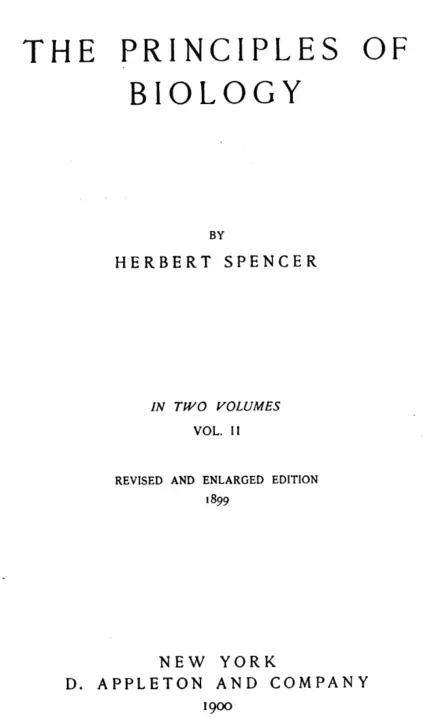
Herbert Spencer (1820–1903). Explore The Principles of Biology, Volume 2 (of 2), First Principles, The Principles of Biology, Volume 1 (of 2) and other works in this collection. These books span science & nature, philosophy, religion & spirituality.

Explore this author’s books →

THE READERS’ VERDICT

How did this story stay with you?

Not rated yet
Your rating for First Principles

Be the first to share your verdict.

One rating per browser, which you can change or remove. A necessary browser identifier remembers your vote. How ratings work

A GOOD STORY DESERVES COMPANY

Pass this book along.

A great read is even better when it’s shared.

SEND A LITTLE INSPIRATION

Share this book

BEHIND THE BOOK

Edition & source details.

Title
First Principles
Author
Herbert Spencer
First publication (Open Library catalogue match)
1860
Digital edition publisher
Project Gutenberg
Gutenberg release date
2017-07-05
Language
English
Source edition imprint
Not stated in source catalogue
Source identifier
Project Gutenberg #55046
Contributors
No additional named contributors in source metadata

Public-domain source & licence

This eBook is for the use of anyone anywhere in the United States and most other parts of the world at no cost and with almost no restrictions whatsoever. You may copy it, give it away or re-use it under the terms of the Project Gutenberg License included with this eBook or online at www.gutenberg.org. If you are not located in the United States, you will have to check the laws of the country where you are located before using this eBook. Read the source licence.

Full source licence and obtaining an original copy

The original source file, including credits and licence, is retained by this library. Request an original-format copy at no charge. Please include the book title and Project Gutenberg identifier #55046.

the full Project Gutenberg License must appear
prominently whenever any copy of a Project Gutenberg work (any work
on which the phrase “Project Gutenberg” appears, or with which the
phrase “Project Gutenberg” is associated) is accessed, displayed,
performed, viewed, copied or distributed:

This eBook is for the use of anyone anywhere in the United States and most
other parts of the world at no cost and with almost no restrictions
whatsoever. You may copy it, give it away or re-use it under the terms
of the Project Gutenberg™ License included with this eBook or online
at www.gutenberg.org. If you
are not located in the United States, you will have to check the laws
of the country where you are located before using this eBook.

1.E.2. If an individual Project Gutenberg electronic work is
derived from texts not protected by U.S. copyright law (does not
contain a notice indicating that it is posted with permission of the
copyright holder), the work can be copied and distributed to anyone in
the United States without paying any fees or charges. If you are
redistributing or providing access to a work with the phrase “Project
Gutenberg” associated with or appearing on the work, you must comply
either with the requirements of paragraphs 1.E.1 through 1.E.7 or
obtain permission for the use of the work and the Project Gutenberg
trademark as set forth in paragraphs 1.E.8 or 1.E.9.

1.E.3. If an individual Project Gutenberg electronic work is posted
with the permission of the copyright holder, your use and distribution
must comply with both paragraphs 1.E.1 through 1.E.7 and any
additional terms imposed by the copyright holder. Additional terms
will be linked to the Project Gutenberg License for all works
posted with the permission of the copyright holder found at the
beginning of this work.

1.E.4. Do not unlink or detach or remove the full Project Gutenberg
License terms from this work, or any files containing a part of this
work or any other work associated with Project Gutenberg.

1.E.5. Do not copy, display, perform, distribute or redistribute this
electronic work, or any part of this electronic work, without
prominently displaying the sentence set forth in paragraph 1.E.1 with
active links or immediate access to the full terms of the Project
Gutenberg License.

1.E.6. You may convert to and distribute this work in any binary,
compressed, marked up, nonproprietary or proprietary form, including
any word processing or hypertext form. However, if you provide access
to or distribute copies of a Project Gutenberg work in a format
other than “Plain Vanilla ASCII” or other format used in the official
version posted on the official Project Gutenberg website
(www.gutenberg.org), you must, at no additional cost, fee or expense
to the user, provide a copy, a means of exporting a copy, or a means
of obtaining a copy upon request, of the work in its original “Plain
Vanilla ASCII” or other form. Any alternate format must include the
full Project Gutenberg License as specified in paragraph 1.E.1.

1.E.7. Do not charge a fee for access to, viewing, displaying,
performing, copying or distributing any Project Gutenberg works
unless you comply with paragraph 1.E.8 or 1.E.9.

1.E.8. You may charge a reasonable fee for copies of or providing
access to or distributing Project Gutenberg electronic works
provided that:

• You pay a royalty fee of 20% of the gross profits you derive from
the use of Project Gutenberg works calculated using the method
you already use to calculate your applicable taxes. The fee is owed
to the owner of the Project Gutenberg trademark, but he has
agreed to donate royalties under this paragraph to the Project
Gutenberg Literary Archive Foundation. Royalty payments must be paid
within 60 days following each date on which you prepare (or are
legally required to prepare) your periodic tax returns. Royalty
payments should be clearly marked as such and sent to the Project
Gutenberg Literary Archive Foundation at the address specified in
Section 4, “Information about donations to the Project Gutenberg
Literary Archive Foundation.”

• You provide a full refund of any money paid by a user who notifies
you in writing (or by e-mail) within 30 days of receipt that s/he
does not agree to the terms of the full Project Gutenberg™
License. You must require such a user to return or destroy all
copies of the works possessed in a physical medium and discontinue
all use of and all access to other copies of Project Gutenberg™
works.

• You provide, in accordance with paragraph 1.F.3, a full refund of
any money paid for a work or a replacement copy, if a defect in the
electronic work is discovered and reported to you within 90 days of
receipt of the work.

• You comply with all other terms of this agreement for free
distribution of Project Gutenberg™ works.


1.E.9. If you wish to charge a fee or distribute a Project
Gutenberg™ electronic work or group of works on different terms than
are set forth in this agreement, you must obtain permission in writing
from the Project Gutenberg Literary Archive Foundation, the manager of
the Project Gutenberg™ trademark. Contact the Foundation as set
forth in Section 3 below.

1.F.

1.F.1. Project Gutenberg volunteers and employees expend considerable
effort to identify, do copyright research on, transcribe and proofread
works not protected by U.S. copyright law in creating the Project
Gutenberg™ collection. Despite these efforts, Project Gutenberg™
electronic works, and the medium on which they may be stored, may
contain “Defects,” such as, but not limited to, incomplete, inaccurate
or corrupt data, transcription errors, a copyright or other
intellectual property infringement, a defective or damaged disk or
other medium, a computer virus, or computer codes that damage or
cannot be read by your equipment.

1.F.2. LIMITED WARRANTY, DISCLAIMER OF DAMAGES - Except for the “Right
of Replacement or Refund” described in paragraph 1.F.3, the Project
Gutenberg Literary Archive Foundation, the owner of the Project
Gutenberg™ trademark, and any other party distributing a Project
Gutenberg™ electronic work under this agreement, disclaim all
liability to you for damages, costs and expenses, including legal
fees. YOU AGREE THAT YOU HAVE NO REMEDIES FOR NEGLIGENCE, STRICT
LIABILITY, BREACH OF WARRANTY OR BREACH OF CONTRACT EXCEPT THOSE
PROVIDED IN PARAGRAPH 1.F.3. YOU AGREE THAT THE FOUNDATION, THE
TRADEMARK OWNER, AND ANY DISTRIBUTOR UNDER THIS AGREEMENT WILL NOT BE
LIABLE TO YOU FOR ACTUAL, DIRECT, INDIRECT, CONSEQUENTIAL, PUNITIVE OR
INCIDENTAL DAMAGES EVEN IF YOU GIVE NOTICE OF THE POSSIBILITY OF SUCH
DAMAGE.

1.F.3. LIMITED RIGHT OF REPLACEMENT OR REFUND - If you discover a
defect in this electronic work within 90 days of receiving it, you can
receive a refund of the money (if any) you paid for it by sending a
written explanation to the person you received the work from. If you
received the work on a physical medium, you must return the medium
with your written explanation. The person or entity that provided you
with the defective work may elect to provide a replacement copy in
lieu of a refund. If you received the work electronically, the person
or entity providing it to you may choose to give you a second
opportunity to receive the work electronically in lieu of a refund. If
the second copy is also defective, you may demand a refund in writing
without further opportunities to fix the problem.

1.F.4. Except for the limited right of replacement or refund set forth
in paragraph 1.F.3, this work is provided to you ‘AS-IS’, WITH NO
OTHER WARRANTIES OF ANY KIND, EXPRESS OR IMPLIED, INCLUDING BUT NOT
LIMITED TO WARRANTIES OF MERCHANTABILITY OR FITNESS FOR ANY PURPOSE.

1.F.5. Some states do not allow disclaimers of certain implied
warranties or the exclusion or limitation of certain types of
damages. If any disclaimer or limitation set forth in this agreement
violates the law of the state applicable to this agreement, the
agreement shall be interpreted to make the maximum disclaimer or
limitation permitted by the applicable state law. The invalidity or
unenforceability of any provision of this agreement shall not void the
remaining provisions.

1.F.6. INDEMNITY - You agree to indemnify and hold the Foundation, the
trademark owner, any agent or employee of the Foundation, anyone
providing copies of Project Gutenberg™ electronic works in
accordance with this agreement, and any volunteers associated with the
production, promotion and distribution of Project Gutenberg™
electronic works, harmless from all liability, costs and expenses,
including legal fees, that arise directly or indirectly from any of
the following which you do or cause to occur: (a) distribution of this
or any Project Gutenberg work, (b) alteration, modification, or
additions or deletions to any Project Gutenberg work, and (c) any
Defect you cause.

Section 2. Information about the Mission of Project Gutenberg

Project Gutenberg is synonymous with the free distribution of
electronic works in formats readable by the widest variety of
computers including obsolete, old, middle-aged and new computers. It
exists because of the efforts of hundreds of volunteers and donations
from people in all walks of life.

Volunteers and financial support to provide volunteers with the
assistance they need are critical to reaching Project Gutenberg’s
goals and ensuring that the Project Gutenberg collection will
remain freely available for generations to come. In 2001, the Project
Gutenberg Literary Archive Foundation was created to provide a secure
and permanent future for Project Gutenberg and future
generations. To learn more about the Project Gutenberg Literary
Archive Foundation and how your efforts and donations can help, see
Sections 3 and 4 and the Foundation information page at www.gutenberg.org.

Section 3. Information about the Project Gutenberg Literary Archive Foundation

The Project Gutenberg Literary Archive Foundation is a non-profit
501(c)(3) educational corporation organized under the laws of the
state of Mississippi and granted tax exempt status by the Internal
Revenue Service. The Foundation’s EIN or federal tax identification
number is 64-6221541. Contributions to the Project Gutenberg Literary
Archive Foundation are tax deductible to the full extent permitted by
U.S. federal laws and your state’s laws.

The Foundation’s business office is located at 41 Watchung Plaza #516,
Montclair NJ 07042, USA, +1 (862) 621-9288. Email contact links and up
to date contact information can be found at the Foundation’s website
and official page at www.gutenberg.org/contact

Section 4. Information about Donations to the Project Gutenberg
Literary Archive Foundation

Project Gutenberg™ depends upon and cannot survive without widespread
public support and donations to carry out its mission of
increasing the number of public domain and licensed works that can be
freely distributed in machine-readable form accessible by the widest
array of equipment including outdated equipment. Many small donations
($1 to $5,000) are particularly important to maintaining tax exempt
status with the IRS.

The Foundation is committed to complying with the laws regulating
charities and charitable donations in all 50 states of the United
States. Compliance requirements are not uniform and it takes a
considerable effort, much paperwork and many fees to meet and keep up
with these requirements. We do not solicit donations in locations
where we have not received written confirmation of compliance. To SEND
DONATIONS or determine the status of compliance for any particular state
visit www.gutenberg.org/donate.

While we cannot and do not solicit contributions from states where we
have not met the solicitation requirements, we know of no prohibition
against accepting unsolicited donations from donors in such states who
approach us with offers to donate.

International donations are gratefully accepted, but we cannot make
any statements concerning tax treatment of donations received from
outside the United States. U.S. laws alone swamp our small staff.

Please check the Project Gutenberg web pages for current donation
methods and addresses. Donations are accepted in a number of other
ways including checks, online payments and credit card donations. To
donate, please visit: www.gutenberg.org/donate.

Section 5. General Information About Project Gutenberg electronic works

Professor Michael S. Hart was the originator of the Project
Gutenberg concept of a library of electronic works that could be
freely shared with anyone. For forty years, he produced and
distributed Project Gutenberg eBooks with only a loose network of
volunteer support.

Project Gutenberg eBooks are often created from several printed
editions, all of which are confirmed as not protected by copyright in
the U.S. unless a copyright notice is included. Thus, we do not
necessarily keep eBooks in compliance with any particular paper
edition.

Most people start at our website which has the main PG search
facility: www.gutenberg.org.

This website includes information about Project Gutenberg,
including how to make donations to the Project Gutenberg Literary
Archive Foundation, how to help produce our new eBooks, and how to
subscribe to our email newsletter to hear about new eBooks.


KEEP YOUR CURIOSITY GOING

Your next chapter awaits.