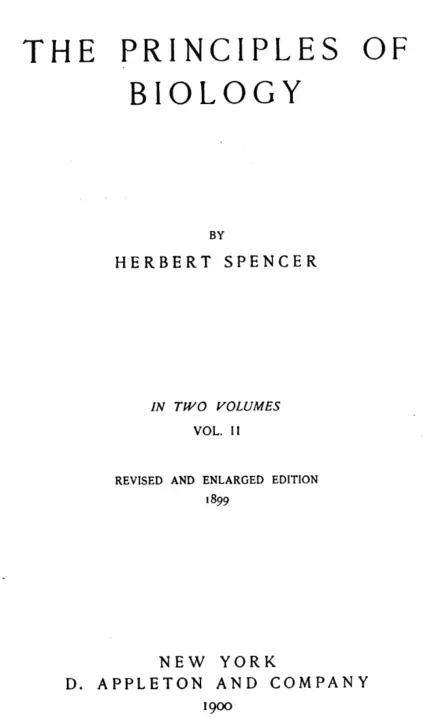
The Principles of Biology, Volume 2 (of 2)
Herbert Spencer

THE CLASSIC COLLECTION · 1860
"First Principles" by Herbert Spencer is a philosophical treatise written in the mid-19th century. The work is part of a larger series that aims to establish a systematic understanding of philosophy grounded in science, religion, and human experience. It explores the interplay between religion and science, seeking to reconcile their seemingly opposing views on existence and knowledge, and discusses the underlying truths present across various belief systems. The opening of the treatise introduces the ambitious scope of Spencer’s work, as he presents a framework for his philosophical inquiry. He begins with a discussion on the nature of human beliefs, suggesting that even widely-held misconceptions may contain elements of truth. By analyzing the historical perspectives on authority and governance, Spencer underscores the evolution of political thought from divine kingship to modern democratic ideals. He proposes that there is a common thread among all religions and philosophies — the acknowledgment of fundamental truths concerning existence that are often obscured by dogma. Thus, the groundwork is laid for his exploration of "the unknowable" and the "laws of the knowable," setting the stage for a deeper analysis of both the limitations and possibilities of human understanding.
Introduction adapted from the source catalogue; source summaries may be automatically generated.
Free to read · English · 166,659 words · No account needed
MAKE TIME FOR A GOOD BOOK
On by default. Untick to stop anonymous reading totals. Each page counts after 10 seconds in view. How this works.
Anonymous counting is on unless you have switched it off.
Internal social movements may also be thus interpreted. Localities naturally fitted for producing particular commodities—that is, localities in which such commodities are got at the least cost of force—that is, localities in which the desires for these commodities meet with the least resistance; become localities especially devoted to the obtainment of these commodities. Where soil and climate render wheat a profitable crop, or a crop from which the greatest amount of life-sustaining power is gained by a given quantity of effort, the growth of wheat becomes the dominant industry. Where wheat cannot be economically produced, oats, or rye, or maize, or rice, or potatoes, is the agricultural staple. Along sea-shores men support themselves with least effort by catching fish; and hence choose fishing as an occupation. And in places that are rich in coal or metallic ores, the population, finding that labour devoted to the raising of these materials brings a larger return of food and clothing than when otherwise directed, becomes a population of miners. This last instance introduces us to the phenomena of exchange; which equally illustrate the general law. For the practice of barter begins as soon as it facilitates the fulfilment of men’s desires, by diminishing the exertion needed to reach the objects of those desires. When instead of growing his own corn, weaving his own cloth, sewing his own shoes, each man began to confine himself to farming, or weaving, or shoemaking; it was because each found it more laborious to make everything he wanted, than to make a great quantity of one thing and barter the surplus for the rest: by exchange, each procured the necessaries of life without encountering so much resistance. Moreover, in deciding what commodity to produce, each citizen was, as he is at the present day, guided in the same manner. For besides those local conditions which determine whole sections of a society towards the industries easiest for them, there are also individual conditions and individual aptitudes which to each citizen render certain occupations preferable; and in choosing those forms of activity which their special circumstances and faculties dictate, these social units are severally moving towards the objects of their desires in the directions which present to them the fewest obstacles. The process of transfer which commerce pre-supposes, supplies another series of examples. So long as the forces to be overcome in procuring any necessary of life in the district where it is consumed, are less than the forces to be overcome in procuring it from an adjacent district, exchange does not take place. But when the adjacent district produces it with an economy that is not out-balanced by cost of transit—when the distance is so small and the route so easy that the labour of conveyance plus the labour of production is less than the labour of production in the consuming district, transfer commences. Movement in the direction of least resistance is also seen in the establishment of the channels along which intercourse takes place. At the outset, when goods are carried on the backs of men and horses, the paths chosen are those which combine shortness with levelness and freedom from obstacles—those which are achieved with the smallest exertion. And in the subsequent formation of each highway, the course taken is that which deviates horizontally from a straight line so far only as is needful to avoid vertical deviations entailing greater labour in draught. The smallest total of obstructive forces determines the route, even in seemingly exceptional cases; as where a detour is made to avoid the opposition of a landowner. All subsequent improvements, ending in macadamized roads, canals, and railways, which reduce the antagonism of friction and gravity to a minimum, exemplify the same truth. After there comes to be a choice of roads between one point and another, we still see that the road chosen is that along which the cost of transit is the least: cost being the measure of resistance. Even where, time being a consideration, the more expensive route is followed, it is so because the loss of time involves loss of force. When, division of labour having been carried to a considerable extent and means of communication made easy, there arises a marked localization of industries, the relative growths of the populations devoted to them may be interpreted on the same principle. The influx of people to each industrial centre, as well as the rate of multiplication of those already inhabiting it, is determined by the payment for labour; that is—by the quantity of commodities which a given amount of effort will obtain. To say that artisans flock to places where, in consequence of facilities for production, an extra proportion of produce can be given in the shape of wages; is to say that they flock to places where there are the smallest obstacles to the support of themselves and families. Hence, the rapid increase of number which occurs in such places, is really a social growth at points where the opposing forces are the least.
Your reading position is saved on this browser. Take it to another device with a library code. Reading pages adapt to text, rather than matching a printed edition.
Herbert Spencer

Herbert Spencer

Herbert Spencer

Herbert Spencer
BEHIND THE BOOK
This eBook is for the use of anyone anywhere in the United States and most other parts of the world at no cost and with almost no restrictions whatsoever. You may copy it, give it away or re-use it under the terms of the Project Gutenberg License included with this eBook or online at www.gutenberg.org. If you are not located in the United States, you will have to check the laws of the country where you are located before using this eBook. Read the source licence.
The original source file, including credits and licence, is retained by this library. Request an original-format copy at no charge. Please include the book title and Project Gutenberg identifier #55046.
KEEP YOUR CURIOSITY GOING

David Patterson (Spirit) Hatch

David Patterson (Spirit) Hatch

David Patterson (Spirit) Hatch
Coulson Kernahan

Ralph Waldo Emerson
Frances Wright