The Principles of Biology, Volume 2 (of 2)
Herbert Spencer
THE CLASSIC COLLECTION · 1860
"First Principles" by Herbert Spencer is a philosophical treatise written in the mid-19th century. The work is part of a larger series that aims to establish a systematic understanding of philosophy grounded in science, religion, and human experience. It explores the interplay between religion and science, seeking to reconcile their seemingly opposing views on existence and knowledge, and discusses the underlying truths present across various belief systems. The opening of the treatise introduces the ambitious scope of Spencer’s work, as he presents a framework for his philosophical inquiry. He begins with a discussion on the nature of human beliefs, suggesting that even widely-held misconceptions may contain elements of truth. By analyzing the historical perspectives on authority and governance, Spencer underscores the evolution of political thought from divine kingship to modern democratic ideals. He proposes that there is a common thread among all religions and philosophies — the acknowledgment of fundamental truths concerning existence that are often obscured by dogma. Thus, the groundwork is laid for his exploration of "the unknowable" and the "laws of the knowable," setting the stage for a deeper analysis of both the limitations and possibilities of human understanding.
Introduction adapted from the source catalogue; source summaries may be automatically generated.
Free to read · English · 166,659 words · No account needed
MAKE TIME FOR A GOOD BOOK
On by default. Untick to stop anonymous reading totals. Each page counts after 10 seconds in view. How this works.
Anonymous counting is on unless you have switched it off.
“But how,” it may be asked, “can we interpret by the law of correlation the genesis of those thoughts and feelings which, instead of following external stimuli, arise spontaneously? Between the indignation caused by an insult, and the loud sounds or violent acts that follow, the alleged connexion may hold; but whence come the crowd of ideas and the mass of feelings that expend themselves in these demonstrations? They are clearly not equivalents of the sensations produced by the words on the ears; for the same words otherwise arranged, would not have caused them. The thing said bears to the mental action it excites, much the same relation that the pulling of a trigger bears to the subsequent explosion—does not produce the power, but merely liberates it. Whence then arises this immense amount of nervous energy which a whisper or a glance may call forth?” The reply is, that the immediate correlates of these and other such modes of consciousness, are not to be found in the agencies acting on us externally, but in certain internal agencies. The forces called vital, which we have seen to be correlates of the forces called physical, are the immediate sources of these thoughts and feelings; and are expended in producing them. The proofs of this are various. Here are some of them. It is a conspicuous fact that mental action is contingent on the presence of a certain nervous apparatus; and that, greatly obscured as it is by numerous and involved conditions, a general relation may be traced between the size of this apparatus and the quantity of mental action as measured by its results. Further, this apparatus has a particular chemical constitution on which its activity depends; and there is one element in it between the amount of which and the amount of function performed, there is an ascertained connexion: the proportion of phosphorus present in the brain being the smallest in infancy, old age and idiotcy, and the greatest during the prime of life. Note next, that the evolution of thought and emotion varies, other things equal, with the supply of blood to the brain. On the one hand, a cessation of the cerebral circulation, from arrest of the heart’s action, immediately entails unconsciousness. On the other hand, excess of cerebral circulation (unless it is such as to cause undue pressure) results in an excitement rising finally to delirium. Not the quantity only, but also the condition of the blood passing through the nervous system, influences the mental manifestations. The arterial currents must be duly aerated, to produce the normal amount of cerebration. At the one extreme, we find that if the blood is not allowed to exchange its carbonic acid for oxygen, there results asphyxia, with its accompanying stoppage of ideas and feelings. While at the other extreme, we find that by the inspiration of nitrous oxide, there is produced an excessive, and indeed irrepressible, nervous activity. Besides the connexion between the development of the mental forces and the presence of sufficient oxygen in the cerebral arteries, there is a kindred connexion between the development of the mental forces and the presence in the cerebral arteries of certain other elements. There must be supplied special materials for the nutrition of the nervous centres, as well as for their oxidation. And how what we may call the quantity of consciousness, is, other things equal, determined by the constituents of the blood, is unmistakably seen in the exaltation that follows when certain chemical compounds, as alcohol and the vegeto-alkalies, are added to it. The gentle exhilaration which tea and coffee create, is familiar to all; and though the gorgeous imaginations and intense feelings of happiness produced by opium and hashish, have been experienced by few, (in this country at least,) the testimony of those who have experienced them is sufficiently conclusive. Yet another proof that the genesis of the mental energies is immediately dependent on chemical change, is afforded by the fact, that the effete products separated from the blood by the kidneys, vary in character with the amount of cerebral action. Excessive activity of mind is habitually accompanied by the excretion of an unusual quantity of the alkaline phosphates. Conditions of abnormal nervous excitement bring on analogous effects. And the “peculiar odour of the insane,” implying as it does morbid products in the perspiration, shows a connexion between insanity and a special composition of the circulating fluids—a composition which, whether regarded as cause or consequence, equally implies correlation of the mental and the physical forces. Lastly we have to note that this correlation too, is, so far as we can trace it, quantitative. Provided the conditions to nervous action are not infringed on, and the concomitants are the same, there is a tolerably constant ratio between the amounts of the antecedents and consequents. Within the implied limits, nervous stimulants and anæsthetics produce effects on the thoughts and feelings, proportionate to the quantities administered. And conversely, where the thoughts and feelings form the initial term of the relation, the degree of reaction on the bodily energies is great, in proportion as they are great: reaching in extreme cases a total prostration of physique.
Your reading position is saved on this browser. Take it to another device with a library code. Reading pages adapt to text, rather than matching a printed edition.
Herbert Spencer
Herbert Spencer
Herbert Spencer
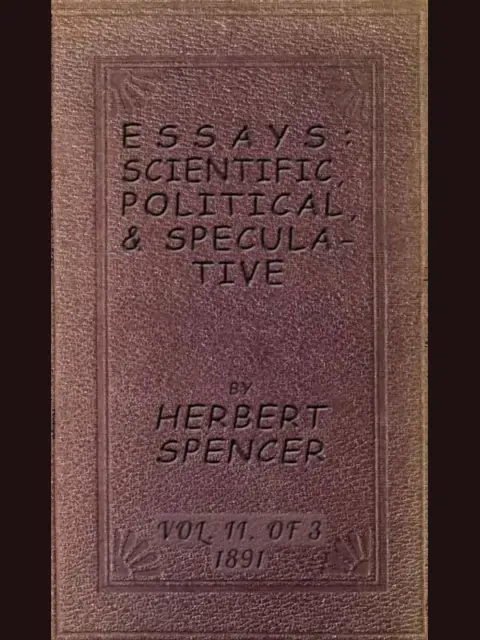
Herbert Spencer
BEHIND THE BOOK
This eBook is for the use of anyone anywhere in the United States and most other parts of the world at no cost and with almost no restrictions whatsoever. You may copy it, give it away or re-use it under the terms of the Project Gutenberg License included with this eBook or online at www.gutenberg.org. If you are not located in the United States, you will have to check the laws of the country where you are located before using this eBook. Read the source licence.
The original source file, including credits and licence, is retained by this library. Request an original-format copy at no charge. Please include the book title and Project Gutenberg identifier #55046.
KEEP YOUR CURIOSITY GOING

David Patterson (Spirit) Hatch

David Patterson (Spirit) Hatch

David Patterson (Spirit) Hatch
Coulson Kernahan

Ralph Waldo Emerson
Frances Wright