
Switch off
Oliver Optic
THE CLASSIC COLLECTION · 1893
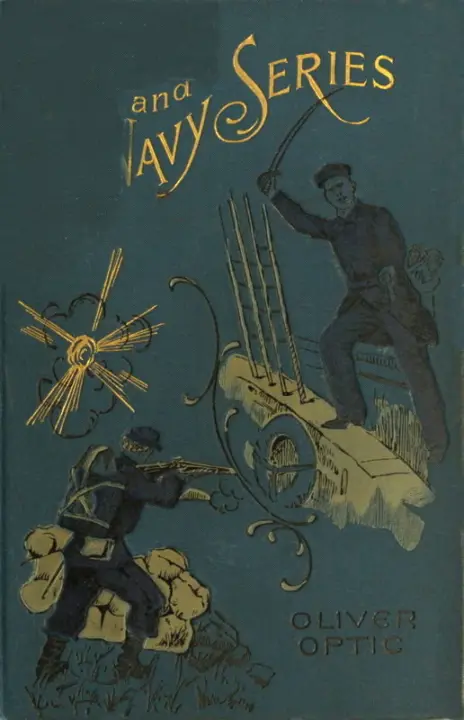
"Fighting Joe; Or, The Fortunes of a Staff Officer. A Story of the Great Rebellion" by Oliver Optic is a historical novel written in the mid-19th century. The book follows Captain Thomas Somers, a staff officer in the Union Army, during the tumultuous period of the American Civil War, highlighting his adventures and encounters in the field. The novel not only focuses on action and conflict but also emphasizes themes of loyalty, patriotism, and moral courage, embodying the spirit of the soldiers of that era. The opening of the narrative introduces Captain Thomas Somers as he navigates his way through uncertain territory while on a mission for the Army of the Potomac. Accompanied by his colored servant Alick, Somers experiences a mix of anxiety and duty as he prepares for potential skirmishes with Confederate forces. Their journey leads them to an encounter with two fellow officers, which quickly escalates into an unexpected confrontation with a group of guerillas. This initial clash highlights Somers's bravery and resourcefulness, setting the tone for his character and the challenges he will face throughout the book. The opening portion establishes a sense of urgency and foreshadows the intense military engagements that will define Somers's experiences as a staff officer.
Introduction adapted from the source catalogue; source summaries may be automatically generated.
Free to read · English · 69,878 words · No account needed
MAKE TIME FOR A GOOD BOOK
On by default. Untick to stop anonymous reading totals. Each page counts after 10 seconds in view. How this works.
Anonymous counting is on unless you have switched it off.
“It is not the first time I have been taken for my brother. He is two years older than I am; but we look very much alike.”
When they were together, several points of difference could be observed; and the resemblance was not now so great as it had been before the battle of Antietam, for the rebel major had grown thinner and paler under the suffering induced by his wound. At the time Somers had met them, the similarity in form and features, in voice and manner, was so great, that a person of ordinary perception, meeting them at different times, could not have told one from the other. The rebel major had changed so much during his illness that the difference was now more perceptible.
“It never occurred to me that you had seen my brother,” said Major Fred, who was the loyal brother. “If it had, I should have understood the whole matter.”
“I understood it perfectly,” added Major Ernest, who was the rebel brother. “I confess, too, that I took advantage of the circumstance.”
“But where did you get my safe-conduct?” asked Fred.
“I picked it up the night we were at home,” replied Ernest, rather
sheepishly.
“That was hardly fair.”
“All fair in war, Fred.”
“Well, then, it is one of the disadvantages of having a brother on the
wrong side, Ernest.”
“That name, Ernest, reminds me that I heard it at your father’s house, in Frederick,” added Somers.
“Captain Somers,” said the loyal major, very seriously, “you may think I am not as patriotic as I ought to be. You know that my brother was at my father’s house, and that I saw him there. You may think I ought to have handed him over as a prisoner of war.”
“Thomas don’t think any such thing,” said Mrs. Somers.
“I have nothing to say about that; it is a family affair,” added Captain Somers. “I need only say that I regard you, Major Fred Riggleston, as a loyal man; and I shall write the general a letter containing a full explanation of my blunder.”
“Thank you, captain,” replied Fred. “That will set me right.”
“By the way, Captain Somers,” said the rebel major, “there is a matter
between us also.”
“What I agreed in honor and confidence to do, I have done, and shall continue to do,” replied Somers, alluding to the matter of the rebel countersign, imparted to him by the wounded major.
“There, Thomas, you musn’t say another word,” interposed Mrs. Somers,
once more.
Your reading position is saved on this browser. Take it to another device with a library code. Reading pages adapt to text, rather than matching a printed edition.
BEHIND THE BOOK
This eBook is for the use of anyone anywhere in the United States and most other parts of the world at no cost and with almost no restrictions whatsoever. You may copy it, give it away or re-use it under the terms of the Project Gutenberg License included with this eBook or online at www.gutenberg.org. If you are not located in the United States, you will have to check the laws of the country where you are located before using this eBook. Read the source licence.
The original source file, including credits and licence, is retained by this library. Request an original-format copy at no charge. Please include the book title and Project Gutenberg identifier #59429.
KEEP YOUR CURIOSITY GOING
Cécile Tormay

Moritz Busch
Coulson Kernahan
John L. Ransom

Maurice Baring
Frances Wright
