
Switch off
Oliver Optic
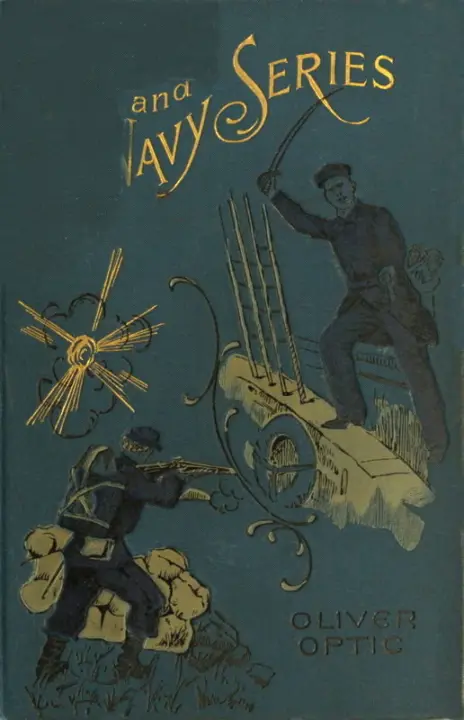
THE CLASSIC COLLECTION · 1893
"Fighting Joe; Or, The Fortunes of a Staff Officer. A Story of the Great Rebellion" by Oliver Optic is a historical novel written in the mid-19th century. The book follows Captain Thomas Somers, a staff officer in the Union Army, during the tumultuous period of the American Civil War, highlighting his adventures and encounters in the field. The novel not only focuses on action and conflict but also emphasizes themes of loyalty, patriotism, and moral courage, embodying the spirit of the soldiers of that era. The opening of the narrative introduces Captain Thomas Somers as he navigates his way through uncertain territory while on a mission for the Army of the Potomac. Accompanied by his colored servant Alick, Somers experiences a mix of anxiety and duty as he prepares for potential skirmishes with Confederate forces. Their journey leads them to an encounter with two fellow officers, which quickly escalates into an unexpected confrontation with a group of guerillas. This initial clash highlights Somers's bravery and resourcefulness, setting the tone for his character and the challenges he will face throughout the book. The opening portion establishes a sense of urgency and foreshadows the intense military engagements that will define Somers's experiences as a staff officer.
Introduction adapted from the source catalogue; source summaries may be automatically generated.
Free to read · English · 69,878 words · No account needed
MAKE TIME FOR A GOOD BOOK
On by default. Untick to stop anonymous reading totals. Each page counts after 10 seconds in view. How this works.
Anonymous counting is on unless you have switched it off.
THE lady conducted Captain Somers to the sitting-room of the house. He was followed by Major Riggleston, who, judging by his looks and actions, regarded the staff officer with no special favor. Miss Hasbrouk did all the talking, however, and seemed to do it for the purpose of keeping the major in the shade, for she carefully turned aside two or three observations he made, as though they were of no consequence, or as though they might provoke an unpleasant discussion.
“I am particularly delighted to meet you again, Captain Somers,” said the imperial beauty, as they entered the apartment.
“Thank you,” replied he; though he could see no good reason why Miss Maud Hasbrouk should be particularly delighted to see him.
He was a Union man and a loyal soldier, while she was a rebel, with strength of mind enough to regret that her sex compelled her to be a non-combatant. She was a magnificent creature, even to Somers, whose knowledge of the higher order of beauties that float about in the mists of fashionable society was very limited. She was fascinating, and he could not resist the charm of her society; albeit in the present instance he was too much exhausted by ill health and over-exertion to be very brilliant himself.
“This is very unexpected, considering the distance from the place at which I met you last evening,” said he.
“O, it isn’t a very great distance to Frederick. The major drove me over in three hours,” replied she.
“Three and a half, Maud,” interposed the major, apparently because he felt the necessity of saying something to avoid being regarded as a mere cipher.
“How do you feel to-day, after the little brush we had yesterday, major?” added Somers, turning to the gentleman.
“What brush do you refer to?” asked Major Riggleston, rather coldly.
“The little rub we had with the guerillas.”
“Really, you have—”
“Now, gentlemen, will you excuse me for a few moments?” said Miss Hasbrouk, very impolitely breaking in upon the major’s remark.
“Certainly,” replied Somers, with his politest bow. “You are a fighting man, Major Riggleston; and the affair of yesterday was pretty sharp work for a few minutes.”
“Of course I’m a fighting man; but—”
“Major, you promised me something, you will remember,” said the lady, who still lingered in the room; “and now is the best time in the world to redeem your promise.”
“What do you mean, Maud?” demanded the major.
“Why, don’t you remember?”
“Upon my life I don’t.”
“Perhaps Captain Somers will excuse you for a few moments, while I
refresh your memory.”
“Certainly; to be sure,” added the polite staff officer.
Your reading position is saved on this browser. Take it to another device with a library code. Reading pages adapt to text, rather than matching a printed edition.
BEHIND THE BOOK
This eBook is for the use of anyone anywhere in the United States and most other parts of the world at no cost and with almost no restrictions whatsoever. You may copy it, give it away or re-use it under the terms of the Project Gutenberg License included with this eBook or online at www.gutenberg.org. If you are not located in the United States, you will have to check the laws of the country where you are located before using this eBook. Read the source licence.
The original source file, including credits and licence, is retained by this library. Request an original-format copy at no charge. Please include the book title and Project Gutenberg identifier #59429.
KEEP YOUR CURIOSITY GOING
Cécile Tormay

Moritz Busch
Coulson Kernahan
John L. Ransom

Maurice Baring
Frances Wright
