
Switch off
Oliver Optic
THE CLASSIC COLLECTION · 1893
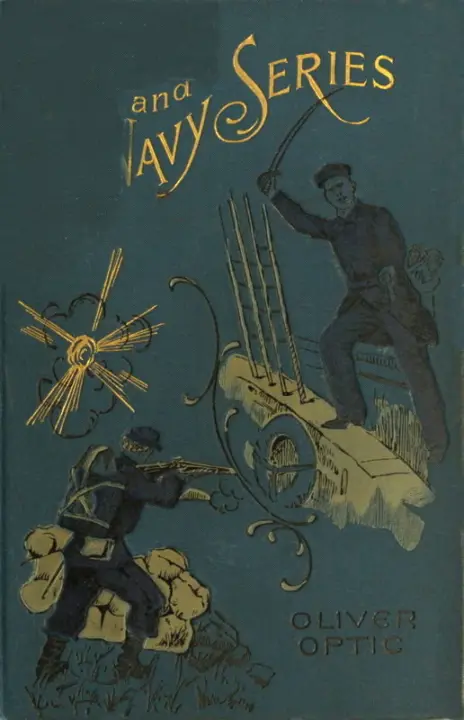
"Fighting Joe; Or, The Fortunes of a Staff Officer. A Story of the Great Rebellion" by Oliver Optic is a historical novel written in the mid-19th century. The book follows Captain Thomas Somers, a staff officer in the Union Army, during the tumultuous period of the American Civil War, highlighting his adventures and encounters in the field. The novel not only focuses on action and conflict but also emphasizes themes of loyalty, patriotism, and moral courage, embodying the spirit of the soldiers of that era. The opening of the narrative introduces Captain Thomas Somers as he navigates his way through uncertain territory while on a mission for the Army of the Potomac. Accompanied by his colored servant Alick, Somers experiences a mix of anxiety and duty as he prepares for potential skirmishes with Confederate forces. Their journey leads them to an encounter with two fellow officers, which quickly escalates into an unexpected confrontation with a group of guerillas. This initial clash highlights Somers's bravery and resourcefulness, setting the tone for his character and the challenges he will face throughout the book. The opening portion establishes a sense of urgency and foreshadows the intense military engagements that will define Somers's experiences as a staff officer.
Introduction adapted from the source catalogue; source summaries may be automatically generated.
Free to read · English · 69,878 words · No account needed
MAKE TIME FOR A GOOD BOOK
On by default. Untick to stop anonymous reading totals. Each page counts after 10 seconds in view. How this works.
Anonymous counting is on unless you have switched it off.
“Sakes alive! who ever heard of such things!” exclaimed Mrs. Somers, when her son had finished his exciting story. “It’s a wonder that you wan’t killed, Thomas.”
“I understand it all now, Captain Somers,” said the major, rather disconcerted. “Though I am not at all to blame in the premises, the affair more nearly concerns me than you may suppose.”
“I exonerate you entirely, Major Riggleston,” continued Somers.
“There, Thomas, you musn’t talk any more now,” interposed the matron.
“I won’t say anything more, but I must settle this affair, mother.”
At this moment the door opened, and Maud Hasbrouk was on the point of entering; but when she saw that the parlor was already occupied, she turned to retire.
“These people in here!” said she, contemptuously, but loud enough to be heard by all in the room.
“No matter, Maud; go in if Ernest is there,” said another person, behind
her.
“He is there; he is a friend of Captain Somers,” sneered she, as she walked into the apartment as though she had been a superior being.
“How is your health, Captain Somers?” asked the person who followed
Maud.
He was an officer, and his head was tied up with a bandage.
“Major Riggleston!” exclaimed Somers, starting from his chair.
“Goodness!” ejaculated Mrs. Somers, fearful that the excitement her son exhibited would throw him into another fever. “What ails the boy?”
“You are certainly the person at whom I fired,” added Somers, as he gazed at the form and features of the newcomer.
“No doubt of that, Captain Somers,” replied the major. “And a very nice time I’ve had of it too.”
“I hope some one will serve you in the same way,” said Maud, spitefully.
“For massy sake!” exclaimed Mrs. Somers, fearful in the gathering events that some one would serve her darling boy in the same way. “What has Thomas done?”
“He is a—”
“Not another word, Maud,” said the wounded major, sternly. “He did his duty, and I am not the one to blame him for it.”
“I hope you will do yours, major, if the circumstances ever place you in the same situation.”
“I should; and Captain Somers would not blame me for it.”
“Certainly not,” replied Somers.
“He saved your life and mine, Maud; and we will not quarrel now.”
The proud beauty was silent and sullen, while Somers gazed in wonder from one Major Riggleston to the other Major Riggleston.
“You understand it now, Captain Somers?” said the loyal major.
“I do; it is all very plain now. You must acknowledge that I made a very
natural mistake.”
Your reading position is saved on this browser. Take it to another device with a library code. Reading pages adapt to text, rather than matching a printed edition.
BEHIND THE BOOK
This eBook is for the use of anyone anywhere in the United States and most other parts of the world at no cost and with almost no restrictions whatsoever. You may copy it, give it away or re-use it under the terms of the Project Gutenberg License included with this eBook or online at www.gutenberg.org. If you are not located in the United States, you will have to check the laws of the country where you are located before using this eBook. Read the source licence.
The original source file, including credits and licence, is retained by this library. Request an original-format copy at no charge. Please include the book title and Project Gutenberg identifier #59429.
KEEP YOUR CURIOSITY GOING
Cécile Tormay

Moritz Busch
Coulson Kernahan
John L. Ransom

Maurice Baring
Frances Wright
