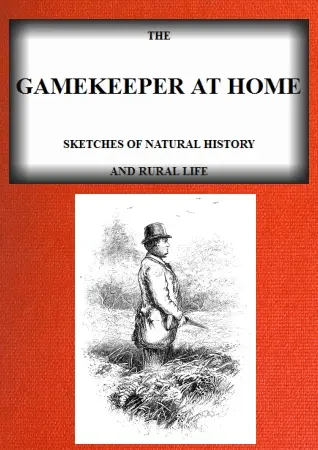
The Gamekeeper at Home: Sketches of natural history and rural life (Illustrated)
Richard Jefferies
THE CLASSIC COLLECTION · 1889
"Field and Hedgerow: Being the Last Essays of Richard Jefferies" by Richard Jefferies is a collection of essays written in the late 19th century, posthumously compiled by his widow. This work reflects Jefferies’ deep appreciation for nature and the countryside, exploring themes related to the relationship between humans and the natural world, as well as observations on rural life, seasons, and the essence of existence. The opening of the collection introduces a contemplative reflection on spring, characterized by vivid descriptions of nature's awakening through birdsong, blossoming flowers, and the budding leaves. Jefferies expresses his wonderment at how the natural world continues effortlessly without human oversight, pondering the significance of his observations and emotions as he experiences nature from within his home. The prose captures not only the beauty of the landscape but also delves into introspective thoughts about life, mortality, and humankind’s connection to the earth, setting a contemplative tone for the essays to follow.
Introduction adapted from the source catalogue; source summaries may be automatically generated.
Free to read · English · 103,814 words · No account needed
MAKE TIME FOR A GOOD BOOK
On by default. Untick to stop anonymous reading totals. Each page counts after 10 seconds in view. How this works.
Anonymous counting is on unless you have switched it off.
One of the hop-picking women told me how she went to church and the parson preached such a curious sermon, all about our 'innerds' (inwards, insides), and how many 'boanes' we had, and by-and-by 'he told us that we were the only beasts who had the use of our hands.' Years since at village schools the girls used to swallow pins; first one would do it, then another, presently half the school were taking pins. Ignorant of physiology! Yet they did not seem to suffer; the pins did not penetrate the pleura or lodge in the processes. Now Anatomy climbs into the pulpit and shakes a bony fist at the congregation. That is the humerus of it, as Corporal Nym might say. At the late election--the cow election--the candidates were Brown, Conservative, and Stiggins, Liberal. The day after the polling a farm labourer was asked how he filled up his voting paper. 'Oh,' said he full of the promised cow, 'I doan't care for that there Brown chap, he bean't no good; zo I jest put a cross agen he, and voted for Stiggins.' The dream of life was accomplished, the labourer had a vote, and--irony--he voted exactly opposite to his intent.
Too-whoo! ooo!--the sound of a horn,--the hunt was up; but this was not the hunting season. Looking out of the kiln door I saw a boy running at full speed down the lane with a small drain-pipe tucked under his arm. He stopped, put the pipe to his mouth, and blew a blast on this 'dread horn,' then jumped through a gap in the hedge and disappeared. They were playing fox and hounds; who but a boy would have thought of using a drain-pipe for a horn? It gave a good note, too. In and about the kiln I learned that if you smash a frog with a stone, no matter how hard you hit him, he cannot die till sunset. You must be careful not to put on any new article of clothing for the first time on a Saturday, or some severe punishment will ensue. One person put on his new boots on a Saturday, and on Monday broke his arm. Some still believe in herbs, and gather wood-betony for herb tea, or eat dandelion leaves between slices of dry toast. There is an old man living in one of the villages who has reached the age of a hundred and sixty years, and still goes hop-picking. Ever so many people had seen him, and knew all about him; an undoubted fact, a public fact; but I could not trace him to his lair. His exact whereabouts could not be fixed. I live in hopes of finding him in some obscure 'Hole' yet (many little hamlets are 'Holes,' as Froghole, Foxhole). What an exhibit for London! Did he realise his own value, he would soon come forth. I joke, but the existence of this antique person is firmly believed in. Sparrows are called 'spadgers.' The cat wandering about got caught in the rat-clams--i.e. a gin. Another cat was the miller's favourite at the windmill, a well-fed, happy, purring pussy, fond of the floury miller--he as white as snow, she as black as a coal. One day pussy was ingeniously examining the machinery, when the wind suddenly rose, the sails revolved, and she was ground up, fulfilling the ogre's threat--'I'll grind his bones to make my bread.' This was not so sad as the fate of the innkeeper's cow. You have read the 'Arabian Nights'--that book of wisdom, for in truth the stories are no stories; they are the records of ancient experience, the experience of a thousand years, and some of them are as true and as deeply to be pondered on as anything in the holiest books the world reverences. You remember the Three Calenders, each of whom lost an eye--struck out in the most arbitrary and cruel fashion. The innkeeper had a cow, a very pretty, quiet cow, but in time it came about that her left horn, turning inwards, grew in such a manner that it threatened to force the point into her head. To remedy this the top of the horn was sawn off and a brass knob fastened on the tip, as is the custom. The cow passed the summer in the meadows with the rest, till by-and-by it was found that she had gone blind in the left eye. It happened in this way: the rays of the sun heated the brass knob and so destroyed the sight. Unable to call attention to its suffering, the poor creature was compelled to endure, and could not escape. Now the Three Calenders could speak, and had the advantage of human intelligence, and yet each lost an eye, and they were as helpless in the hands of fate as this poor animal.
Your reading position is saved on this browser. Take it to another device with a library code. Reading pages adapt to text, rather than matching a printed edition.
Richard Jefferies
Richard Jefferies
Richard Jefferies
Richard Jefferies
BEHIND THE BOOK
This eBook is for the use of anyone anywhere in the United States and most other parts of the world at no cost and with almost no restrictions whatsoever. You may copy it, give it away or re-use it under the terms of the Project Gutenberg License included with this eBook or online at www.gutenberg.org. If you are not located in the United States, you will have to check the laws of the country where you are located before using this eBook. Read the source licence.
The original source file, including credits and licence, is retained by this library. Request an original-format copy at no charge. Please include the book title and Project Gutenberg identifier #7030.
KEEP YOUR CURIOSITY GOING
Wilfrid Scawen Blunt
Wilfrid Scawen Blunt

E. W. (Edgar Watson) Howe

David Patterson (Spirit) Hatch

David Patterson (Spirit) Hatch

David Patterson (Spirit) Hatch