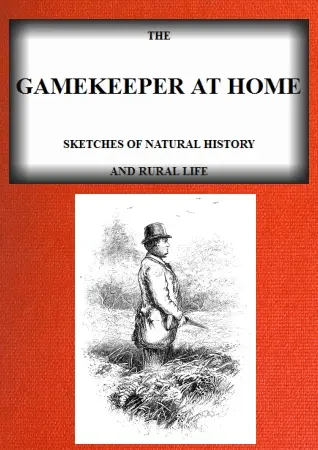
The Gamekeeper at Home: Sketches of natural history and rural life (Illustrated)
Richard Jefferies
THE CLASSIC COLLECTION · 1889
"Field and Hedgerow: Being the Last Essays of Richard Jefferies" by Richard Jefferies is a collection of essays written in the late 19th century, posthumously compiled by his widow. This work reflects Jefferies’ deep appreciation for nature and the countryside, exploring themes related to the relationship between humans and the natural world, as well as observations on rural life, seasons, and the essence of existence. The opening of the collection introduces a contemplative reflection on spring, characterized by vivid descriptions of nature's awakening through birdsong, blossoming flowers, and the budding leaves. Jefferies expresses his wonderment at how the natural world continues effortlessly without human oversight, pondering the significance of his observations and emotions as he experiences nature from within his home. The prose captures not only the beauty of the landscape but also delves into introspective thoughts about life, mortality, and humankind’s connection to the earth, setting a contemplative tone for the essays to follow.
Introduction adapted from the source catalogue; source summaries may be automatically generated.
Free to read · English · 103,814 words · No account needed
MAKE TIME FOR A GOOD BOOK
On by default. Untick to stop anonymous reading totals. Each page counts after 10 seconds in view. How this works.
Anonymous counting is on unless you have switched it off.
The giant at the kiln must watch and bide his time the night through till the hops are ready to be withdrawn from the cone. He is alone. Deep shadows gather round the farmstead and the ricks, and there is not a sound, nothing but the rustle of a leaf falling from the hollow oak by the gateway. But at midnight, just as the drier is drawing the hops, a thunderstorm bursts, and the blue lightning lights up the red cone without, blue as the sulphur flames creeping over the charcoal within. It is lonely work for him in the storm. By day he has many little things to do between the greater labours, to make the pockets (or sacks) by sewing the sackcloth, or to mark the name of the farmer and the date with stencil plates. For sewing up the mouth of the pocket when filled there is a peculiar kind of string used; you may see it hanging up in any of the country 'stores;' they are not shops, but stores of miscellaneous articles. He must be careful not to fill his pockets too full of hops, not to tread them too closely, else the sharp folk in the market will suspect that unfair means have been resorted to to increase the weight, and will cut the pocket all to pieces to see if it contains a few bricks. Nor must it be too light; that will not do.
In this district, far from the great historic hop-fields of Kent, the hops are really grown in gardens, little pieces often not more than half an acre or even less in extent. Capricious as a woman, hops will only flourish here and there; they have the strongest likes and dislikes, and experience alone finds out what will suit them. These gardens are always on a slope, if possible in the angle of a field and under shelter of a copse, for the wind is the terror, and a great gale breaks them to pieces; the bines are bruised, bunches torn off, and poles laid prostrate. The gardens being so small, from five to forty acres in a farm, of course but few pickers are required, and the hop-picking becomes a 'close' business, entirely confined to home families, to the cottagers working on the farm and their immediate friends. Instead of a scarcity of labour, it is a matter of privilege to get a bin allotted to you. There are no rough folk down from Bermondsey or Mile End way. All staid, stay-at-home, labouring people--no riots; a little romping no doubt on the sly, else the maids would not enjoy the season so much as they do. But there are none of those wild hordes which collect about the greater fields of Kent. Farmers' wives and daughters and many very respectable girls go out to hopping, not so much for the money as the pleasant out-of-door employment, which has an astonishing effect on the health. Pale cheeks begin to glow again in the hop-fields. Children who have suffered from whooping-cough are often sent out with the hop-pickers; they play about on the bare ground in the most careless manner, and yet recover. Air and hops are wonderful restoratives. After passing an afternoon with the drier in the kiln, seated close to a great heap of hops and inhaling the odour, I was in a condition of agreeable excitement all the evening. My mind was full of fancy, imagination, flowing with ideas; a sense of lightness and joyousness lifted me up. I wanted music, and felt full of laughter. Like the half-fabled haschish, the golden bloom of the hops had entered the nervous system; intoxication without wine, without injurious after-effect, dream intoxication; they were wine for the nerves. If hops only grew in the Far East we should think wonders of so powerful a plant. At hop-picking a girl can earn about 10s. a week, so that it is not such a highly paid employment as might be supposed from the talk there is about it. The advantages are sideways, so to say; a whole family can work at the same time, and the sum-total becomes considerable. Hopping happily comes on just after corn harvest, so that the labourers get two harvest-times. The farmers find it an expensive crop. It costs 50l. or 60l. to pick a very small garden, and if the Egyptian plague of insects has prevailed the price at market will not repay the expenditure. The people talk much of a possible duty on foreign hops. The hop farmer should have a lady-bird on his seal ring for his sign and token, for the lady-bird is his great friend. Lady-birds (and their larvae) destroy myriads of the aphides which cause rust, and a flight of lady-birds should be welcomed as much as a flight of locusts is execrated in other countries.
Your reading position is saved on this browser. Take it to another device with a library code. Reading pages adapt to text, rather than matching a printed edition.
Richard Jefferies
Richard Jefferies
Richard Jefferies
Richard Jefferies
BEHIND THE BOOK
This eBook is for the use of anyone anywhere in the United States and most other parts of the world at no cost and with almost no restrictions whatsoever. You may copy it, give it away or re-use it under the terms of the Project Gutenberg License included with this eBook or online at www.gutenberg.org. If you are not located in the United States, you will have to check the laws of the country where you are located before using this eBook. Read the source licence.
The original source file, including credits and licence, is retained by this library. Request an original-format copy at no charge. Please include the book title and Project Gutenberg identifier #7030.
KEEP YOUR CURIOSITY GOING
Wilfrid Scawen Blunt
Wilfrid Scawen Blunt

E. W. (Edgar Watson) Howe

David Patterson (Spirit) Hatch

David Patterson (Spirit) Hatch

David Patterson (Spirit) Hatch