
The story of Betty
Carolyn Wells
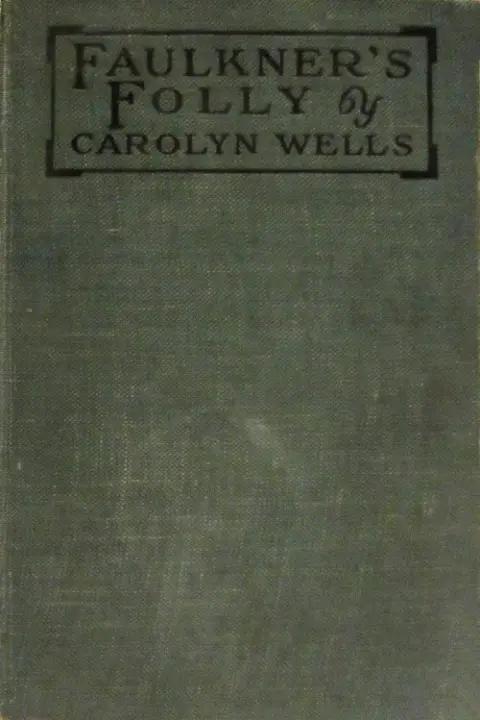
THE CLASSIC COLLECTION · 1917
"Faulkner's Folly" by Carolyn Wells is a mystery novel written in the early 20th century. The story unfolds in a grand home known as Faulkner's Folly, where the life of renowned artist Eric Stannard takes a tragic turn when he is found murdered. The primary characters include Beatrice Faulkner, who is a guest in the house, and the women closely associated with the victim, namely his wife Joyce and a model named Natalie Vernon, who are both quickly embroiled in the subsequent investigation. The opening of the novel introduces the dramatic scene in the studio of Faulkner's Folly, where Stannard is discovered dead with an etching needle protruding from his chest. The narrative sets an eerie atmosphere as the characters, particularly Beatrice and the footman Blake, respond to the horrifying situation. As they enter the studio, we learn that Stannard's last words implicate one of the women present, casting suspicion over both Joyce and Natalie. The initial confusion leads to a storm of emotions and conflicting testimonies as a police investigation begins, focusing on the relationships and motives surrounding the characters involved. The rich detail in the opening hints at a complex web of intrigue that will unravel as the mystery deepens.
Introduction adapted from the source catalogue; source summaries may be automatically generated.
Free to read · English · 58,762 words · No account needed
MAKE TIME FOR A GOOD BOOK
On by default. Untick to stop anonymous reading totals. Each page counts after 10 seconds in view. How this works.
Anonymous counting is on unless you have switched it off.
"If Mrs. Stannard had had any angry words with her husband just before he was attacked, could you have overheard them?" asked Roberts.
"I don't think so. Not unless they had spoken very loudly. The door to the Terrace was closed, or almost closed. And I was not thinking about what might be going on in the house. Unless there had been an especial disturbance, I should not have noticed it."
"Yet you heard that gasping cry for help through the closed door."
"Yes. But that was not a faint gasp, it was a penetrating sort of a cry. An attempted scream, I should describe it."
Roberts looked at her closely. Was she innocent or was she an infant
Machiavelli?
"It is a difficult situation," he said, with a sigh. "We have but two eye-witnesses. Each naturally accuses the other and denies her own guilt. One speaks truth and one falsehood. How can we distinguish which one tells the truth?"
"Don't say eye-witnesses," objected Natalie. "I didn't see the crime committed. If I think Joyce did it, it's only because I went in and found her there and nobody else about."
"Suppose," and Bobsy Roberts looked her straight in the face, "suppose Eric Stannard held in his hand your picture,--that etching, you know, and suppose he was, in a way, talking to it. Or, say, he wasn't talking to it, but what he did say, and what his wife overheard, was said while he held your picture, and she thought he referred to you. Then she, in a jealous fury, resented the idea of his giving you the emeralds, and----"
"I didn't want the emeralds," said Natalie, coldly, "and I certainly didn't want Eric to marry me, but even granting your premises right, it takes suspicion of the murder from me, and places it on Joyce."
"It does," agreed Barry, "and that's where it belongs, if on either of
you two."
"It must be so," said Beatrice Faulkner, "for if Natalie had known where the emeralds were, and if that letter was written to her, and gave her the gems,--for it really did give them to the one it was written to,--then she would have kept them and not have given them back to Joyce."
"By Jove, that's so!" exclaimed Roberts. "Whatever woman that letter was meant for, is the real owner of the jewels this minute, according to Eric Stannard's wish, and if she had them she would be extremely unlikely to give them up unnecessarily. But how, then, explain their return?"
"It wasn't a return," said Beatrice. "Joyce had them herself all the
time."
"I believe she had," said Roberts.
Your reading position is saved on this browser. Take it to another device with a library code. Reading pages adapt to text, rather than matching a printed edition.
Carolyn Wells

Carolyn Wells & Harry Persons Taber

Carolyn Wells

Carolyn Wells
BEHIND THE BOOK
This eBook is for the use of anyone anywhere in the United States and most other parts of the world at no cost and with almost no restrictions whatsoever. You may copy it, give it away or re-use it under the terms of the Project Gutenberg License included with this eBook or online at www.gutenberg.org. If you are not located in the United States, you will have to check the laws of the country where you are located before using this eBook. Read the source licence.
The original source file, including credits and licence, is retained by this library. Request an original-format copy at no charge. Please include the book title and Project Gutenberg identifier #59126.
KEEP YOUR CURIOSITY GOING
Coulson Kernahan

Maurice Baring
Frances Wright
Cécile Tormay

Frederic Jesup Stimson

W. H. P. (William Henry Pope) Jarvis