
The story of Betty
Carolyn Wells
THE CLASSIC COLLECTION · 1917
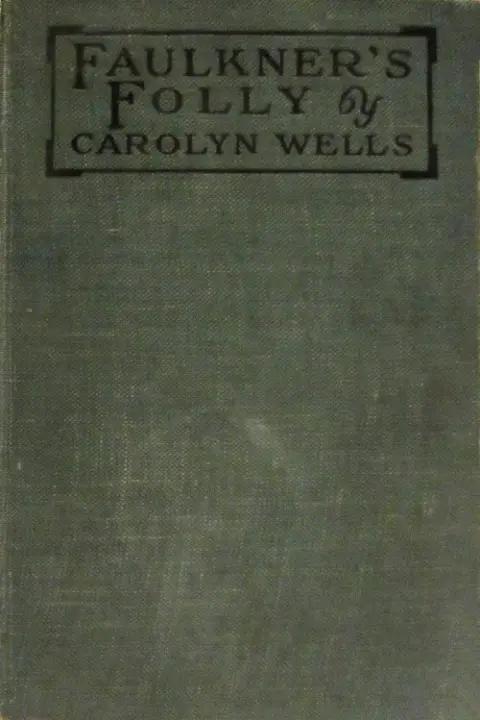
"Faulkner's Folly" by Carolyn Wells is a mystery novel written in the early 20th century. The story unfolds in a grand home known as Faulkner's Folly, where the life of renowned artist Eric Stannard takes a tragic turn when he is found murdered. The primary characters include Beatrice Faulkner, who is a guest in the house, and the women closely associated with the victim, namely his wife Joyce and a model named Natalie Vernon, who are both quickly embroiled in the subsequent investigation. The opening of the novel introduces the dramatic scene in the studio of Faulkner's Folly, where Stannard is discovered dead with an etching needle protruding from his chest. The narrative sets an eerie atmosphere as the characters, particularly Beatrice and the footman Blake, respond to the horrifying situation. As they enter the studio, we learn that Stannard's last words implicate one of the women present, casting suspicion over both Joyce and Natalie. The initial confusion leads to a storm of emotions and conflicting testimonies as a police investigation begins, focusing on the relationships and motives surrounding the characters involved. The rich detail in the opening hints at a complex web of intrigue that will unravel as the mystery deepens.
Introduction adapted from the source catalogue; source summaries may be automatically generated.
Free to read · English · 58,762 words · No account needed
MAKE TIME FOR A GOOD BOOK
On by default. Untick to stop anonymous reading totals. Each page counts after 10 seconds in view. How this works.
Anonymous counting is on unless you have switched it off.
"It may be so," said Roberts. "Now here's another point. Mrs. Stannard declares she heard her husband talking to another woman or at least to somebody, in his studio, as she herself stood in the Billiard Room, near the connecting door. Shall we say this is an invented story of hers?"
"Let me see," said Barry, "what were the words?"
"To the effect that he was not willing to leave his wife for her, and that as a consolation she could have the emeralds."
"Practically what was in the note," exclaimed Mrs. Faulkner.
"Almost," returned Roberts. "Now was Miss Vernon there and were these words addressed to her? this question being quite apart from consideration of her as the criminal."
"If so, then the letter was to her," said Beatrice.
"And it wasn't," maintained Barry. "My father admired Natalie,--made love to her, we'll say, but he never went so far as to offer her jewels, nor did she want him to marry her, as the overheard conversation implies."
"Could this be the way of it?" said Beatrice. "Suppose Mr. Stannard was even then writing that note----"
"But it was found in his desk."
"Well, suppose he was thinking it over, and muttered to himself the actual wording of it. Mrs. Stannard says she heard no other voice, so may he not have been alone in the studio at that time?"
Bobsy Roberts turned this over in his mind. "It is a possibility," he conceded. "And then, let us say, after hearing those words, Mrs. Stannard entered the room, and confronted him, and perhaps there was a quarrel and in a moment of insane rage, Mrs. Stannard caught up the etching needle and----"
"It isn't at all like her," said Barry, "but I can only say it is more easily to be conceived of in her case than in Natalie's. I don't want to admit the possibility of Joyce being the criminal, but I can believe it, before I can imagine Natalie doing such a thing. And as you say, Joyce had motive, and Natalie had none."
"I won't subscribe entirely to that, Mr. Stannard. Miss Vernon inherits a goodly sum, and too, she may have been incensed at the manner of the artist toward her----"
"No, I wasn't," said Natalie herself, suddenly reappearing. "On the contrary, I had persuaded Mr. Stannard, that very day, not to ask me to pose for him, except as a fully draped model. He had apologised for his previous insistence, and I looked for no more trouble on that score. I was trying to get up courage to ask him to let Barry be engaged to me, but I hadn't accomplished that."
Your reading position is saved on this browser. Take it to another device with a library code. Reading pages adapt to text, rather than matching a printed edition.
Carolyn Wells

Carolyn Wells & Harry Persons Taber

Carolyn Wells

Carolyn Wells
BEHIND THE BOOK
This eBook is for the use of anyone anywhere in the United States and most other parts of the world at no cost and with almost no restrictions whatsoever. You may copy it, give it away or re-use it under the terms of the Project Gutenberg License included with this eBook or online at www.gutenberg.org. If you are not located in the United States, you will have to check the laws of the country where you are located before using this eBook. Read the source licence.
The original source file, including credits and licence, is retained by this library. Request an original-format copy at no charge. Please include the book title and Project Gutenberg identifier #59126.
KEEP YOUR CURIOSITY GOING
Coulson Kernahan

Maurice Baring
Frances Wright
Cécile Tormay

Frederic Jesup Stimson

W. H. P. (William Henry Pope) Jarvis