
The story of Betty
Carolyn Wells
THE CLASSIC COLLECTION · 1917
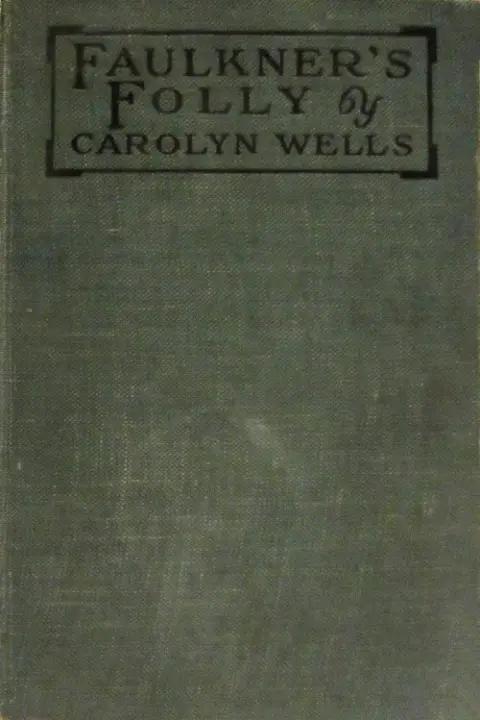
"Faulkner's Folly" by Carolyn Wells is a mystery novel written in the early 20th century. The story unfolds in a grand home known as Faulkner's Folly, where the life of renowned artist Eric Stannard takes a tragic turn when he is found murdered. The primary characters include Beatrice Faulkner, who is a guest in the house, and the women closely associated with the victim, namely his wife Joyce and a model named Natalie Vernon, who are both quickly embroiled in the subsequent investigation. The opening of the novel introduces the dramatic scene in the studio of Faulkner's Folly, where Stannard is discovered dead with an etching needle protruding from his chest. The narrative sets an eerie atmosphere as the characters, particularly Beatrice and the footman Blake, respond to the horrifying situation. As they enter the studio, we learn that Stannard's last words implicate one of the women present, casting suspicion over both Joyce and Natalie. The initial confusion leads to a storm of emotions and conflicting testimonies as a police investigation begins, focusing on the relationships and motives surrounding the characters involved. The rich detail in the opening hints at a complex web of intrigue that will unravel as the mystery deepens.
Introduction adapted from the source catalogue; source summaries may be automatically generated.
Free to read · English · 58,762 words · No account needed
MAKE TIME FOR A GOOD BOOK
On by default. Untick to stop anonymous reading totals. Each page counts after 10 seconds in view. How this works.
Anonymous counting is on unless you have switched it off.
With a vague idea of taking advantage of a psychological moment, Coroner Lamson began to question Joyce.
"Why do you make that statement, Mrs. Stannard?" he said; "do you realise that it is a grave implication?"
But Joyce, though not hysterical, was at high tension, and she said, talking rapidly, "My husband's words were in direct answer to the footman's question. Blake said, 'Who did this?' and Mr. Stannard, even pointing to Miss Vernon, said, 'Natalie, not Joyce.' Could anything be plainer?"
"It might seem so, yet we must take into consideration the fast clouding intellect of the dying man, and endeavour thus to get at the truth. Will you tell the circumstances of your entering the room, Mrs. Stannard?"
"Of course I will. I had been in the Billiard Room for some time, ever since dinner, in fact----"
"Alone?"
"Not at first. Several were there with me. Then, later, all had
gone--and--I was there alone."
The speaker paused. She seemed to forget her audience and became lost in recollection or in thought. She looked very beautiful, as she sat, robed in her black gown of soft, thin material, with a bit of white turned in at the throat. Her brown hair waved carelessly back to a loose, low knot and her deep-set brown eyes, full of sorrow, grew suddenly luminous.
"Perhaps it wasn't Natalie," she said, speaking breathlessly. "Perhaps it wasn't Miss Vernon--after all."
"We are not asking your opinion, Mrs. Stannard," said the Coroner, stiffly; "kindly confine your recital to the facts as they happened."
But now, the witness' poise was shaken. Of a temperamental nature, Joyce Stannard had thought of something or realised something that affected the trend of her testimony.
Bobsy Roberts watched her with intense interest. "Well, Milady," he said to her, mentally, "you've struck a snag in your well-planned defence. Careful now, don't leap before you look!"
"Yes," said Joyce, but her quivering lip precluded further speech.
The Coroner was made decidedly uncomfortable by the sight of her beauty and her distress, always a disquieting combination, and to hide his sympathy, he repeated, brusquely, "The facts, please, as they occurred."
"I was in the Billiard Room," Joyce began again, "and I heard, in the
studio, a slight sound of some sort, and then the light in here went
out."
"Which was first, the sound or the sudden darkness?"
"The sound--no, the darkness. I don't really know. Perhaps they were
simultaneous."
"One moment; was the Billiard Room lighted?"
"Yes."
"And the door between open?"
"The sliding doors were open--the curtains pulled together."
Your reading position is saved on this browser. Take it to another device with a library code. Reading pages adapt to text, rather than matching a printed edition.
Carolyn Wells

Carolyn Wells & Harry Persons Taber

Carolyn Wells

Carolyn Wells
BEHIND THE BOOK
This eBook is for the use of anyone anywhere in the United States and most other parts of the world at no cost and with almost no restrictions whatsoever. You may copy it, give it away or re-use it under the terms of the Project Gutenberg License included with this eBook or online at www.gutenberg.org. If you are not located in the United States, you will have to check the laws of the country where you are located before using this eBook. Read the source licence.
The original source file, including credits and licence, is retained by this library. Request an original-format copy at no charge. Please include the book title and Project Gutenberg identifier #59126.
KEEP YOUR CURIOSITY GOING
Coulson Kernahan

Maurice Baring
Frances Wright
Cécile Tormay

Frederic Jesup Stimson

W. H. P. (William Henry Pope) Jarvis